Live update: Updated 2 hours ago.
August core CPI advanced by a stronger-than-expected 0.3%, whereas the annual figure of 2.4% aligned with expectations and marked the slowest pace since early 2021.
It’s never just one: Focus now shifts to October Fed meeting
Presuming this morning’s inflation figures guarantee a 25 basis point Federal Reserve rate hike at the upcoming meeting next week, does that not imply yet another rate increase at the subsequent Fed gathering on October 28?
Considering the persistent climb in energy costs since the August CPI metrics were gathered, imagining any progress in inflation figures prior to that October session is difficult.
If the logic held by Federal Reserve Chair Kevin Warsh and central bank hawks stays consistent, another wave of monetary tightening is virtually certain.
In fact, fixed income markets reflected this activity on Friday, with expectations for an October rate increase climbing to 42% from merely 27% a day prior, according to CME FedWatch.
By Friday afternoon, the two-year Treasury yield surged by a full eight basis points, reaching 4.63%—its highest mark in over two years.
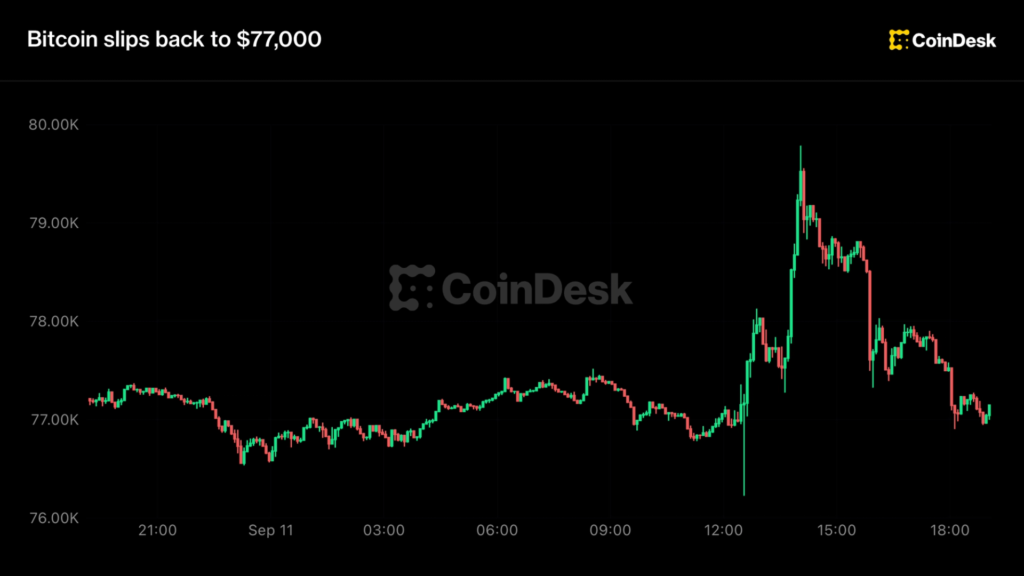
Equities are absorbing the shift comfortably, as the Nasdaq, S&P 500, and Dow Jones Industrial Average all gained upwards of 1%. Having risen earlier, bitcoin surrendered its gains and currently rests at $77,000, remaining flat over the trailing 24 hours.
August core CPI drivers to ‘largely unwind over coming months’: BofA
“We do not view the CPI report as particularly informative about the underlying inflation trend,” wrote the analysis team at Bank of America on Friday.
As observed by others, BofA pointed out that an unusual spike in cellular service costs likely fueled the unexpected climb in the core index. Offering further context, the group noted the increase likely stemmed from AT&T phasing out specific unlimited packages alongside higher administrative charges—both of which are expected to be temporary.
Two additional volatile sectors—airline tickets and accommodations away from home—also registered significant surges, according to BofA.
“These effects should prove temporary and largely unwind over coming months.”
Trump will have “an opinion” if Fed hikes: WH advisor Kevin Hassett
Inflation has clearly moderated over the past three months, stated Kevin Hassett, chief economic advisor to the White House, in the wake of this morning’s CPI numbers.
When questioned about how President Trump might respond to a potential Fed rate increase next week, Hassett mentioned during a television appearance, “The president will have an opinion about it, I’m sure… He believes there’s plenty of room for interest rates to go down, and he voices that opinion while respecting the independence of the Fed.”
Why your cell phone bill is the likely trigger for next week’s Fed rate hike
This morning’s core CPI statistics arrived elevated, posting a 0.3% rise against the anticipated 0.2% for August. In reality, the increase measured 0.29%, which was rounded upward to 0.3% by the Bureau of Labor Statistics; consequently, a variation of five one-hundredths of a percentage point would have yielded a 0.2% reading and likely prompted a Fed pause next week.
As it turns out, telephone service costs experienced a record monthly jump of 1.549%. Historically, this specific index has remained within a tightly bound corridor of roughly 0.1% declines to 0.5% advances (h/t ZeroHedge).
Goldman Sachs observed: “Core CPI increased by 0.29% in August, above expectations. On the firmer side, the volatile wireless phone services category boosted the core by about 10 basis points.”
Crypto-related stocks bounce from week’s losses
Markets advanced broadly on Friday as participants adjusted to what now appears to be a guaranteed Federal Reserve rate increase next Wednesday.
The Nasdaq index gained nearly 1%, while bitcoin advanced 1.8% to $78,750.
Having suffered declines as a sector throughout the majority of the week, cryptocurrency-linked equities participated actively in the recovery.
Notable risers included Coinbase (COIN) up 4.4%, Circle (CRCL) higher by 3.3%, Strategy (MSTR) climbing 4.3%, and Gemini (GEMI) adding 6.2%.
While classifying neocloud firms strictly as crypto businesses is increasingly difficult, they advanced as well, including Hut 8 (HUT) up 7.7%, CleanSpark (CLSK) up 6.7%, and Cipher Mining (CIFR) higher by 6%.
UMich Consumer Sentiment plunges in September, while inflation outlook soars
The preliminary September University of Michigan Consumer Sentiment Index dropped to 47.8 from the previous month’s 51.7. Economists had previously projected a minor decline to 51.
The Expectations Index showed an even steeper drop, declining to 45.8 from 51.5.
Projections for inflation over a one-year horizon jumped to 4.6% from 4% in the prior month.
“With a resurgence in fuel prices and trade tensions, consumers anticipate greater pressures on their pocketbooks to come,” noted survey director Joanne Hsu. “Democrats and Republicans alike posted sizable declines.”
Bitcoin heads higher as investors look past looming rate hike
Sell the rumor, buy the news.
Markets experienced a form of post-Labor Day turbulence throughout the week as the inevitability of elevated Federal Reserve monetary policy rates became increasingly apparent. With this morning’s hotter-than-desired core CPI data for August, that reality is essentially confirmed, prompting participants to resume accumulation.
Roughly 30 minutes into the trading session, the Nasdaq, S&P 500, and Dow Jones Industrial Average all advanced by over 1%, accompanied by a modest easing in bond yields.
Digital assets followed suit, with bitcoin rebounding to just below $80,000, representing a greater than 2% gain since the unfavorable inflation metrics were published. Ether outperformed other major tokens, advancing 8.3% over the trailing 24 hours.
SpaceX could draw $12.4 billion in passive buying if Nasdaq 100 weight rises
The outcomes of the Nasdaq 100 rebalancing are scheduled for release following Friday’s market close, with adjustments going into effect on September 21.
Elon Musk’s SpaceX (SPCX) already forms part of the index, though JPMorgan estimates indicate its weighting could increase from 1.25% to 1.51% as successive lock-up expirations expand the equity’s free float. This adjustment could spark approximately $12.4 billion in passive inflows from index-tracking funds.
SpaceX shares have recovered roughly 40% from their troughs following an earlier 50% retracement from their June initial public offering price.
‘Warsh painted himself in corner’: UBS on why Fed has to hike
“Warsh painted himself in a corner here,” stated the UBS team following this morning’s CPI figures. “We’ve gotten the hard language tough guy speech at Jackson Hole. His remarks were prepared and his messaging was intentional.”
“Now, we’ve gotten the data – labor market print more robust, inflation still supported.”
They pointed out that September FOMC pricing moved to 23 basis points, effectively reflecting a 100% probability of a Fed rate hike next week.
“At this point, it would be a massive blow to credibility if they fumble the football on following through with the adjustment.”
Rate hike odds move to 90% after CPI data, but wait
Within short-term interest rate markets, the reaction to the elevated core CPI reading (0.3% in August versus 0.2% anticipated) was immediate, with traders quickly pricing in a 90% probability of a Federal Reserve rate increase next week.
That conclusion, however, may be premature.
The actual core inflation rate for August registered at 0.29%. During his inaugural press conference, Chairman Warsh remarked that he preferred the Fed not focus strictly on the decimal’s right side. What viewpoint might he hold regarding the digit located to the right of that decimal position?
Examining a broader timeframe, core CPI declined to 2.4% in August from July’s 2.5% reading—marking the slowest rate of core inflation observed since February 2021.
“Do not confuse an energy-price shock with demand overheating,” commented economist Daniel Lacalle. “Hiking into a recovering job market would be a massive policy mistake.”
“The Fed has other tools to reduce monetary inflation, and balance sheet management is the way, not rate hikes.”
Core CPI disappoints in August
United States inflation metrics for August arrived largely aligned with consensus projections, though the core figure advanced quicker than anticipated, placing a Federal Reserve rate increase securely on the agenda for next week.
The Consumer Price Index climbed 0.4% in August, matching analyst predictions of 0.4% and following July’s 0.1% increase.
On a year-over-year basis, headline CPI expanded 3.4%, aligning with expectations of 3.4% and July’s corresponding 3.4% reading.
Core CPI, which strips out volatile food and energy costs, rose 0.3% month-over-month, exceeding the 0.2% forecast and outpacing July’s 0.2% advancement.
Annually, core inflation registered at 2.4%, matching expectations of 2.4% while coming in below July’s 2.5% rate.
The valuation of bitcoin (BTC) retreated toward $76,700 in the minutes immediately following the announcement, though it rapidly reversed that decline shortly thereafter to trade at $77,400.
The two-year Treasury yield surged six basis points to 4.61% as market participants began pricing in nearly a 100% likelihood that the Fed will enact a rate hike during its policy gathering next week. The 10-year yield—which maintains less direct correlation to Fed actions—held steady at 4.95%.
Nasdaq 100 futures climbed to a session high, posting a 0.8% gain.
Consistently scrutinized by investors, the August CPI release assumed paramount significance over the preceding fortnight after Federal Reserve Chairman Kevin Warsh signaled during his Jackson Hole address that the central bank might be forced to intervene if inflation failed to display slowing momentum.
Bond markets have experienced intense volatility ever since, with participants shifting from the assumption of zero rate hikes—potentially for the duration of 2026—to hedging against up to 75 basis points of monetary tightening throughout the year.
That shift drove the 10-year U.S. Treasury yield from the 4.60% region to just under 5.00% leading up to this morning’s release. The two-year yield, which correlates more closely with monetary policy, increased from 4.20% to 4.56% ahead of the data release.
‘Bloomberg Terminal Bros’: Bessent defends bond strategy
“If some of the Bloomberg Terminal Bros are unhappy with what I’m doing, well, that’s too bad.”
During a television interview overnight as U.S. bond yields continued scaling multi-year highs, Treasury Secretary Scott Bessent defended his approach of repurchasing longer-maturity debt.
He asserted that rising bond yields represented a global trend likely driven by soaring petroleum quotations. A more reliable indicator, he suggested, involves examining yield curves between short-dated and long-dated securities. Those spreads are trending downward, indicating that long-term debt buybacks were functioning as intended.
Oil eases, but there’s no relief in bond market
Following yesterday’s advance to multi-month peaks, crude oil experienced a pullback early Friday.
Both WTI and Brent crude retreated approximately 3%, with WTI sliding back underneath $100 per barrel. While no notable positive developments emerged from the Middle East, traders were more likely securing profits following the substantial upward trend.
Conversely, the bond market exhibited no such reversal following yesterday’s severe yield expansion, with both the 10-year and 2-year Treasury yields advancing by an additional basis point on the day.
U.S. equities, which declined only moderately during yesterday’s fixed-income selloff, pointed toward higher opens, with the Nasdaq 100 up 0.65% and the S&P 500 higher by 0.6%.
The U.S. CPI publication was scheduled for 8:30 am ET.
Bitcoin sinks to $77,000 ahead of U.S. CPI report
Bitcoin changed hands near $77,000 during European morning trading hours on Friday, reflecting a decline exceeding 1% over 24 hours and 5% across the week, based on CoinDesk figures.
Zcash emerged as the principal underperformer with a loss approaching 10%, though it retained an 8% gain across seven days following its prior advance past $1,000. Hyperliquid retreated 4% and XRP dropped nearly 3%. Dogecoin, solana, and bitcoin each experienced declines ranging between 1% and 2%, whereas ether, BNB, and tron remained relatively unchanged. Tron stood out as the sole major asset maintaining a weekly gain at 3%, contrasting with XRP down 8%, hyperliquid lower by 9%, and solana retreating 5%.
The August CPI release arrived Friday, with the CME FedWatch instrument placing the probability of a rate increase next week at 69%, up from 59% a week earlier and 48% a month prior. This metric moderated from 72% on Thursday. A quarter-point adjustment would elevate the target band to 375 to 400 basis points.
Brent crude retreated beneath $104 per barrel while maintaining an advance of nearly 8% since Monday, prompting the International Energy Agency to caution that price levels of this magnitude begin suppressing consumption. Global bond yields hover near multi-year peaks, with the 10-year Treasury yield nearing 5%.
An elevated inflation print pushes that 69% probability toward certainty and pulls the short end of the yield curve along with it. Such dynamics dictate the outlook for digital assets, which have closely tracked rate projections across every trading session this week.
Originally published at https://www.coindesk.com/business/2026/09/11/live-updates-bitcoin-sinks-to-usd77-000-as-cpi-lands-with-hike-odds-near-70.