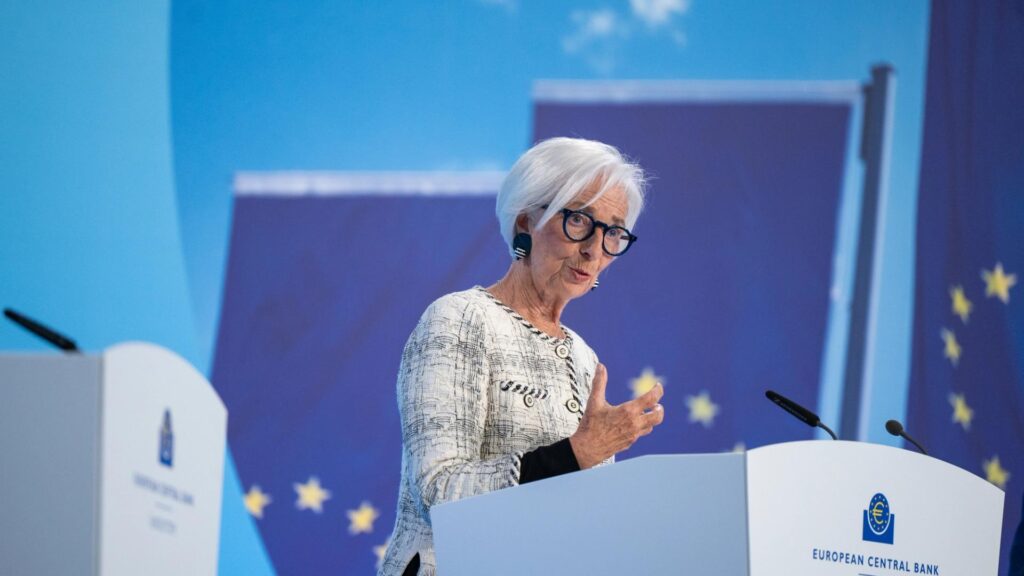
European Central Bank President Christine Lagarde personally stepped in to stall digital asset exchange Binance from securing a Markets in Crypto-Assets (MiCA) permit within Greece, according to a Wall Street Journal report citing insiders familiar with the matter.
A high-ranking Greek official informed Binance that Lagarde requested the ruling be postponed until the European Securities and Markets Authority (ESMA) assumes direct supervisory control over digital asset platforms under an impending legislative overhaul that has not yet been enacted, the Journal noted.
MiCA authorization is normally issued by regulatory bodies in individual European Union member states, where approval in one jurisdiction grants a passport to service the entire trading bloc. The ECB is exerting influence over these determinations because of apprehensions regarding stablecoins and the digital euro, according to the Wall Street Journal.
Lagarde harbored worries that Binance’s massive footprint as the globe’s foremost cryptocurrency platform could amplify the adoption of dollar-pegged stablecoins across the territory, potentially weakening the central bank’s digital euro initiative as well as alternative euro-denominated financial products.
“We will not comment on speculation,” noted a representative for Binance. “In Europe, Binance remains dedicated to operating on a long-term, compliant basis under the EU’s Markets in Crypto-Assets Regulation (MiCA).”
The business affirmed its ongoing commitment to acquiring a license.
“We are actively working toward becoming MiCA-authorised and view this as an important step in providing users with a consistent, regulated, and trusted service across the European market,” the spokesperson added.
Binance rescinded its Greek application during the middle of June and began unwinding activities after members of the Hellenic Capital Market Commission (HCMC) opted at the eleventh hour against validating Binance’s compliance filing.
Gillian Lynch, who leads European operations for Binance, communicated to CoinDesk early in July that the exchange had satisfied every single mandate set by the HCMC.
“We were deemed to have a complete application,” Lynch stated. “Nothing was missing, nothing material was outstanding.”
The WSJ additionally disclosed that ESMA confidentially advised local financial watchdogs to decline Binance’s MiCA submissions due to anxieties surrounding the exchange’s historical regulatory compliance infractions.
Changpeng “CZ” Zhao, the creator of Binance, admitted guilt inside the United States back in 2023 to transgressing the Bank Secrecy Act (BSA) alongside an agreement to remit $4.3 billion in monetary penalties. He completed a four-month confinement term inside California throughout 2024 and secured a presidential pardon courtesy of President Donald Trump in October 2025.
An ECB representative chose not to issue statements when reached out to by CoinDesk. They highlighted that the ECB possesses no formal institutional responsibility regarding the authorization of crypto-asset service providers (CASPs), noting that authority remains strictly within the purview of national competent authorities—in this scenario, the Hellenic Capital Market Commission (HCMC).
Originally published at https://www.coindesk.com/policy/2026/09/18/ecb-president-christine-lagarde-intervened-to-block-binance-s-eu-mica-license-wsj.