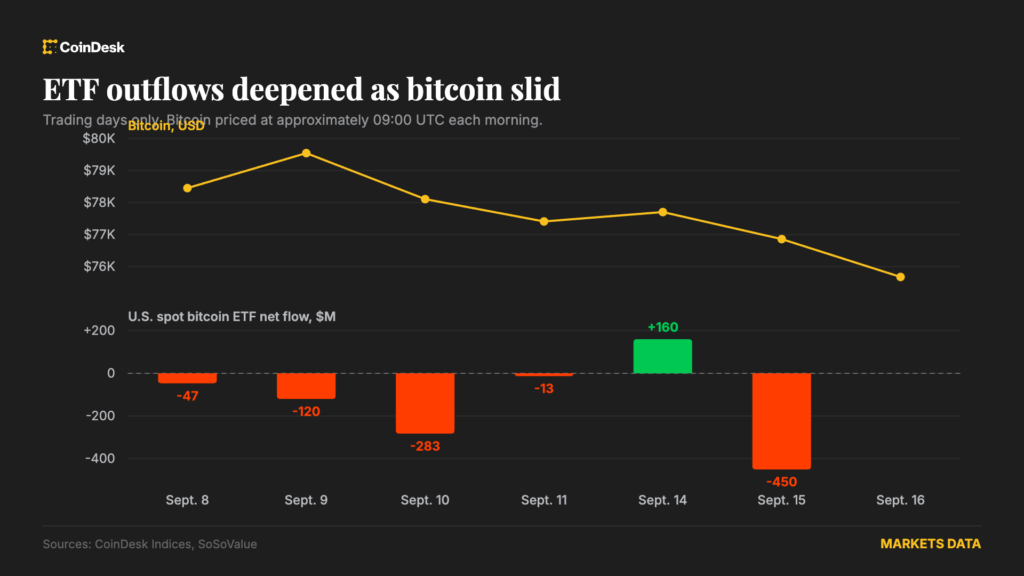
U.S. spot bitcoin exchange-traded funds lost $450.33 million on Tuesday, marking the largest single-session withdrawal since June 25, according to SoSoValue data following the Senate’s decision not to advance the Digital Asset Market Clarity Act.
Bitcoin price levels remained relatively steady following midnight UTC after declining in the wake of the vote, which fell short of the necessary 60 votes by about 10 lawmakers. Seven Democrats who spent months working on the legislation’s wording were among those who voted against the measure.
The CoinDesk 20 Index maintained its losses, slipping less than 0.1% after a 0.4% drop on Tuesday that marked its worst performance since June 5.
Market participants now shift their focus toward the Federal Reserve, which is scheduled to deliver its interest-rate announcement later today, with a rate increase having been anticipated as the primary market expectation going into the gathering.
The defeat of the proposal essentially concludes any likelihood that market structure regulations will pass the Senate this year, as Congress anticipates entering a split leadership structure in January.
Bitcoin’s 1.7% decrease over 24 hours appears modest compared to the steeper pullbacks seen in tokens carrying greater exposure to American regulatory developments.
Stellar dropped 9.6% across a 24-hour window, while XRP declined 8.1%. Across the constituents of the CoinDesk 100, exactly 95 assets registered losses during the timeframe.
Traditional financial markets remained stable in comparison, with Nasdaq 100 futures advancing 0.33%, gold climbing 0.88%, silver rising 1.37%, and the U.S. Dollar Index holding steady.
Derivatives positioning
- Futures liquidations: Forced unwinding of leveraged exposure picked up pace over the past day as digital asset prices retreated following the failed Senate procedural vote on the Clarity Act. Leveraged derivative positions exceeding $570 million were wiped out during this period, representing the highest total since August 22, though remaining well below the major liquidations recorded in early February and early June.
- Taker long-short ratio: The taker long-short volume metric shifted toward a bearish bias, with short positions representing 51.5% of trading activity across 24 hours. Takers refer to market participants who execute against existing bids or asks on the order book, thereby removing market liquidity.
- Hyperliquid long/short ratio: The Hyperliquid participant long-short indicator retreated moderately to 2.53 compared to 2.71, which had marked the peak reading since October 2025 when bitcoin last tested all-time highs above $120,000. Despite this pullback, longs still outnumber shorts by more than two to one, signaling significant bullish leverage vulnerable to liquidation if the downtrend continues.
- Bitcoin futures positioning: Bitcoin pulled back 1.4% over 24 hours even as total open interest in futures rose from 676,000 BTC to 688,000 BTC. This configuration is typically interpreted as a short-leaning stance, with traders initiating bearish positions amid the price correction. The 24-hour open-interest-adjusted cumulative volume delta for Bitcoin is in negative territory, indicating that an increasing number of short trades are hitting prevailing market prices instead of resting on passive limit orders. Meanwhile, perpetual funding rates suggest persistent optimism among certain traders.
- XRP futures positioning: The payments-centric asset XRP retreated nearly 10% alongside a modest increase in futures open interest. Open interest totals continue to sit far beneath historical peaks, demonstrating that aggregate market positioning remains light overall.
- Altcoin CVD and funding rates: XRP along with the majority of prominent digital assets, such as ETH, TRX, DOGE, XLM, and SHIB, exhibit negative 24-hour cumulative volume deltas, signaling aggressive selling pressure within the derivatives ecosystem. This environment suggests caution regarding the potential for deeper losses. Funding rates similarly reflect a bearish outlook for ETH, XLM, TRX, SOL, BCH, ADA, and LINK.
- Implied volatility: Thirty-day implied volatility benchmarks for both bitcoin and ether, represented by BVIV and EVIV, hold stable inside their recent boundaries and remain well beneath year-to-date highs, indicating that market participants are not pricing in an extreme volatility spike surrounding the U.S. rate determination.
- Options skew: One-week and one-month options skews for bitcoin remain positive and are climbing upward, signaling heightened demand for put contracts and downside hedging instruments. The one-week skew currently sits near 5.76%, while the one-month metric rests around 6.33%. Ether skews display a comparable trajectory.
- Options volume: Trading volumes paint a different picture. The most heavily traded bitcoin options contracts over the previous day consisted largely of call options, spearheaded by the $79,000 strike price. Conversely, the top five most active ether options contracts were exclusively put options.
Token talk
- Arbitrum emerged as the top-performing asset over the past 24 hours, advancing 16% after Standard Chartered projected the token to reach $10 by late 2030, representing roughly 70 times its current valuation. The banking institution highlighted projected revenue originating from Robinhood Chain alongside the broader expansion of tokenized real-world assets. The near-term price objective is set at a more conservative $0.50 by the close of the current year.
- Moving against the wider market downturn, Synapse more than doubled in value to reach $0.1787 without an obvious fundamental catalyst. However, the internal metrics of the move provide insight: futures volume totaled $310.64 million over 24 hours against a market capitalization of just $41.18 million, open interest equaled 60% of the token’s total worth, and the long-to-short accounts ratio on Binance stood at 0.93, implying the price surge stemmed from a short squeeze rather than organic spot purchasing demand.
- Privacy-centric assets remained the most resilient sector of the month, with Zcash gaining 6.9% to reach $1,186.75 to lead daily category gains, while Dash increased 2.9%.
- Decentralized derivatives exchange token Lighter gained 6% to $4.27, and Raydium advanced 5.4% to $1.30, with both assets recovering a portion of the value shed during Tuesday’s market correction without fully returning to their weekly starting levels.
- Decentralized finance tokens AAVE, JUP, and ETHFI each experienced declines exceeding 2% following midnight, despite ether.fi founder Mike Silagadze sharing with CoinDesk prior to the Clarity vote that the U.S. market represents only a minor share for ether.fi, meaning the legislative outcome would carry minimal operational impact.
Originally published at https://www.coindesk.com/markets/2026/09/16/bitcoin-etfs-shed-usd450-million-as-clarity-act-fails.