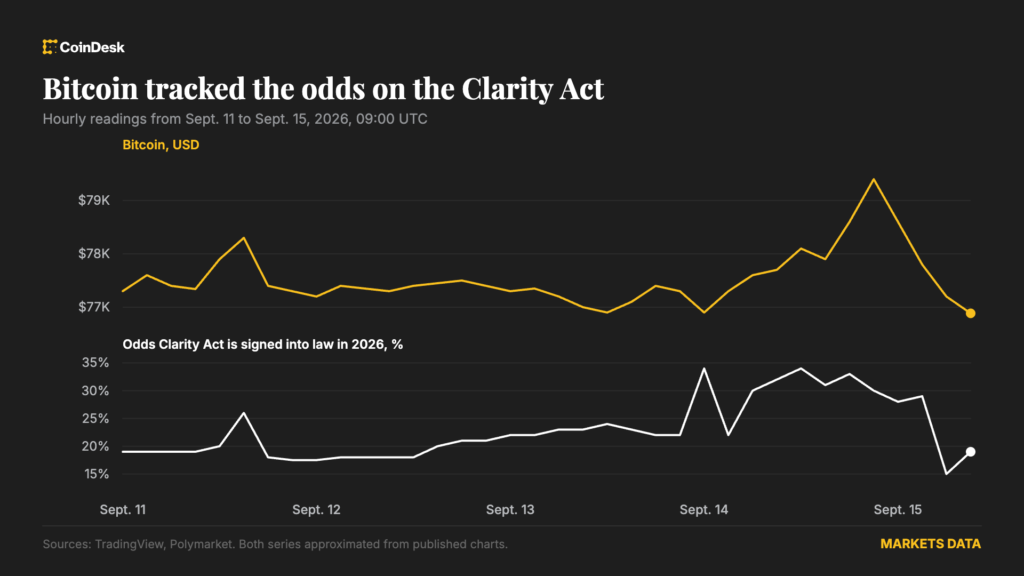
An upward price movement that pushed bitcoin up to $79,427 on Monday reversed course on Tuesday, bringing the leading cryptocurrency down to $76,862, which marks a 1.7% decrease since midnight UTC and sits 6.6% lower than the monthly peak of $82,284 achieved on September 4. Ether dropped 1.6% to reach $2,474.76, while solana slipped 2% to land at $100.43.
Prediction market probabilities on Polymarket regarding the U.S. Clarity Act receiving enactment this year tracked a parallel path, climbing to 34% on Monday before dropping back down to 17%. The decline was triggered by reports that Democratic lawmakers formulated a counteroffer following the rejection of a modified Republican draft distributed on Sunday. The primary point of contention revolves around ethics provisions regulating the digital asset holdings of officials rather than the core market structure regulations themselves.
The Senate has scheduled a vote for 2.15 p.m. ET to determine whether to invoke cloture, effectively forcing a vote on the legislation. A successful outcome would bring the crypto sector closer to its inaugural definitive framework outlining regulatory oversight responsibilities. Conversely, a defeat would likely postpone market structure rulemaking until after the November midterm elections.
Selling pressure proved nearly comprehensive on Tuesday, with 92 assets within the CoinDesk 100 trading lower on the session while the aggregate index retreated 1.6%.
Conventional financial markets trended in the opposite direction, as Nasdaq 100 futures advanced 0.43% and S&P 500 futures added 0.35% as part of a recovery from Monday’s artificial intelligence-led sell-off. The U.S. Dollar Index climbed 0.17%, turning Tuesday’s pullback into an isolated crypto event and inverting the dynamic seen 24 hours prior, when digital assets represented the sole major asset category in positive territory.
Derivatives positioning
- Long-short taker volume hangs in the balance: The long-short taker-volume ratio across crypto derivatives remains tightly balanced ahead of the Senate vote concerning the Clarity Act. Total open interest experienced a minor contraction, dipping 1% to reach $135 billion over the past 24 hours, whereas trading activity expanded 54% to total $207 billion. This indicates that current market participants are liquidating positions quicker than new ones are being established.
- Bitcoin futures show taker selling: The overnight descent of bitcoin toward $77,000 featured aggressive taker selling within the derivatives sector, based on commentary from Marex analysts. Takers consist of traders who extract liquidity from exchange order books by executing transactions at currently quoted prices. In general, open interest continues to contract, staying under 680,000 BTC, which highlights minimal appetite for leveraged exposure.
- Open interest declines in major tokens: Open interest figures for ether, solana, and XRP futures also persist in a downward trend. Regarding SOL specifically, open interest recently measured 58.81 million tokens, representing the lowest threshold since May, according to analytics provider CoinGlass.
- Negative CVD signals bearish pressure: The 24-hour open-interest-adjusted cumulative volume delta metrics for primary digital assets are negative, implying that bearish traders are dictating price trajectories. A negative value arises when a growing proportion of short positions are executed via market orders instead of passive limit orders.
- XLM bucks the trend: Stellar’s native token, XLM, serves as an exception regarding both valuation performance and open interest expansion. Its spot price holds a 4% gain across the prior 24 hours, while futures open interest expanded over 10% to total 1 billion XLM. This combination is widely interpreted as an indication of long accumulation, or bullish positioning. Annualized funding rates stay at a healthy 10%, validating sustained demand for upward exposure without exhibiting overheating indicators.
- Funding rates remain mostly bullish: Funding rates maintain moderately positive and bullish levels for most prominent coins, including bitcoin. Ether and SOL display mildly negative values, pointing to a slight inclination toward short positions. Nevertheless, this positioning could trigger a short squeeze if the procedural vote for the Clarity Act succeeds. TRX stands apart as an exception, featuring deeply negative open interest, a trend that has persisted over recent days.
- Volatility edges higher ahead of vote: The 30-day implied volatility benchmarks for bitcoin and ether, designated as BVIV and EVIV, are higher yet remain close to recent averages and substantially below the peaks documented during February and June. This demonstrates a modest rise in hedging demand, which is anticipated given that the Clarity Act decision will likely establish the short-term market trajectory.
- Calls dominate options volume: Within options contracts listed on Deribit, the implied volatility curve preserves its standard upward slope, implying that participants anticipate relatively orderly trading conditions over the ensuing 24 hours rather than a sudden volatility surge. The 24-hour volume standings likewise present a bullish outlook, with higher-strike call options leading the top five rankings for both bitcoin and ether.
Token talk
- Monday’s 27% rally in filecoin occurred alongside a 70% spike in derivatives open interest, and both metrics are now rapidly reversing, sending the token down 5.1% since midnight UTC to $0.89 and recording a 13% loss over 24 hours, while open interest dropped 23% to $106 million.
- Artificial intelligence and computing assets bore the heaviest losses for a second consecutive session following remarks made over the weekend by Anthropic CEO Dario Amodei urging a slowdown in AI development, with internet computer registering the steepest daily decline by dropping 6% to $2.58. Theta network fell 4.5% and NEAR Protocol retreated 3.7%.
- Uniswap sustained its bid while the broader decentralized finance sector experienced liquidations, adding 1% to reach $6.60 and rising 4.8% over 24 hours within a sector segment that has more at stake in Tuesday’s vote than most.
- After establishing an all-time high last Wednesday driven by a token burn and short covering rather than sustained organic demand, Venice Token has since retreated roughly 20%, relinquishing another 4.5% to settle at $22.05 on Tuesday.
- The two premier privacy-focused coins diverged for a fifth straight session, with monero ticking up 0.37% to $516.41, whereas zcash declined 1.87% to $1,141.
- Advances of 1.4% each for cosmos and XDC Network completed a sparse roster of gainers, alongside stellar, which showed minimal movement on the day but remains 4.3% higher on a 24-hour basis.
- CoinMarketCap’s “Altcoin Season” metric stands at 36 out of 100, remaining in a neutral territory after cooling off from last week’s peak of 51 out of 100.
Originally published at https://www.coindesk.com/markets/2026/09/15/bitcoin-gives-back-monday-s-gain-as-clarity-act-odds-fade-on-polymarket.