Coverage concluded on September 30, 2026, at 5:00 p.m. EDT. Digital currency values advanced early Wednesday following softer-than-expected inflation metrics, but relinquished those gains as borrowing costs continued to climb.
Micron surpasses earnings and forecast projections
“As strong as fiscal 2026 was, we expect fiscal 2027 to be even better,” stated Micron (MU) CEO Sanjay Mehrotra. “Industry demand has strengthened since our last earnings call, and we expect memory and storage supply-demand conditions to be much tighter in fiscal 2027 and 2028 than they were in 2026.”
Micron disclosed a fiscal fourth-quarter adjusted EPS of $33.42, compared to projections of $33.61. Revenues reached $54.23 billion, exceeding the expected $51.1 billion.
First-quarter 2027 revenue is projected at $61.5 billion against expectations of $57 billion, with an EPS forecast of $38.15 versus the anticipated $35.40.
Equities rose by 1.1% during after-hours trading.
Persistent bond liquidation drives long-term U.S. yields to peaks not seen since 2002
“Those betting against ‘the house’ keep winning,” wrote Jeff Gundlach.
The 10-year Treasury yield climbed to 5.30% on Wednesday, reaching its highest mark since 2002.
The 30-year yield ascended to 5.65%, additionally establishing a 24-year peak.
Both yields traded lower earlier following favorable U.S. August inflation figures, though the relief proved short-lived before fixed-income sellers regained control.
After advancing over 1% earlier in the session, the Nasdaq closed with a modest 0.25% gain, while the S&P 500 and the Dow Jones Industrial Average slipped into negative territory.
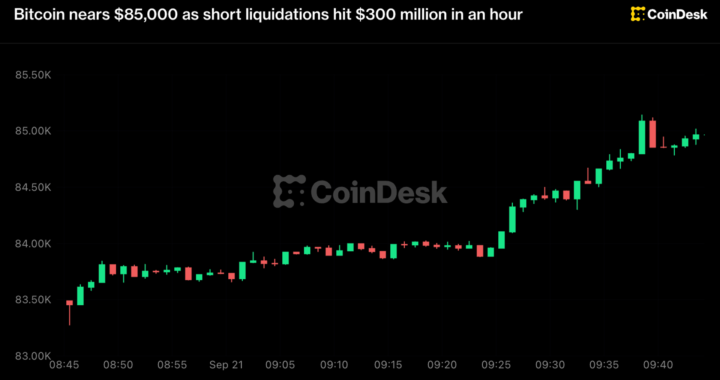
Similarly, bitcoin surged sharply following the inflation release before sliding down to $83,500, marking a 0.4% decline over the trailing 24 hours.
Bitcoin approaches its strongest quarter since 2024, while ether records its best since 2021
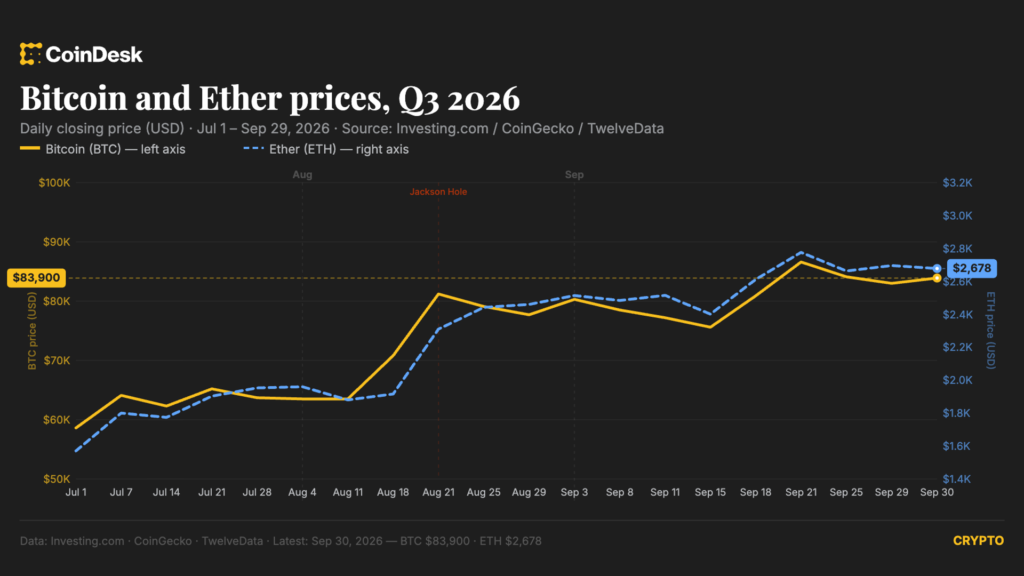
Assuming a daily close hovering near $84,000, bitcoin BTC$83,547.27 is set to conclude the third quarter with an approximate 44% surge, marking its finest quarterly performance since the initial three months of 2024 when it expanded by 68.7%, according to Coinglass.
This quarterly growth arrives directly on the heels of three consecutive losing quarters.
Following a matching pattern of three straight quarters in the red, ether ETH$2,683.73 has surged 70.9% across the past three months, representing its strongest quarter since the first quarter of 2021 when it appreciated by 160.7%.
Looking ahead, the fourth quarter historically represents bitcoin’s most robust period since 2013, delivering an average return of 77% and a median gain of 47.7%.
Hut 8 CEO addresses confusion surrounding insider stock transactions
Data center equities mostly trended lower for the day, led downward by Hut 8 HUT$86.11·Market Closed following regulatory filings indicating a disposal of 1.5 million shares by Michael Ho, the firm’s Chief Strategy Officer and board member.
“Mike did not sell 1.5 million shares in the open market,” stated CEO Asher Genoot on X this afternoon. “Mike has not sold any shares since we started the company.”
Genoot further clarified that Ho secured a loan backed by a portion of his holdings, and the 1.5 million shares detailed in the filing denote collateral for that credit arrangement rather than an outright sale.
“Ultimately, the structure gave Mike the liquidity he needed without selling shares in the open market, while allowing him to retain substantial exposure to the upside in Hut 8,” Genoot concluded.
HUT equity values declined by 4.8% during afternoon sessions.
Federal Reserve renovation audit uncovers irregularities, yet uncovers no criminal wrongdoing
“At no point during our evaluation did we find reasonable grounds to believe that a violation of federal criminal law had occurred,” according to the report issued by the Federal Reserve’s Office of Inspector General.
“Further, while our report outlines deficiencies in the management of the renovation project, resulting in our recommended corrective actions in accordance with the Inspector General Act, we did not identify administrative misconduct during our evaluation.”
The controversy centered around the Federal Reserve’s roughly $1.3 billion overhaul of its Eccles Building headquarters, which experienced nearly a doubling of its initial budget, and whether former Chairman Jerome Powell or other officials could face criminal liability.
Having cleared the hurdle of potential criminal culpability, the finding may clear the path for Powell to depart the central bank after he took the unprecedented step of remaining on as a Fed governor following the conclusion of his chairmanship term.
In notable shift, Bank of Korea prepares initial gold acquisition in 13 years
The Bank of Korea intends to procure roughly one metric ton of domestically sourced gold, marking its first acquisition of the precious metal in 13 years, reported the Seoul Economic Daily.
The disclosure originated from Representative Chung Tae-ho of the Democratic Party of Korea, who serves on the National Assembly’s Strategy and Finance Committee.
The central bank suspended bullion purchases back in 2013 amid declining market prices and mounting political scrutiny, the report noted.
Chung described the decision to restart gold acquisitions as a vital initial measure toward diversifying South Korea’s financial reserves.
As of late August, the Bank of Korea’s gold reserves stood at 104.4 tons, representing a mere 3.4% of total assets based on prevailing market valuations.
Fixed-income gains evaporate as Treasury yields rebound upward
The battered bond market and stagnant bitcoin market both initially found relief from cooler-than-projected inflation statistics earlier in the morning.
Both assets have since surrendered those temporary advances.
The benchmark 10-year U.S. Treasury yield is currently higher by 1.6 basis points on the session, resting at 5.276% after touching a low of 5.20%.
The 30-year yield advanced 3.6 basis points to hit 5.63% following a dip down to 5.54%.
The PCE inflation metrics that sparked the initial relief rally are 1) derived from historical August data, 2) continuing to reflect inflation well above the Federal Reserve’s 2% objective, and 3) serving as the inaugural readings utilizing updated Bureau of Labor Statistics benchmarking that potentially induced an artificial upside surprise.
Petroleum pricing—which has driven much of the underlying inflationary pressure—is similarly climbing again today, with WTI crude advancing more than 2%, while refined products including gasoline and heating oil gained 4%.
Long-term investors now control 80% of circulating bitcoin supply, setting historical peak

Long-term investors now command 80% of the entire bitcoin supply, establishing an unprecedented milestone according to Glassnode’s HODL Waves metrics. This category tracks coins that have remained static for a minimum of 155 days, with individual colored segments illustrating the supply percentage untouched during specific windows, collectively totaling 100%.
This proportional holding has climbed from 65% to 80% over the preceding year, indicating that market participants consistently accumulated and retained tokens through the prior year’s bear market, during which bitcoin retreated from $126,000 down to $60,000.
The 155-day milestone currently maps back to approximately late April, designating coins untouched since prior to that timeframe as long-term inventory.
Subdued PCE inflation figures could propel Bitcoin as Treasury yields and greenback decline
Digital asset markets could find additional room for expansion if moderated U.S. inflation metrics maintain downward pressure on sovereign yields and the dollar.
The most recent PCE release has led market participants to scale back expectations regarding subsequent Federal Reserve interest rate hikes. Joel Kruger, global markets strategist at LMAX Group, noted that this sentiment shift is pulling yields downward while eroding the dollar’s rate advantage.
Such dynamics could grant crypto markets necessary breathing room, as bitcoin has sustained its position despite robust currency demand that typically diminishes the appeal of risk assets.
“If that headwind now eases alongside lower US yields, it could provide an additional tailwind for bitcoin and ETH by improving global financial conditions and reducing the relative appeal of holding cash in dollars,” Kruger explained.
Nevertheless, notable risks persist, according to Fitch Ratings executive Olu Sonola, who emphasized that inflation persists near or above 3%, whereas Oliver Rust of Truflation points to energy expenses and trade tariffs as primary cost drivers.
Consequently, bitcoin remains highly sensitive to upcoming inflation metrics, petroleum valuations, and the Federal Reserve’s monetary trajectory.
Bitcoin retreats to $84,000 after relinquishing preliminary gains
A pronounced bitcoin rally triggered by stronger-than-anticipated August U.S. inflation figures was almost entirely reversed within a two-hour window.
Digital asset values surged more than 2% to cross above $85,500 immediately following the official PCE price disclosure, which registered cooler than economists expected.
With leveraged short positions thoroughly liquidated, prices have retreated back to pre-release levels near $84,000.
Conversely, U.S. equities exhibited no comparable retracement, with the Nasdaq climbing over 1% to reach a session peak as government yields drifted slightly lower.
Chicago Purchasing Managers’ Index substantially exceeds forecasts
In a potential precursor to national ISM indicators scheduled for release tomorrow, the Chicago PMI advanced to 58.8 in September, up from its prior reading of 47.1.
Analyst estimates had anticipated a much more modest uptick to 51.2.
Broader markets are presently surrendering portions of the immediate knee-jerk advances that followed the PCE inflation data published roughly 90 minutes prior.
The U.S. 10-year Treasury yield is currently lower by a modest 1.2 basis points at 5.248%, while bitcoin trades approximately $1,000 below session peaks at $84,550.
Probability of October interest rate increase slips below 50% following cooled inflation data
Traders were already scaling back expectations regarding an October Federal Reserve rate hike following dovish commentary delivered yesterday by New York Fed President John Williams.
Those projections experienced further contraction following the release of softer-than-expected domestic inflation metrics minutes ago.
According to the CME FedWatch tool, which aggregates trader positioning within short-term interest rate futures, the probability of a policy adjustment during the Fed’s October 28 gathering has declined to 47.1%, compared to roughly 70% observed 48 hours prior.
As numerous observers note, the Bureau of Labor Statistics—responsible for compiling this morning’s PCE price figures—altered its methodology regarding how specific underlying components are measured, potentially influencing the softer inflation print.
Bitcoin advances as sovereign yields recede following favorable inflation statistics
Bitcoin BTC$83,547.27 climbed roughly 1% to touch $84,750 following the publication of August PCE inflation metrics that registered below analyst expectations.
The 10-year U.S. Treasury yield retreated 4.2 basis points to 5.218%, while the 2-year yield contracted 2.1 basis points to 4.868%.
U.S. stock index futures concurrently advanced approximately 0.4% across the board.
PCE inflation metrics outperform analyst expectations
The Personal Consumption Expenditures price index climbed 0.3% during August, according to an official government release, marking an acceleration from July’s 0.1% increase but falling shy of the 0.4% consensus estimate.
On an annualized basis, PCE prices advanced 3.4%, remaining unchanged from July while resting substantially below expectations of 3.7%.
Core PCE prices rose 0.2% in August, representing an increase from July’s 0.1% print while beating forecasts calling for 0.3%.
Annualized core PCE inflation held steady at 3.0%, matching July’s rate while tracking below the 3.3% consensus projection.
ADP employment metrics exceed expectations
The U.S. private sector generated 90,000 employment positions in September, according to the latest ADP Employment Report.
The figure marks an expansion from August’s revised total of 36,000 and outpaced the 70,000 positions anticipated by economists.
Markets are presently awaiting the pending August PCE price statistics.
Investors additionally look ahead to Friday’s primary macroeconomic event, featuring the government’s official September employment situation report.
Bitfinex indicates real yields represent primary headwind confronting Bitcoin
Inflation-adjusted, or real, yields associated with U.S. Treasury notes constitute a principal resistance factor for bitcoin, according to research analysts at Bitfinex.
The 10-year inflation-protected yield climbed from 2.68% up to 2.83% during the week concluding September 25.
A sovereign debt instrument providing nearly 3% in inflation-adjusted returns elevates the opportunity cost associated with retaining non-yielding assets such as gold and bitcoin.
Multicoin Capital allocates capital to Grass, machine intelligence read layer
Multicoin Capital, an investment firm focused on cryptographic tokens, digital assets, and blockchain ventures, is deploying capital into Grass—functioning as the read layer for machine intelligence—via both its venture and hedge fund structures.
Grass has successfully demonstrated commercial viability by generating substantial revenue and achieving operational profitability following initial accomplishments in supplying pretraining datasets for frontier artificial intelligence laboratories through millions of residential connections, the disclosure indicated.
The investment firm expresses confidence that Grass is well-positioned to evolve into fundamental infrastructure for autonomous AI agents by deploying specialized search and content APIs designed to tap into the massive, recurring live context retrieval market during inference.
Market breadth metrics deteriorate across the S&P 500 index
A mere 25% of equities within the S&P 500 are currently trading above their respective 50-day moving averages, marking the lowest proportion observed since April 2, according to insights from The Kobeissi Letter.
This indicates a sharp contraction in market breadth compared to the 70% participation rate recorded in mid-August.
By comparison, the digital asset ecosystem maintains comparatively healthier underlying conditions.
Bitcoin and gold maintain stability ahead of critical domestic inflation disclosures
The primary macroeconomic event for Wednesday centers on the publication of PCE inflation metrics, which serve as the Federal Reserve’s preferred inflation benchmark. Core PCE, stripping out volatile food and energy costs, is projected to expand 0.3% month-over-month and 3.3% year-over-year, alongside expectations for quarterly GDP growth of 1.5%.
Both bitcoin and gold posted modest gains on the session, changing hands at $83,700 and just under $4,200 per ounce, respectively.
Derivatives markets currently price in a 57% probability that the Federal Reserve will maintain target interest rates unchanged during its October 28 policy gathering.
Standard Chartered establishes $2 price target for Ethena’s ENA token by late 2028
Standard Chartered has initiated formal research coverage of Ethena’s ENA token with a projected valuation target of $2 by the conclusion of 2028, representing a potential appreciation of nearly 670% from its prevailing market valuation of 26 cents.
The financial institution emphasized that Ethena benefits directly from escalating demand for yield-generating stablecoins alongside the broader expansion of tokenized real-world assets across both decentralized and traditional financial networks, while highlighting the rapid adoption of its USDe stablecoin, which achieved a $10 billion market capitalization within its inaugural nine months.
The bank further cited Ethena’s token buyback-and-burn mechanism while projecting that total USDe supply could scale to $40 billion by 2028, though it cautioned that slower adoption rates and muted growth in real-world assets represent potential downside risks.
Gold requires daily close exceeding $4,200 to validate new upward trajectory, states XS.com
Gold prices are hovering near $4,200 per ounce. Simon-Peter Massabni, head of business development at XS.com, noted in commentary provided to CoinDesk that this price threshold represents a critical battleground where bullish trend followers intersect with sellers anticipating a deeper correction.
He emphasized the necessity of a definitive daily or four-hour close above $4,200 to confirm the initiation of a subsequent upward leg.
In the near term, monetary policy decisions from the Federal Reserve remain paramount. Because gold generates no coupon or yield, expectations for prolonged high interest rates increase the opportunity cost of holding the metal relative to cash and sovereign bonds, positioning today’s PCE inflation figures as the next significant test. A higher-than-anticipated reading “could trigger another wave of short-term selling pressure,” Massabni warned.
Following the inflation report, market focus will pivot toward the monthly U.S. employment report, where weaker labor metrics could temper expectations regarding further monetary tightening.
Bitcoin momentum stalls amid upcoming PCE release and diminishing buying pressure
Bitcoin retreated 0.3% to approximately $83,700 during early U.S. trading hours as market participants awaited the personal consumption expenditures price index—the Federal Reserve’s preferred inflation indicator—which is anticipated to reflect accelerating inflation throughout August.
An inflation print exceeding projections would reinforce expectations for policy tightening that fueled a severe bond market sell-off earlier in the month. Concurrently, Brent crude advanced above $103 per barrel, marking a roughly 14% gain across September despite Middle East production flows returning toward pre-conflict baselines. U.S. Treasuries stabilized following a session where 30-year yields achieved peaks unseen since 2002, while the U.S. dollar held close to its highest level since July.
Ether slipped 0.7% to approximately $2,690. Among major digital assets, HYPE experienced the steepest decline at nearly 2%, whereas XRP and TRX recorded modest gains of under 1%, according to CoinDesk market data.
Onchain analytics provider CryptoQuant calculates that spot market demand for bitcoin has contracted by roughly 170,000 BTC across the trailing 30 days, while expansion in derivatives futures demand has dropped by 90% since September 14.
Micron Technology is scheduled to publish its earnings report following the U.S. market close, providing a key barometer for artificial intelligence-adjacent equities that previously helped insulate the S&P 500 from deeper losses during the recent fixed-income sell-off.
Originally published at https://www.coindesk.com/markets/2026/09/30/live-updates-bitcoin-below-usd84-000-ahead-of-pce-inflation-data-micron-earnings.