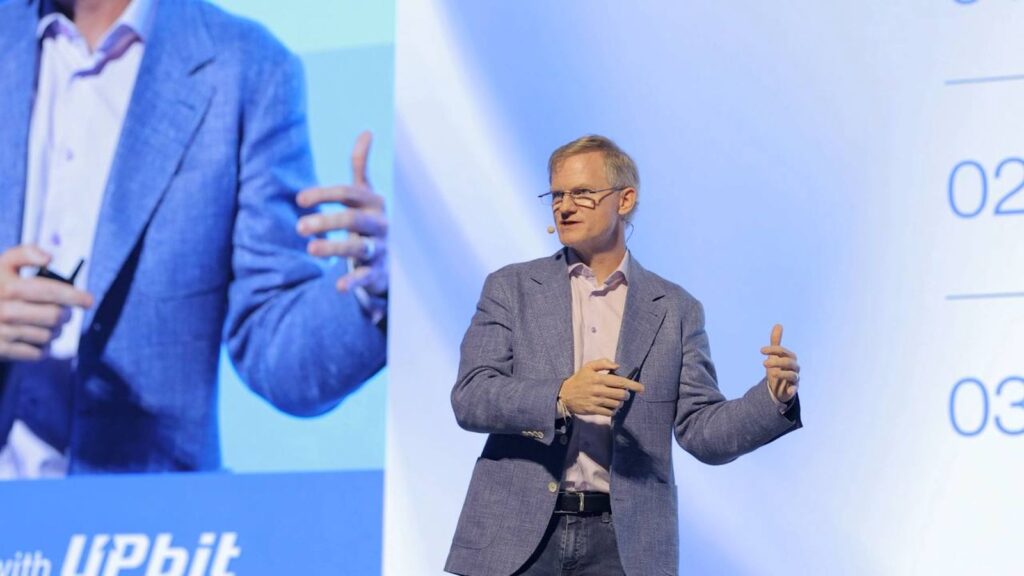
BitGo chief executive Mike Belshe cautioned that the failure of the Clarity Act leaves U.S. markets vulnerable to systemic hazards stemming from a single enterprise controlling brokerage, exchange, and custody operations.
Speaking with The Block at Korea Blockchain Week 2026, BitGo (BTGO) leader Mike Belshe noted that his company strongly backed the legislation and hoped for its approval. The U.S. Senate declined a motion to advance the Clarity Act on September 15, missing the 60 votes required to move forward.
The BitGo executive explained that enterprises are constructing comprehensive platforms combining trading, brokerage, and safekeeping services absent the market infrastructure needed to control risks. He highlighted Coinbase (COIN), which recently secured a derivatives clearing organization permit alongside an existing futures commission merchant authorization and trading platform.
Belshe identified two primary dangers as digital finance platforms evolve into comprehensive service providers: counterparty credit exposure and custody risk.
Lehman, only worse
“Exchanges have never held custody, never, of anything,” Belshe stated. “And they certainly didn’t hold custody of the world’s most dangerous asset, the bearer asset, the one where if you lose the private key, you lose money.”
As every market participant digitizes, multi-service companies will become the central core of the industry, according to Belshe. A safekeeping failure within such an entity would not remain isolated, he warned, as “the entire market goes down.”
Addressing counterparty credit exposure, Belshe likened this integrated platform model to the 2008 collapse of Lehman Brothers, describing the current threat as even more severe. The broker-dealer collapsed because it lacked visibility into its risk exposure, Belshe noted, yet the broader financial network managed to endure the fall.
“Imagine if that had been the New York Stock Exchange offering those services and the whole New York Stock Exchange went down. As devastating as the 2008 crisis was, we survived it. But if it had been New York’s stock exchange going down, I don’t know if we would have.”
Belshe emphasized that the price of regulatory ambiguity is the absence of protective frameworks to manage these hazards.
“Without solving clarity for really relatively small and petty political differences, the legislature decided to put the American capital markets at risk,” Belshe stressed.
The BitGo leader added that his company can function effectively without the legislation, having navigated the crypto sector for 13 years under constant scrutiny. Conversely, banks and traditional institutions—which he views as BitGo’s most formidable rivals—will proceed much more cautiously due to anxieties regarding a potential resurgence of Operation Chokepoint 2.0.
AI and stablecoins
Additionally, Belshe commented on assertions made during Korea Blockchain Week by Maelstrom CIO Arthur Hayes, who argued that stablecoins and related digital assets cannot serve as native currencies for artificial intelligence agents because they lack direct convertibility into computational power.
“So I wouldn’t count that out entirely, but I think it’s a little bit far away, and it’s not like both of these things can’t exist,” Belshe remarked. “You could end up with agents that are paying each other in some sort of value that the agents decide is good, but they’re still going to interface to with human system.”
The BitGo chief stated his view that humanity will direct artificial intelligence for a significantly longer duration than what AI alarmists suggest. People will deploy autonomous agents to assist them, and those agents will ultimately rely on human-centric interfaces tied to the dollar or other traditional currencies.
Originally published at https://www.theblock.co/news/regulation/2026-10-02-mike-belshe-bitgo-interview-clarity-417560.