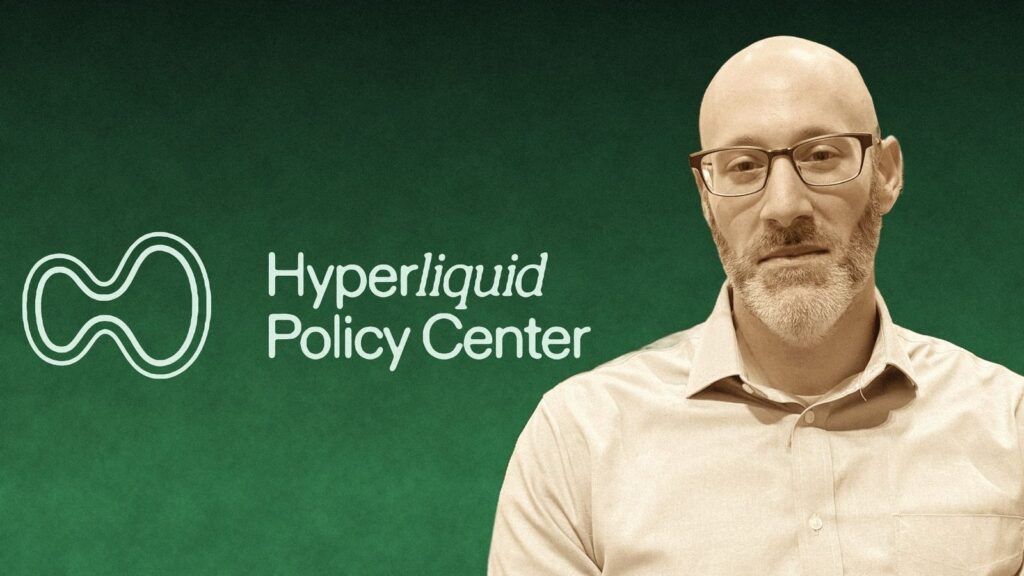
Chervinsky stated that beyond regulated perpetuals, decentralized markets need to integrate into the American regulatory framework, a milestone he anticipates will occur ‘at some point soon.’
Hyperliquid Policy Center CEO Jake Chervinsky mentioned on Tuesday that “every single exchange,” including Intercontinental Exchange (ICE) and CME Group, will be forced to adopt public blockchain infrastructure within the next ten years if they hope to remain competitive.
During a discussion with The Block at the Digital Asset Summit 2026 Asia held in Singapore, the cryptocurrency policy specialist explained that Hyperliquid (HYPE) functions as foundational technology rather than a traditional exchange, allowing various participants—including U.S. entities—to leverage its capabilities.
Chervinsky likened the Hyperliquid network to Bitcoin, Ethereum, and Solana, noting that a public blockchain has no requirement to register as an exchange.
“Hyperliquid is not designed to rival Kalshi, Coinbase, Robinhood, and CME. Hyperliquid operates one layer lower within the technology architecture. It is a system they can leverage to enhance their offerings,” Chervinsky noted, explaining that the ultimate vision for Hyperliquid is for the entire financial sector to upgrade its foundation to utilize public blockchains.
“I expect that if our efforts succeed, a decade from now, every single trading venue you can think of—whether it is a crypto-native platform like Coinbase or Kraken, or a legacy institution like the Chicago Mercantile Exchange or the Intercontinental Exchange—will need to adopt this technology to stay in the race,” Chervinsky stated.
Next steps
Chervinsky’s remarks arrive on the heels of Payward’s announcement in September revealing plans to launch permissioned perpetual markets on Hyperliquid tailored for American users. Bitnomial, the CFTC-regulated clearinghouse and exchange acquired by Payward, will generate and clear these contracts, while NinjaTrader Clearing will maintain the accounts.
This development followed remarks by U.S. President Donald Trump indicating that the Commodity Futures Trading Commission would transition Hyperliquid onshore in a fully compliant manner. Prior to that, the CFTC cleared the path for Kalshi to provide regulated perpetual futures to domestic clients.
U.S. regulatory authorities have already permitted registered trading platforms to offer crypto perpetual contracts to local users, though they have yet to approve the underlying onchain infrastructure. The Hyperliquid representative stated he anticipates onchain markets to enter the United States at “some point soon.”
“I am certain that regulatory bodies are putting in tremendous effort to introduce onchain markets to the United States,” Chervinsky remarked. “I appreciate that they are proceeding in a thoughtful, methodical, and careful manner, as this is no simple task.”
Chervinsky emphasized that the advantages of bringing onchain markets within regulatory boundaries are evident: decentralization and a shared public ledger deliver enhanced security, transparency, and resilience, whereas accelerated speeds and reduced costs optimize current market operations.
He added that the subsequent regulatory milestone following onchain markets will involve perpetuals tied to alternative underlying commodities, including metals and oil—which already represent some of the most active trading categories on Hyperliquid—alongside agricultural agreements.
CME’s ‘delay tactics’
In addition, Chervinsky addressed CME Group’s legal action against the CFTC initiated in June, which aims to overturn the agency’s prior authorization of perpetual futures as legitimate futures contracts. CME has contended that these products should instead be categorized as swaps.
Chervinsky asserted that the exchange is highly unlikely to prevail in the lawsuit, which currently faces a pending motion to dismiss. The CFTC previously argued that CME lacks legal standing because the regulation it challenges permits CME to list the exact same instruments.
“If you choose not to participate, you cannot complain about the competition that you are voluntarily avoiding,” Chervinsky noted. He explained that perpetuals do not siphon volume away from the dated futures products CME currently provides, representing instead an entirely separate, new market that the exchange can choose to bypass.
“I believe this is fundamentally about CME attempting to stall progress simply because they lack the readiness to capitalize on that progress,” Chervinsky said. “Therefore, I view it as a delaying strategy.”
The Hyperliquid Policy Center CEO also dismissed CME’s recent choice to scrap its proposed round-the-clock energy futures, which the exchange attributed to staffing constraints.
“I do not believe staffing was the true reason,” Chervinsky stated. “I think CME simply overextended themselves and failed to gauge the genuine demand within the energy sector for 24/7 trading capabilities.”
Originally published at https://www.theblock.co/news/regulation/2026-10-07-hyperliquid-policy-center-jake-chervinsky-interview-417896.


