When President Donald Trump came back to the White House last year, he moved past his previous skepticism toward digital currency, welcoming the sector by appointing a prominent cryptocurrency czar and setting up his President’s Council of Advisors for Digital Assets.
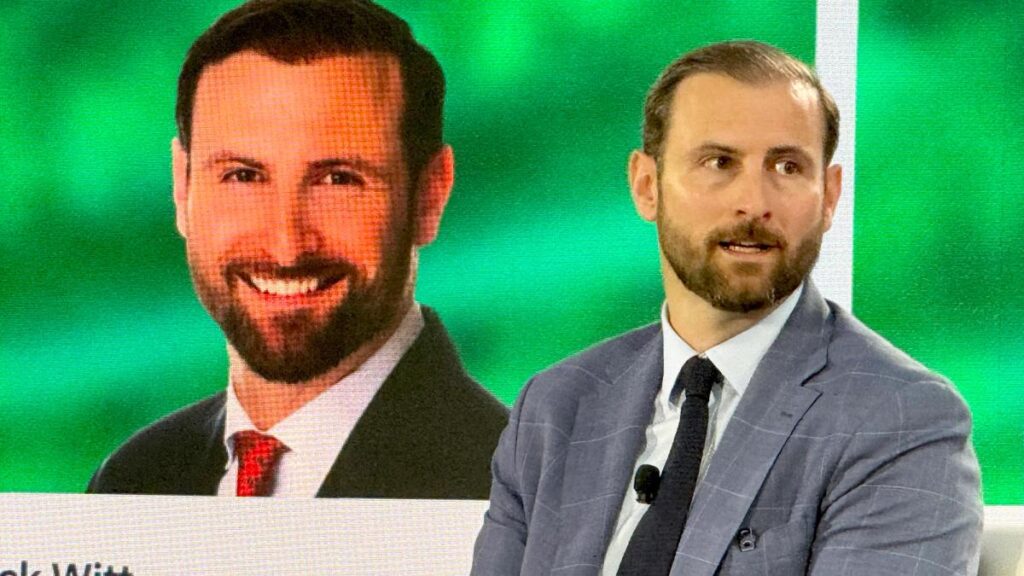
Almost two years later, that policy momentum appears to have slowed down temporarily following the exit of Patrick Witt, who served as the final crypto official managing that department. Furthermore, when the president recently introduced a new artificial intelligence chief, the position that previously combined both crypto and AI seemed to exclude cryptocurrency from its responsibilities.
Consequently, who is currently managing digital asset policy within the administration remains uncertain, even though several lawmakers on Capitol Hill still suggest that the final weeks of the legislative session following the November elections could bring about some policy achievements for the sector. The executive mansion still maintains a group of policy aides, and Trump’s administration currently has multiple digital asset regulatory efforts underway at agencies like the Securities and Exchange Commission. Nevertheless, no new individual has been formally assigned to lead Trump’s internal crypto initiatives.
A White House representative informed CoinDesk on Thursday that Witt’s contributions were valued and wished him well in upcoming endeavors. The official chose not to disclose who would succeed him.
Digital assets and the Clarity Act will remain a top priority for the president, the representative stated.
The administration’s work on digital asset policy was never a massive operation, yet these advisers were vocal on numerous occasions, and their presence provided a significant governmental backing for digital asset objectives. This initiative started several weeks prior to Trump’s return to office in 2025, when the president-elect designated David Sacks, an ex-PayPal executive, as his incoming artificial intelligence and cryptocurrency czar.
Trump also selected Bo Hines, a lesser-known former college football player, as the inaugural director of the digital asset advisory council—initially operating as a single-person group before eventually bringing on a deputy. Hines rapidly emerged as the prominent face of the administration’s crypto efforts, holding regular consultations with industry figures and appearing at public events. His brief term of approximately eight months concluded with a major legislative achievement for the sector: the enactment of the Guiding and Establishing National Innovation for U.S. Stablecoins (GENIUS) Act into law.
An official White House signing ceremony and celebration followed, where many prominent figures in the digital asset space secured front-row seats. Less than two weeks later, the administration published a comprehensive crypto agenda outlining specific strategies for advancing the industry inside the United States.
Having assisted in establishing federal law for stablecoin providers, Hines accepted a position directing the U.S. division of the leading issuer, Tether. Meanwhile, a consultancy he launched alongside his father and an additional partner, Nxum, also collected millions of dollars as the primary provider of services for a newly formed political action committee, first uncovered through reporting by CoinDesk. This super PAC received the majority of its funding from Tether’s financial partner in the U.S., Cantor Fitzgerald, and was managed by a Tether executive.
This week, the Wall Street Journal reported that Hines’ company, Nxum, obtained consulting payments from Tether during the period Hines was stationed at the White House working on the GENIUS Act.
Witt, who served as Hines’ deputy on the council, stepped up to replace Hines as the new executive director. As another former football standout, Witt also brought a more extensive background in Washington politics, positioning himself as the spokesperson for the administration’s campaign advocating for the Digital Asset Market Clarity Act. Throughout subsequent months of negotiations, Witt made no secret of his frustration, frequently utilizing the social media platform X to criticize individuals he believed were obstructing the Senate legislation designed to establish a regulatory framework for digital asset markets.
During that legislative procedure, Sacks departed from his czar position in March, leaving Witt and his deputy, Harry Jung, to shoulder the administration’s digital asset strategy. This task was further complicated by the fact that President Trump’s own digital asset business interests played a major role in discussions, with Democrats demanding that high-ranking government officials be prohibited from maintaining personal crypto connections.
As negotiations extended further into the year and drew closer to the elections, the administration proposed certain compromises that would have introduced unprecedented ethics restrictions regarding the president’s involvement in digital assets, though Democrats decided the terms were still insufficient.
Witt had verified in July that he faced upcoming military service obligations with the Georgia National Guard, yet he remained to finalize the negotiations for the Clarity Act, even after his deputy resigned to join Hines’ Nxum. The bill encountered a political barrier a month ago, failing to pass during a Senate floor vote before the chamber adjourned for an extended break ahead of the upcoming elections.
Following reports circulating this week indicating Witt had already departed, he published a message Wednesday night close to midnight to confirm his exit. He expressed gratitude to the agency directors and lawmakers who supported the Clarity initiative, noting that with regulators and elected officials like them, he felt confident that the future of digital asset innovation in America remains bright. He added that he will be transitioning into the private sector.
Digital asset figures report uncertainty regarding who they will interact with now that their expectations for market structure have largely diminished for the present.
When Trump acted earlier this month to reinstate an artificial intelligence supervisor, appointing former SEC Chairman and current intelligence director Jay Clayton to head his Super Intelligence Force, the title omitted any reference to digital assets. Although artificial intelligence and cryptocurrency share certain overlapping areas, Clayton brings a controversial digital asset background, having led the SEC during the initiation of the regulatory approach commonly termed “regulation by enforcement.”
Originally published at https://www.coindesk.com/news-analysis/2026/10/15/at-the-white-house-crypto-policy-vacancy-looms-large.


