On August 15, 1971, Richard Nixon declared that he instructed Treasury Secretary John Connally “to suspend temporarily the convertibility of the dollar into gold.” This suspension was never undone. Exactly fifty-five years later, Lucho Poletti debuted the first of ten drawings reacting to that proclamation.
Europe had previously gone through its own monetary turbulence. Hieronymus Bosch and Pieter Bruegel the Elder created art during a period characterized by expanding credit, banking, and financial speculation. Antwerp, Bruegel’s home base, evolved into one of the premier commercial hubs in Europe. Both painters populated their artwork with hundreds of individuals, building intricate environments where societal structure, human behavior, and moral evaluation could be analyzed simultaneously.
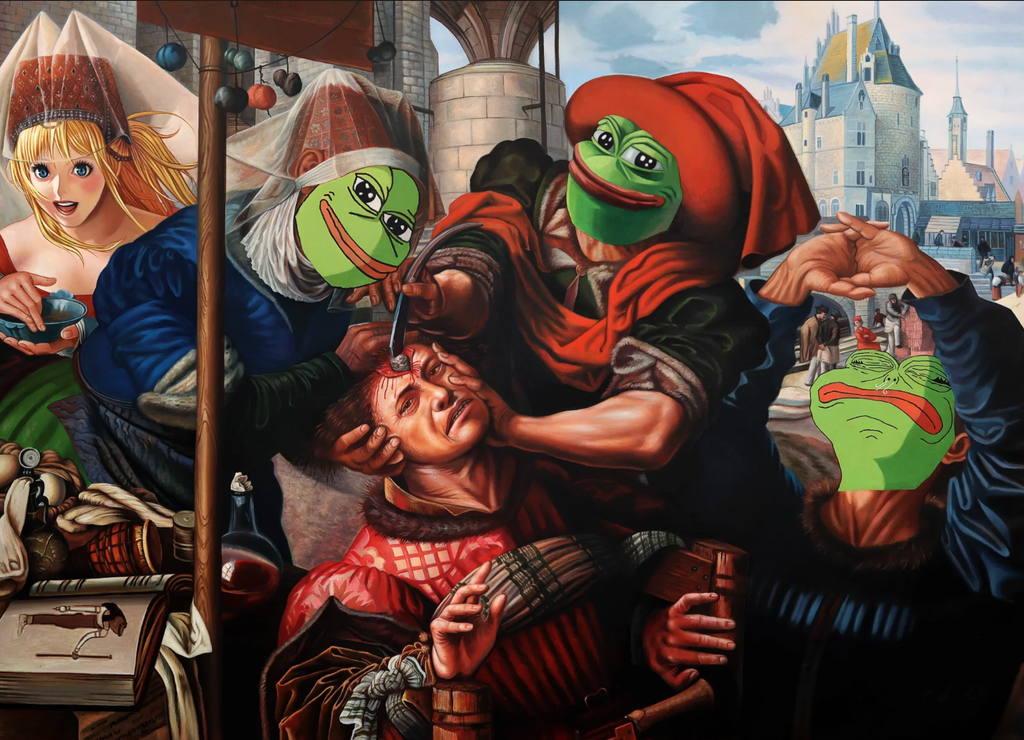
Bitcoin creators have increasingly drawn inspiration from this artistic lineage. Pepenardo’s Master Cuts Out the Stone, showcased by BMAG earlier in the year, reinterpreted Jan Sanders van Hemessen’s The Surgeon as an exploration of extraction dynamics. Carlijn Kingma’s The Waterworks of Money, displayed at Bitcoin Amsterdam the previous year, portrayed the contemporary financial architecture as a web of connected systems. Intricate structures seem to naturally demand imagery that captures everything within a single composition.
Lucho Poletti has produced bitcoin-focused artwork since 2017, viewing his work as visual advocacy for the monetary revolution. Having contributed to the Bitcoin Conference art exhibition since 2021, he returns for Bitcoin Amsterdam this November with Ten Decrees.
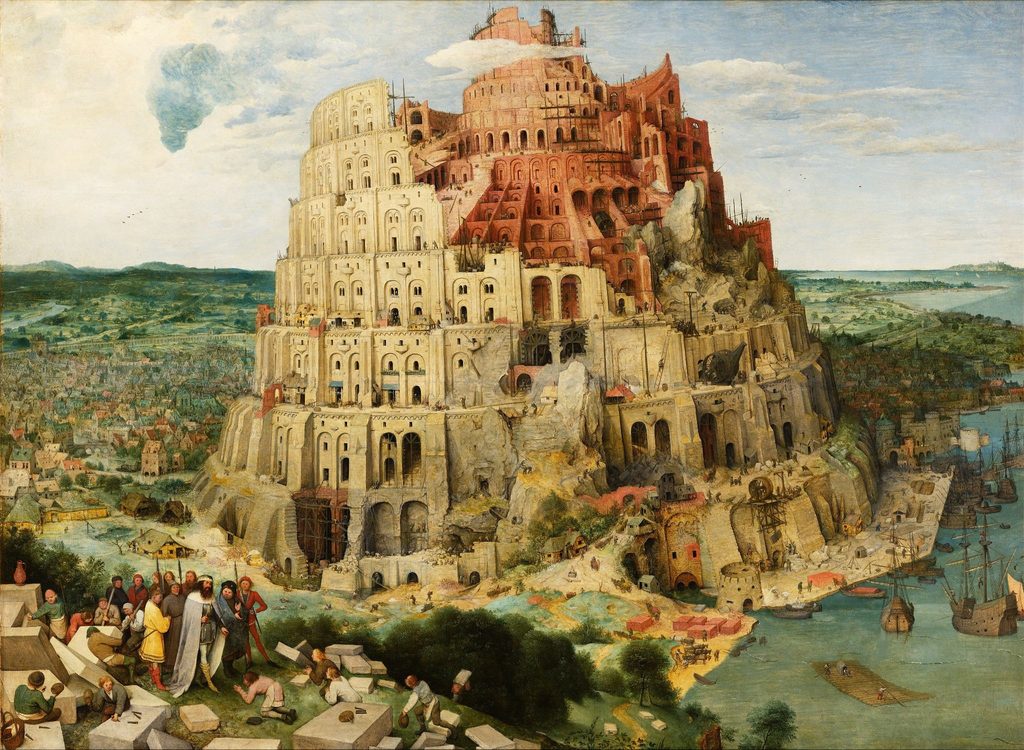
This collection reinterprets ten paintings—four by Bosch and six by Bruegel—through the lens of money. Fiat, the Latin expression for “let it be done,” serves as the structural theme. Nine of the titles issue distinct commands: let there be fury, profit, chaff, a game, folly, hunger, refuge, collapse, and ash. The final piece, Ultima Fiat, inverts that authority: let it be the last.
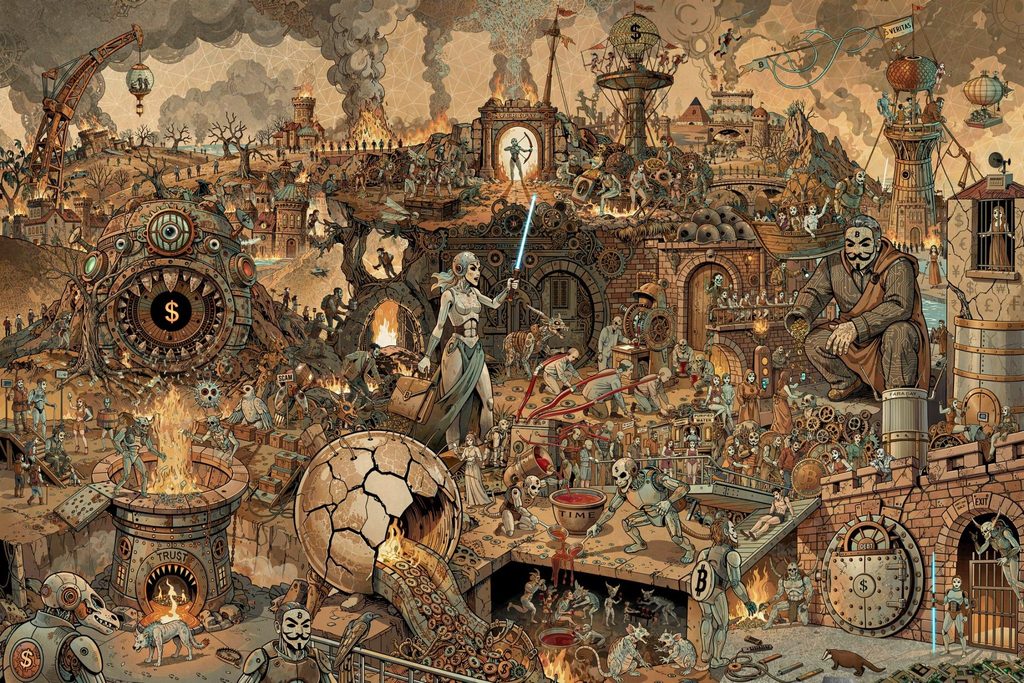
Launched on August 15, 2026, marking the anniversary of Nixon’s declaration, the project follows a biweekly rollout starting August 29 and finishing on January 3, 2027, which marks the anniversary of the Bitcoin Genesis Block. Every artwork features hundreds of characters and elements, with text details often discernible only upon close inspection. Measuring 30 by 20 inches, the prints are released in editions of ten, creating an overarching display nearly four meters long when set up across two rows of five.
Five pieces have already debuted, most recently Fiat Moria, inspired by Bruegel’s Netherlandish Proverbs, on October 24. The sixth installment, Fiat Fames, arrives on November 7.
Prior to Bitcoin Amsterdam on November 5–6, I spoke with Poletti regarding the ongoing inspiration drawn from Bosch and Bruegel in bitcoin art, the interplay between propaganda and allegory, and adapting his richly detailed creations for the main-stage LED displays at the conference.
BMAG: Bosch and Bruegel appear to experience a shared moment of renewed relevance among creators focused on Bitcoin. Both operated within present-day Belgium and the Netherlands during an era when Antwerp rose as a financial hub and the Habsburgs debased coinage. What drives artists back to Bosch, Bruegel, and their complex crowds during eras of transition like our own?
Lucho Poletti: Because they had already resolved the exact challenge I faced: how do you portray an entire society going off track simultaneously? Bosch and Bruegel packed hundreds of individuals into a single composition, each preoccupied with their private concerns. The system itself emerges from the aggregate of those actions. You do not simply look at a Bruegel piece; you scour it. It serves as an ideal method for illustrating the consequences of currency, which remains unseen by most yet felt by everyone.
They also navigated a monetary crisis remarkably similar to our own. Silver from the Americas flooded into Europe via Seville before reaching Antwerp bankers. Across Western Europe, prices multiplied sixfold over a century and a half. Philip II defaulted in 1557, triggering a continent-wide economic crash. Two years afterward, Bruegel painted Netherlandish Proverbs, depicting a village where everyone remains consumed by trivial pursuits while failing to perceive the bigger picture.
The four Bosch pieces focus on human appetite: the allure and the subsequent reckoning. The six Bruegels examine the collective crowd and societal behavior once established rules lose their meaning.
BMAG: The collection leverages the authentic definition of the word familiar to every bitcoiner. Nine titles apply fiat imperatively, whereas the tenth, Ultima Fiat, seems to flip that authority. How did Latin become the linguistic foundation for this project, and why does the speaker shift in the final decree?
Lucho Poletti: Fiat was never a noun. In Latin, it functions as a verb meaning “let it be done.” It represents the utterance spoken by God in the Latin Genesis prior to the appearance of light: fiat lux. An authoritative figure decrees it, and reality follows. That serves as a literal explanation of how fiat money comes into being, which is why I wanted the verb embedded in every title.
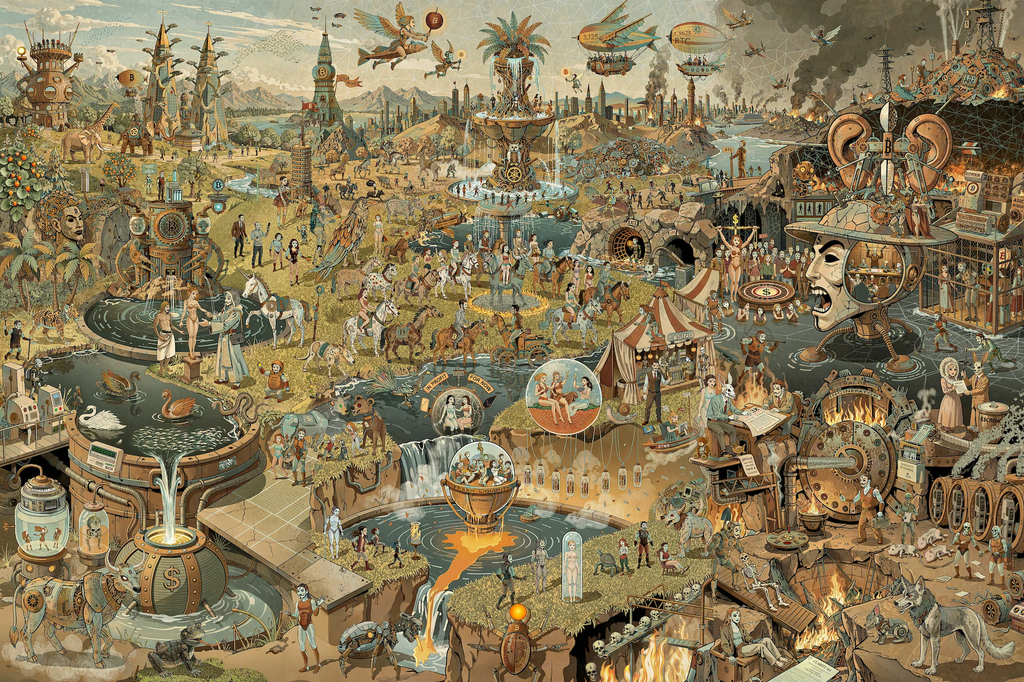
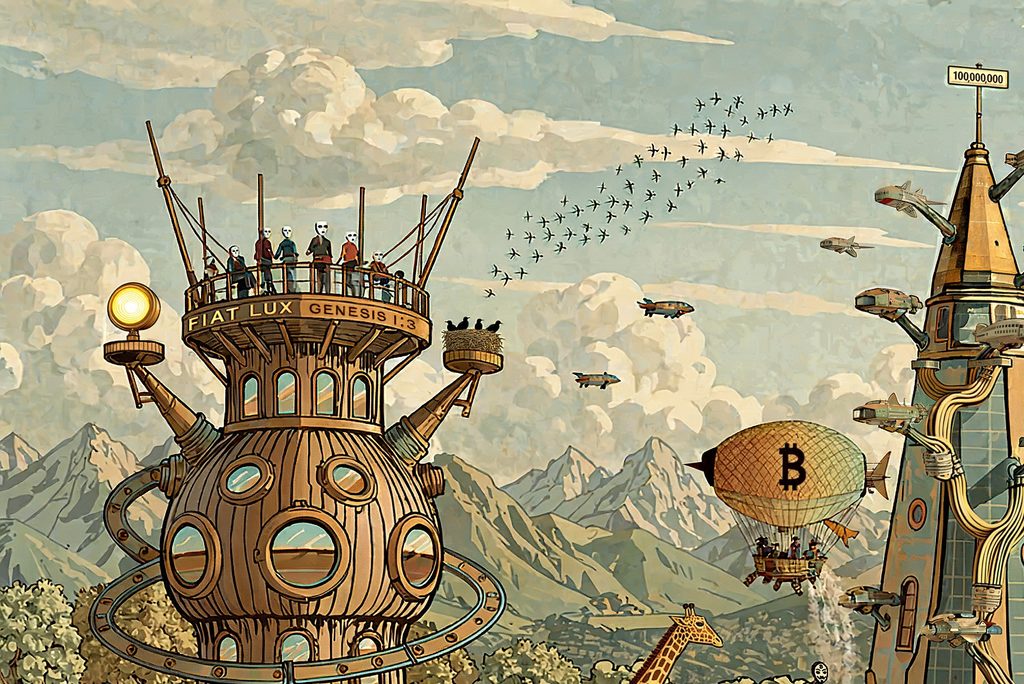
Using Latin felt natural to me. I have incorporated it into titles for years, including Moneta Divina, Cypher Deos, and Novus Moneta Seclorum dating back to 2020. The U.S. dollar already employs it as well. Flip a dollar bill over, and you find three Latin phrases on the back. Ultima Fiat, Fiat Lucrum, and Furia Fiat had their names established before the overarching series took shape. Once three conceptual decrees existed, I continued until reaching ten, making the collective title self-evident. Ten Decrees evokes the Ten Commandments, which fits art built out of painted sermons. In Fiat Lucrum, a lighthouse in the top-left corner features FIAT LUX GENESIS 1:3 inscribed on it. The title adapts the phrase for money creators: turning let there be light into let there be profit.
Nine of the decrees are directed at you using the indifferent tone typical of institutions. Let there be profit, let there be hunger, let there be a game. The tenth is the sole response we get to voice. Ultima fiat translates to “let it be the last,” which sounds closer to an entreaty than a command. Every one of us has existed under the first nine directives since 1971, regardless of whether we noticed, and Bitcoin provides our means of issuing the tenth. It brings the collection to a close on January 3, the Genesis Block anniversary, which also happens to be my birthday.
BMAG: Bosch and Bruegel crafted remarkably complex visual realms where satire, allegory, religious imagery, and daily life intersect. Their works reward careful observation while rarely providing a single definitive meaning. In Ten Decrees, you utilize their compositions while offering a more direct critique of the financial system. How do you balance ambiguity and message within your art?
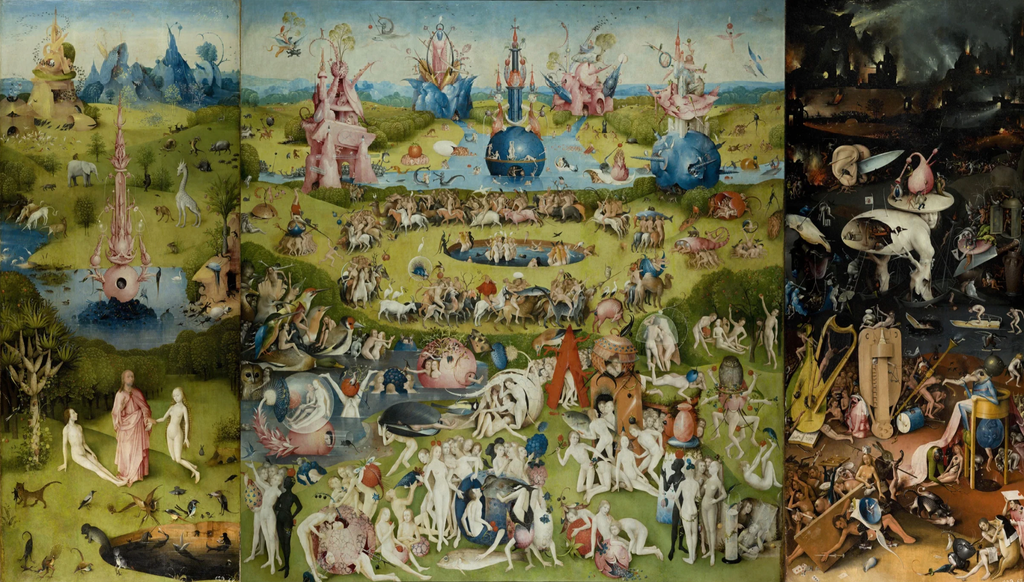
Lucho Poletti: The text carries the message so the audience doesn’t have to guess. Bosch’s Garden of Earthly Delights lacks a single written word. Fiat Lucrum contains over fifty lettered objects, some as direct as protest signs: four printing presses labeled QE-1, QE-2, QE-3, and QE-∞, alongside a handwritten card on a broker’s desk stating genius, we print, you pay, have a nice day. Nobody needs to wonder about my stance on the monetary apparatus.
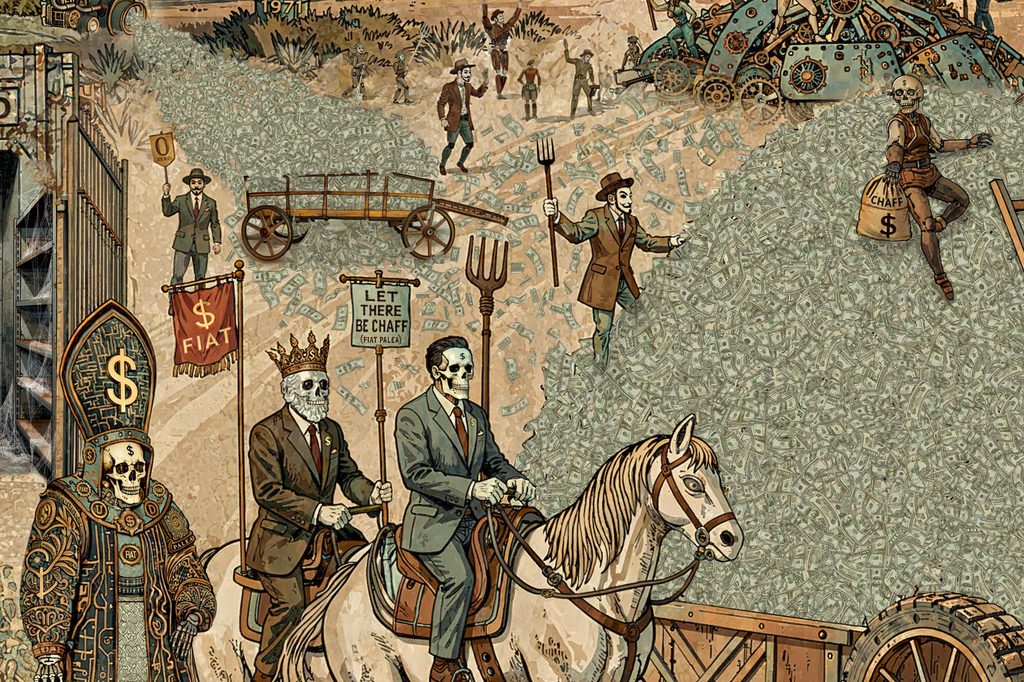
I maintain ambiguity within the human figures. In Fiat Lucrum, a crowd cheers a woman lifting a dollar sign on a golden staff under an ETF banner, and those individuals wear my mask. So does the man executing a leverage agreement, and the woman securing a mortgage. In Fiat Palea, a masked figure stands knee-deep amid heaps of printed notes. Bosch placed his own neighbors inside his garden scenes, and I included mine. If sporting a ₿ on one’s forehead signified sainthood, I would not distribute it so freely. It functions more as an indicator of awareness and initiation. Recognizing that the currency is broken does not make someone virtuous.
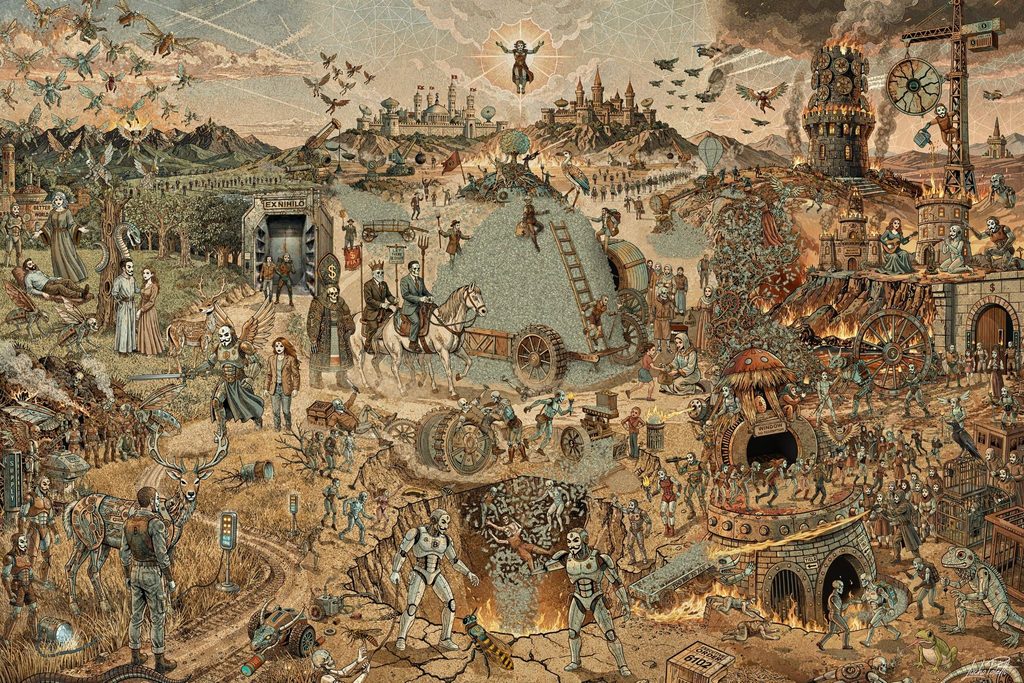
I approach conclusions with similar care. These pieces present an exit strategy without guaranteeing safe passage. Near the center of Fiat Moria stands an illuminated doorway bearing MONEY ₿ BETTER WORLD across the arch, accompanied by a plain-faced man on the steps gazing back toward the square. He has not stepped inside yet, and no one bars his way. Where you imagine yourself standing within that scene remains your decision.
BMAG: In Fiat Lucrum, your reworking of Bosch’s Garden of Earthly Delights, you incorporate a hydraulic infrastructure featuring pipes, reservoirs, and flowing liquidity. Bosch frequently enabled viewers to perceive elements hidden from his painted figures. What opportunities does this type of visual metaphor provide when depicting an abstract concept like the monetary system?
Lucho Poletti: Bosch’s original garden lacked plumbing, so I added some. Water governs the entirety of Fiat Lucrum. It originates clean high in the mountain left, emerges from an Edenic machine, and settles into a reflecting pool. Carved into the basin wall is an inspection window with fish swimming behind the glass. Someone installed an observation port into the reservoir to monitor conditions, mirroring how every full node on the Bitcoin network functions as that exact window.
Further downstream, the water expands into a lake. At its center floats a glass tank labeled FRESH LIQUIDITY with BOTTOMLESS engraved on the bowl, housing eight people enjoying themselves immensely inside. The valve regulating the flow sits atop the dome outside the glass, entirely out of their reach. Monetary policy gets determined by someone absent from the celebration. Moreover, the tank leaks. From there, the stream turns orange, cascading over a waterfall into a pool where a tick sporting a dollar sign on its cheek drinks through a tube.
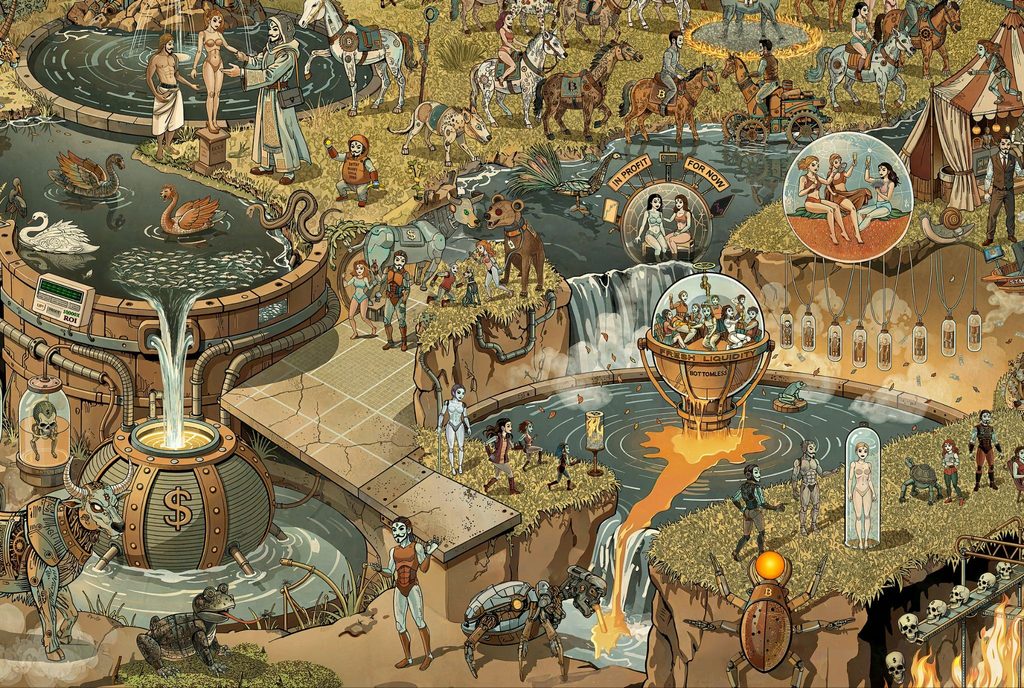
That illustrates the classic Bosch device you mentioned. The bathers remain blind to the leak and the valve, both of which are obvious to observers across the room. Richard Cantillon established around 1730 that newly minted money benefits early recipients while burdening the late arrivals. I illustrated it as a water flow because everyone understands waterways: whoever sits upstream drinks first, leaving whatever remains for those downstream.
BMAG: Across the entire collection, are there specific details, allusions, or artistic choices you consider crucial yet vulnerable to being missed by observers? What elements would you hope viewers examine more closely during their initial encounter?
Lucho Poletti: Close inspection is essential, as the most significant details are often diminutive.
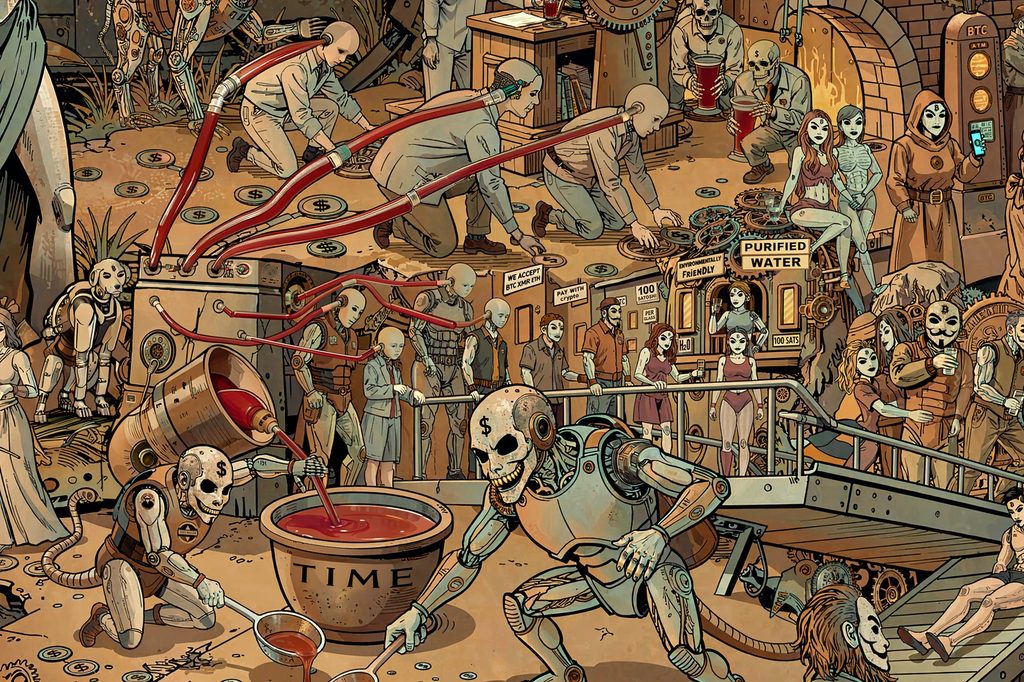
Consider the unmasked faces first. Everyone immediately notices the Satoshi masks and dollar-sign skulls because they dominate visually, but the plain faces represent the ordinary people affected by the system. In Furia Fiat, a row of bald men crawl on hands and knees with red tubing connected to the backs of their heads, matching the fluid color in a nearby bowl labeled TIME. That depicts what is being extracted from them. In Fiat Palea, Adam and Eve stand beneath a serpent featuring a dollar sign for an eye. They wear the mask, yet neither possesses a ₿ upon their brow.
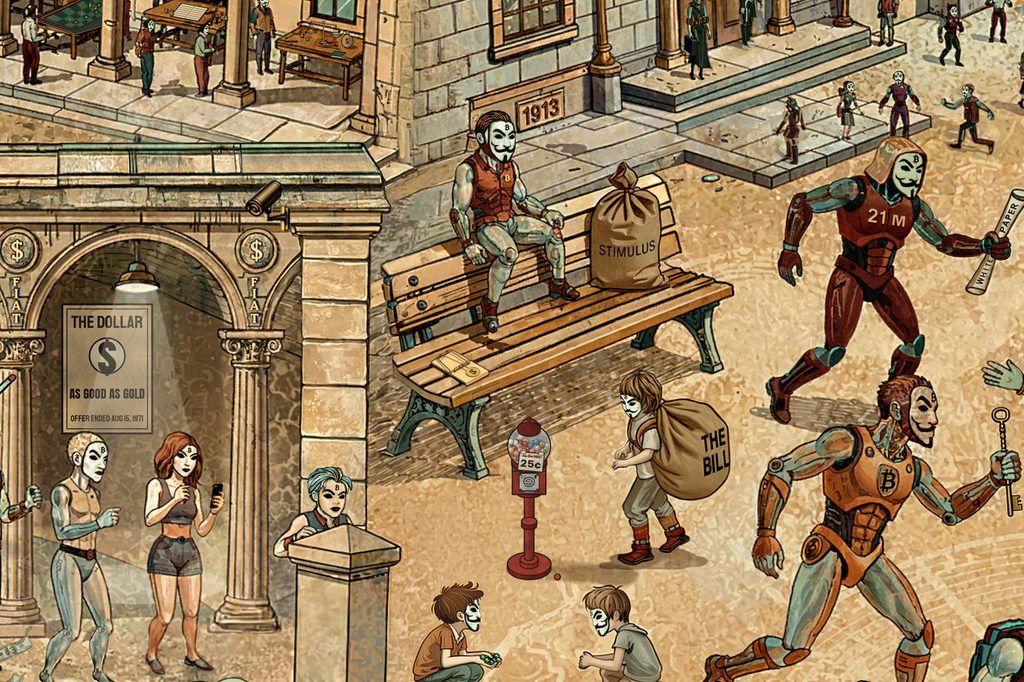
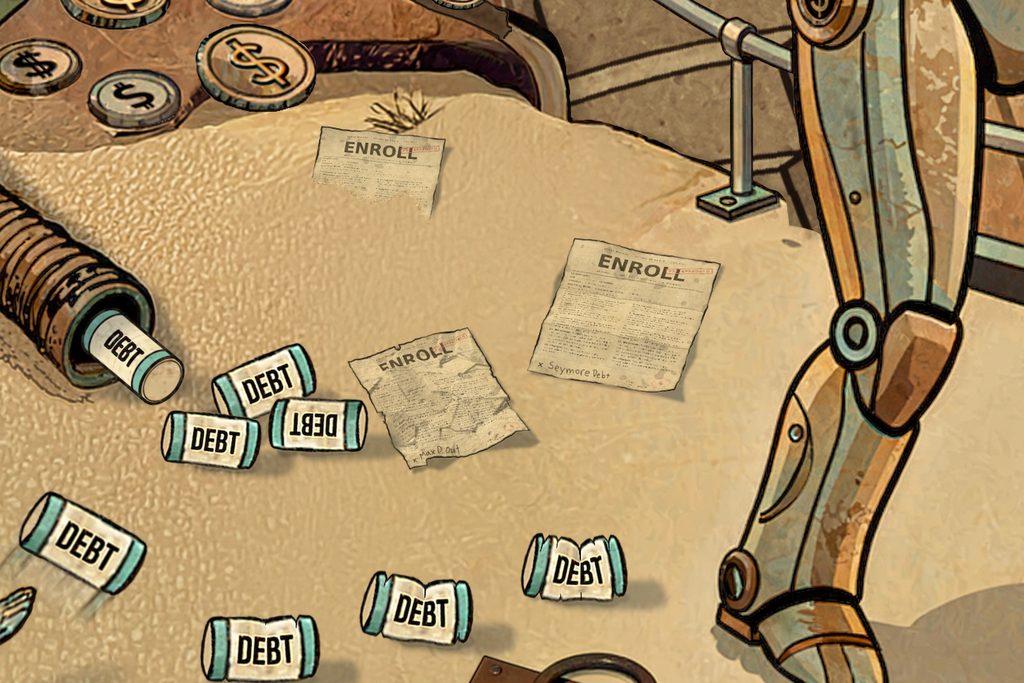
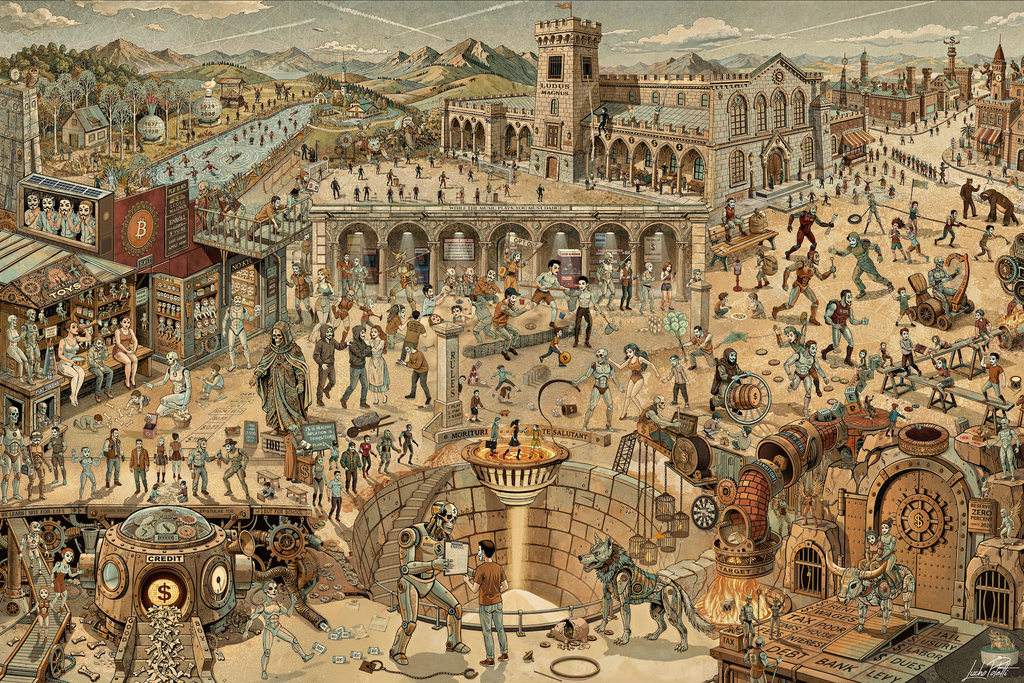
Observe how characters relate across distances. In Fiat Ludus, a sack marked STIMULUS rests on a bench beside an elderly figure, while nearby a child walks away carrying a matching bag labeled THE BILL. A blindfolded boy reaches out blindly while a lunging companion brandishes dollar-sign balloons hidden from the boy’s view. Even the registration documents bear signatures from Seymore Debt and Max D. Out.
In Fiat Palea, a broken crate stenciled EXECUTIVE ORDER 6102 lies amongst the straw, while further back, a plate bolted across a vault reads WINDOW, NO REDEMPTION. Roosevelt confiscated gold in 1933, and Nixon closed the gold window in 1971; placing these milestones near each other invites readers to connect them. Higher up in that same piece, a masked figure with WHOOPS written on his vest pours fuel onto a burning bank. In Furia Fiat, dollar-sign skulls stand atop GNOSIS clutching knowledge tomes, hoarding them for themselves.
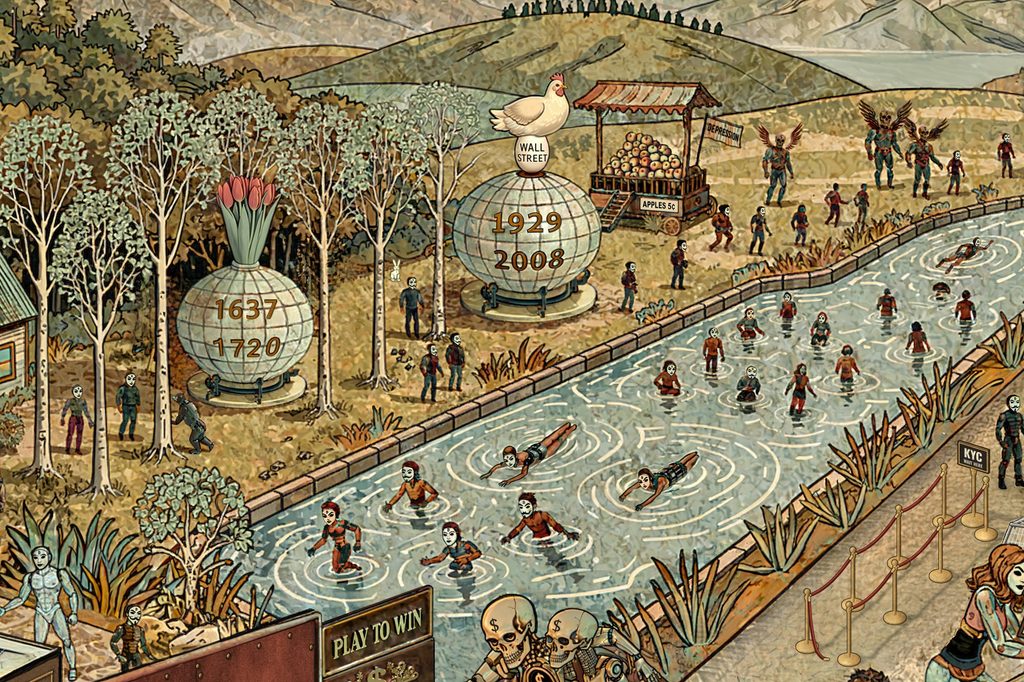
The spheres feature dates. Fiat Ludus displays a globe sprouting tulips marked 1637 and 1720, alongside another featuring a hen nesting on a WALL STREET egg stamped 1929 and 2008. Variety famously headlined the 1929 crash as WALL ST. LAYS AN EGG. Faint airplane condensation trails are visible across certain skies behind the smoke.
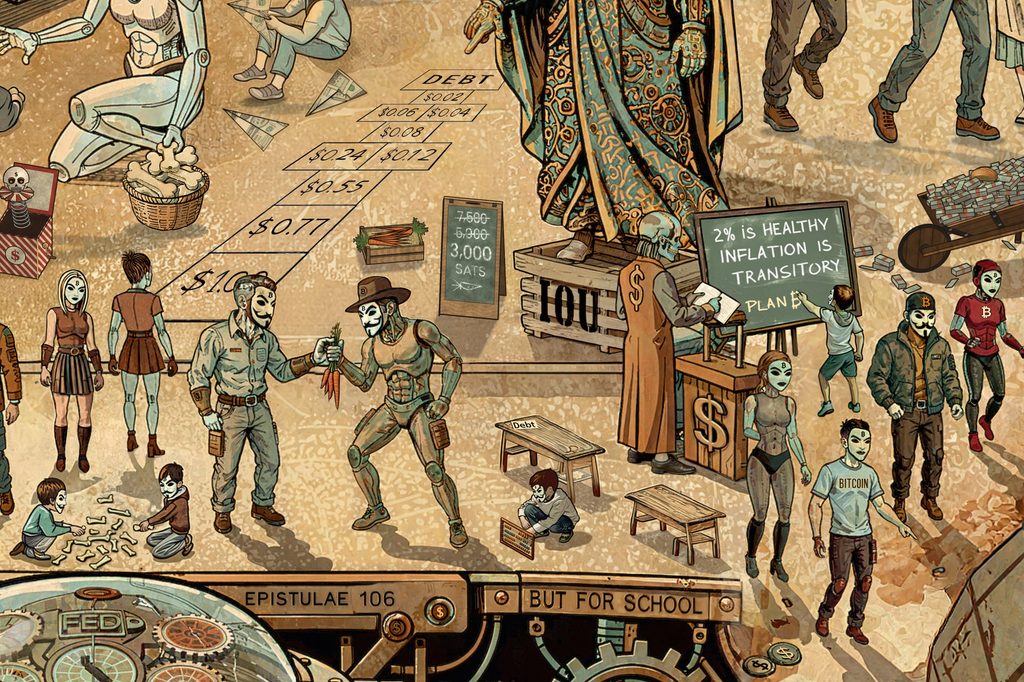
Track the pricing trends as well. Dollar-denominated prices continually climb: at CANTILLON’S hot dog stand in Fiat Ludus, 5¢ is crossed out in favor of $9. Conversely, satoshi-denominated prices drop: a fish stall in Fiat Moria displays 4000 crossed out, then 2000, settling at 1000 SATS. In Fiat Ludus, the chalkboard beside the dollar hopscotch shows carrot prices falling from 7,500 down to 3,000 SATS.
Latin inscriptions demand reading. MORITURI TE SALUTANT—those who are about to die salute you—is carved along the arena edge in Fiat Ludus. EX NIHILO, meaning out of nothing, appears over an empty vault in Fiat Palea. In Fiat Moria, a dollar-sign skull leaning from a window is flanked by plaques reading MUNDUS VULT DECIPI (the world wishes to be deceived) and $TULTORUM INFINITUS EST NUMERUS (the number of fools is infinite, utilizing a dollar sign for the S). Fiat Lucrum includes a small panel summarizing a lifetime across four stages: school, debt, employment, and death.
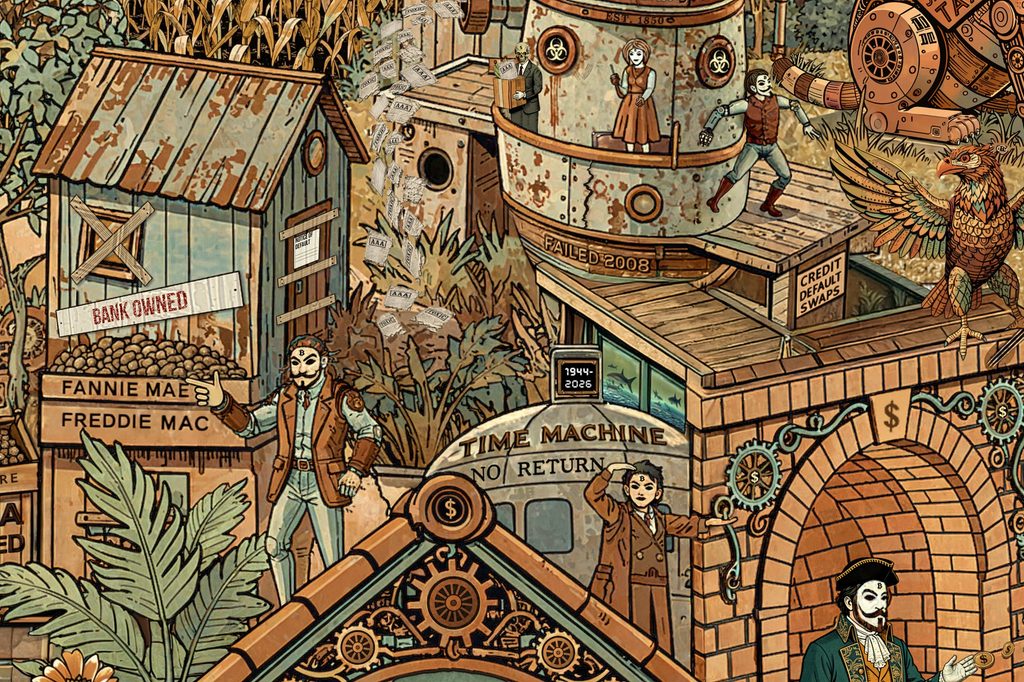
Within Fiat Moria, a compact circular time machine marked NO RETURN carries the dial numbers 1944-2026. A figure climbs out, staring in disbelief at the village. 1944 marks Bretton Woods, when global currencies tied to the dollar and the dollar to gold. Having departed then and arrived only now, he struggles to process his surroundings.
None of these elements are explained by captions. Discovering them requires lingering close to the canvas, much like viewing a Bruegel piece, and the act of discovery remains paramount.
BMAG: Each print spans 18,000 pixels across, packed with hundreds of figures, featuring manually drawn Satoshi masks alongside nuanced details revealed only upon closer inspection. You characterized the collection as “crafted, not generated.” In an era where AI can convincingly replicate Old Masters, what value does manual labor hold for you, and how does it influence audience engagement?
Lucho Poletti: “Crafted, not generated” represents how these pieces take shape. Technology plays a role in my pipeline, but it forms only a single phase. A model trained on my historical art handles the preliminary compositional draft, acting as an apprentice. Bosch emerged from a family workshop, relying on assistants for foundational preparation so masters could concentrate on conceptual meaning. My AI generates an initial rough layout providing a base toward the desired standard. Afterward, I dedicate weeks to intensive manual Photoshop work, making deliberate choices and drawing countless figures, objects, text, and symbols until the artwork conveys my exact intent.
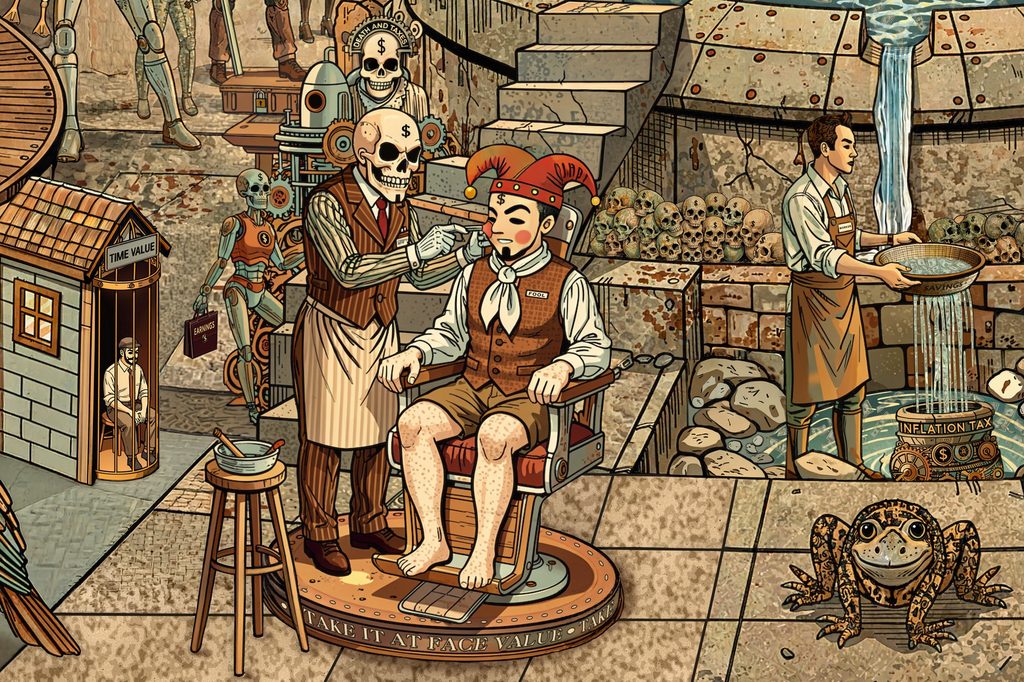
While AI can mimic the aesthetic of Bosch or Bruegel skillfully, it lacks the capacity for genuine meaning. It will never decide that the liquidity valve in Fiat Lucrum should sit outside the glass away from bathers, nor determine that ground refuse should consist of piggy banks wired into printing presses labeled SAVINGS, PENSION, and NEST EGG. It fails to generate humor. It will never seat a jester on a platform reading TAKE IT AT FACE VALUE while a dollar-sign skull applies his makeup. My personal rule dictates that if I fail to execute the majority of the labor, the result is not my art. I hold myself accountable to that standard, allowing anyone inspecting the details to recognize human decision-making at work.
That reflects how I hope audiences experience these pieces: closely and patiently. I do not demand blind trust regarding their creation; the craftsmanship speaks for itself.
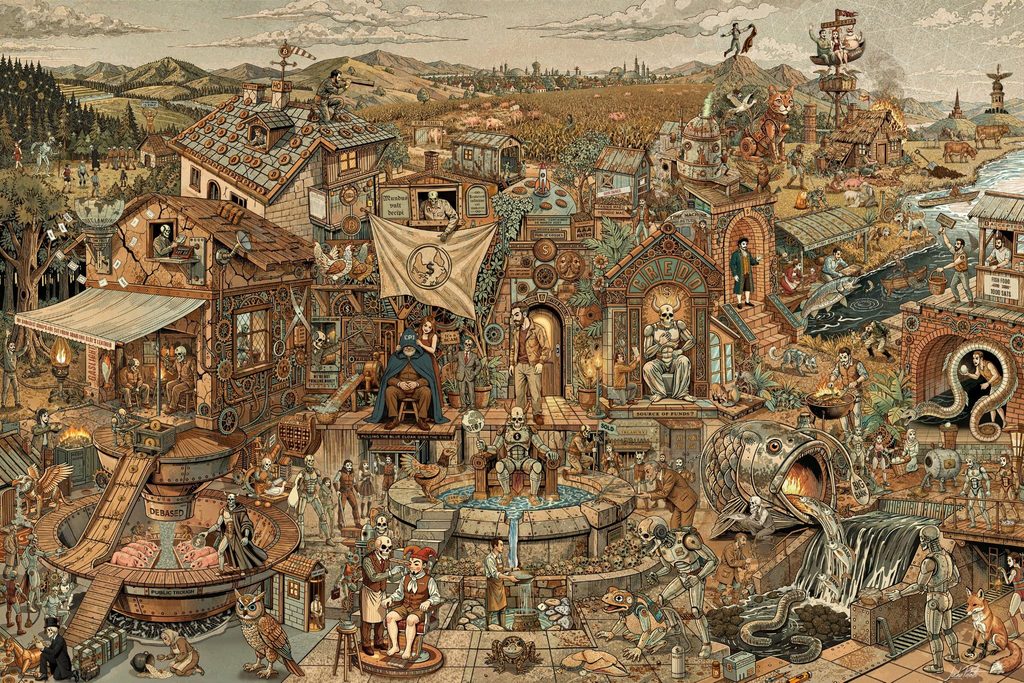
BMAG: Having participated in the Bitcoin Conference since 2021, you are now bringing Ten Decrees to the main stage at Bitcoin Amsterdam this November, near the historical roots of Bosch and Bruegel. Given that these intricately detailed works reward close inspection, how are you approaching their adaptation onto monumental LED displays, and does exhibiting them in the Netherlands hold special meaning?
Lucho Poletti: The physical prints target individual viewers standing close to explore personalized details. Conversely, an LED wall addresses thousands of people across fifty meters, presenting an incredible opportunity to stage a visual spectacle for static imagery, so I developed a compelling presentation format.
Each artwork runs for fifteen seconds in chronological release order. The central display scrolls slowly across the middle of each piece from left to right, conveying the overall composition. The right-side screen starts with the historical Bosch or Bruegel painting and its metadata before transitioning midway to my interpretation. The left-side screen highlights peripheral details typically missed from a distance, such as the ship of fools on the mast in Fiat Moria or pigs feeding at the DEBASED trough. All five released pieces play sequentially in a continuous loop, juxtaposing old masters with new money throughout.
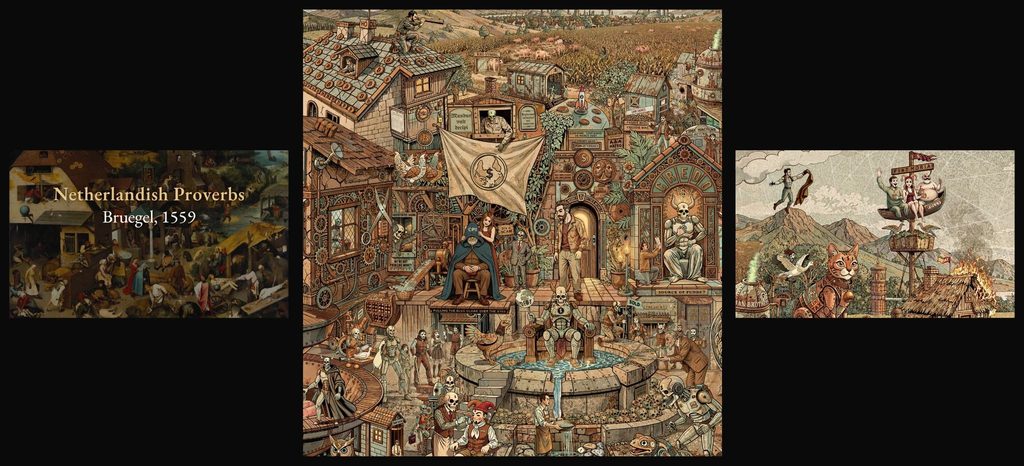
The Netherlands holds genuine personal significance. Bosch lived his entire life in ’s-Hertogenbosch, situated roughly an hour south of Amsterdam by train. Several Bruegel proverbs persist in modern Dutch phrasing, such as turning one’s cloak with the wind when following the crowd; in Fiat Moria, a masked Satoshi figure leaps off a mountain clutching his cloak as an allusion to this Dutch idiom.
Amsterdam possesses its own unique historical chapter in this narrative. The Bank of Amsterdam launched in 1609 to offer merchants incorruptible currency, and for over a century, its guilders traded at a premium over standard coinage because citizens trusted the silver remained secured in vaults. David Hume praised it as a model for fully backed banking. However, it had secretly extended loans to the Dutch East India Company; when this disclosure emerged in 1790, the premium evaporated and the institution declared insolvency. I cannot imagine a more fitting venue to showcase a series addressing monetary decrees and trust, arriving two months prior to the final piece’s debut on the Genesis Block anniversary.
Exhibition & Further Reading
Lucho Poletti’s Ten Decrees will be displayed on the main stage at Bitcoin Amsterdam on November 5–6, 2026, as part of the Bitcoin Museum & Art Gallery (BMAG) presentation. Explore Poletti’s detailed write-ups on each Decree for deeper context regarding the art, symbolism, and historical references throughout the series, and connect with him on X.
Read additional pieces from BMAG’s Bitcoin Amsterdam lineup: The Undercurrent: Three European Artists on Making Money Visible and The Architecture of Money: Mapping Financial Power in the Age of Bitcoin.
The Bitcoin Museum & Art Gallery (BMAG) coordinates global exhibitions, auctions, and artist partnerships investigating bitcoin and its cultural impact.
Join us at Bitcoin Amsterdam on November 5–6, 2026, and apply discount code BA26-BMAG20 for reduced registration rates. Secure your passes here.
Originally published at https://bitcoinmagazine.com/culture/ten-decrees-old-masters-new-money.