Wall Street is re-evaluating the artificial intelligence data center expansion following the Democratic sweep in Tuesday’s midterm elections, which included an unexpected gubernatorial victory in Texas that threatens to stall multibillion-dollar initiatives.
Regarding bitcoin BTC miners who have transitioned into artificial intelligence, the primary worry is whether they will manage to acquire the electricity required to construct fresh data centers. Enterprises that have already secured electrical power might find themselves in a significantly stronger position.
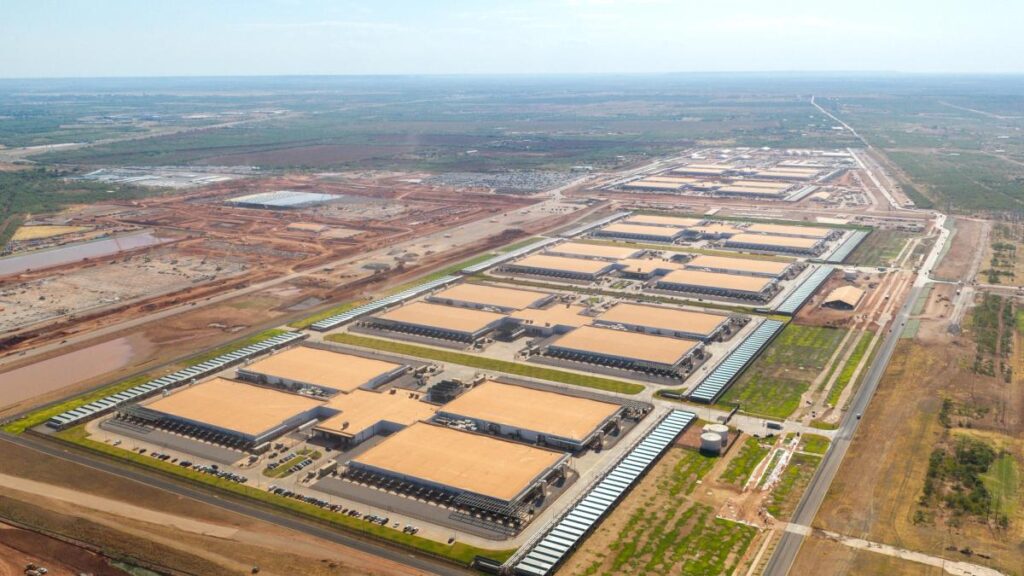
Texas is the epicenter of these anxieties.
Democratic candidate Gina Hinojosa triumphed over the Republican incumbent Greg Abbott, who had been heavily favored to win. Hinojosa aims to freeze new data center authorizations until Texas establishes regulations to shield citizens from elevated electricity and water expenses.
Goldman Sachs projects that jurisdictions likely to impose stricter data center guidelines represent roughly 45% of planned capacity across the United States, with Texas alone accounting for approximately 25% of that aggregate. SemiAnalysis positions Texas at nearly 30% of the capacity slated to launch by 2028, according to Bloomberg data referenced by analyst Neil Sethi.
Technology equities experienced an initial downturn as election outcomes emerged. Nasdaq-100 futures dropped around 1.5% overnight prior to rebounding on Wednesday morning.
Nevertheless, analysts do not anticipate the vote to bring data center development to a complete halt. The principal concern is that projects will encounter extended approval timelines and elevated construction expenses.
Libby Cantrill of PIMCO forecasts “considerably more friction,” even absent statewide prohibitions, based on Sethi’s compilation of market responses.
Goldman Sachs economists predict that Democratic officials in Texas, Georgia, and Michigan will institute temporary moratoriums on fresh data centers while legislators contemplate stricter controls concerning electricity and water usage alongside tax incentives. Still, they anticipate these limitations will be short-lived, arguing that data centers do not rank among primary voter concerns.
What it means for bitcoin miners
Bitcoin miners spent the past couple of years trying to leverage their low-cost power access and expansive industrial properties into AI hosting ventures. Texas has served as the anchor for those strategies.
Gautam Chhugani, senior analyst at Bernstein, noted that over half of the power capacity controlled or planned by the miner-turned-AI operators evaluated by his firm is located in Texas.
Investors previously anticipated that Abbott would relax restrictions on new data centers post-election, provided developers satisfied certain criteria. Hinojosa’s win alters that equation.
“We would expect the data center pause to continue and any data center potential legislation to remain in gridlock,” Chhugani stated in an analytical report.
That outcome does not imply that every miner operating in Texas faces distress. Chhugani explained that enterprises possessing pre-approved power might actually benefit if novel regulations complicate grid interconnection for rival developers.
IREN IREN, Riot Platforms RIOT, and Cipher Mining CIFR hold the heaviest Texas concentrations among the firms tracked by Bernstein. However, all three also boast authorized power capacities measured in gigawatts, which Chhugani remarked “may be considered scarce and valuable.”
Morgan Stanley drew a comparable differentiation between ongoing initiatives and those awaiting clearance.
In a Wednesday bulletin, a team of analysts headed by Stephen Byrd highlighted Cipher Mining, MARA Holdings MARA, and Galaxy Digital GLXY as confronting heightened ambiguity within Texas. The financial institution stated it would re-examine the outlooks for Cipher’s Colchis location, Galaxy’s Helios II initiative, and MARA’s expansion objectives.
Morgan Stanley views TeraWulf WULF, Hut 8 HUT, and Applied Digital (APLD) as better equipped to navigate constrained electricity reserves. TeraWulf bears minimal exposure to shifts in Texas mandates, whereas Hut 8 could gain advantages if developers relocate initiatives to Louisiana.
Riot presents a more complex assessment. Its active grid connections in Corsicana and Rockdale could appreciate in worth, Morgan Stanley noted, yet ambitions to expand data center capacity at those properties might still encounter obstacles.
Bernstein slashes price targets
Bernstein is not waiting to observe how the emerging mandates unfold. The institution reduced its price targets across seven bitcoin miners, attributing the move to tighter financing markets and lingering uncertainty regarding future developments in Texas.
“In the view of tighter financing markets and overall Texas uncertainty, we now value AI colocation business at 12x EV/one year forward EBITDA on CY30E EBITDA,” Bernstein indicated.
Stated differently, Bernstein is assigning a diminished valuation to the revenue streams miners anticipate producing by leasing out data center space and power infrastructure to artificial intelligence clients.
The organization dropped its price target for Cipher Mining down to $15 from $23 and IREN to $55 from $100. TeraWulf’s objective sank to $20 from $36, while Core Scientific CORZ was adjusted to $19 from $32.
Additionally, Bernstein lowered Riot’s goal to $18 from $35, MARA’s to $10 from $17, and CleanSpark’s CLSK to $11 from $24. These reductions span approximately 35% to 54%.
Conversely, not everyone across Wall Street interprets construction deceleration as a negative development for the AI sector.
Rich Privorotsky, a strategist at Goldman Sachs, observed that AI equities had already experienced extensive liquidation ahead of the vote. He suggests certain corporations might accelerate capital expenditures into 2027 to initiate initiatives before new regulations take effect.
Furthermore, if fewer data centers achieve completion, those already functioning could appreciate in value.
Pershing Square likewise argued in favor of sustained AI commitments within its November 2 investor correspondence. The entity pointed out that Microsoft, Meta, Amazon, and Google are projected to disburse approximately $740 billion toward capital ventures this year, climbing from roughly $140 billion in 2023. That figure could surpass $1 trillion by 2027.
For bitcoin miners, however, the central issue remains capturing a share of that spending. Enterprises featuring operational sites, cleared electricity, and executed AI hosting agreements retain an advantage. Those relying on upcoming grid links could confront multi-year delays.
AI Disclaimer: Parts of this article were generated with the assistance from AI tools and reviewed by our editorial team to ensure accuracy and adherence to our standards. For more information, see CoinDesk’s full AI Policy.
Originally published at https://www.coindesk.com/markets/2026/11/04/wall-street-cuts-bitcoin-miner-price-targets-after-democrats-texas-win-threatens-ai-data-center-boom.