Updated Nov 14, 2026, 11:00 a.m. EST. Published Nov 14, 2026, 7:57 a.m. EST.
3 min read
Summary
- Market makers’ negative gamma exposure could make bitcoin and ether more volatile.
- They may sell as prices fall and buy as prices rise.
- Above about $73,000, bitcoin’s gamma exposure turns positive, so market-maker hedging could reduce volatility, but this can change quickly.
Bitcoin (BTC $64,139.70) and ether (ETH $1,767.58) could encounter more intense price fluctuations as options market makers’ risk management threatens to exacerbate both sell-offs and surges, according to metrics from Greeks.Live.
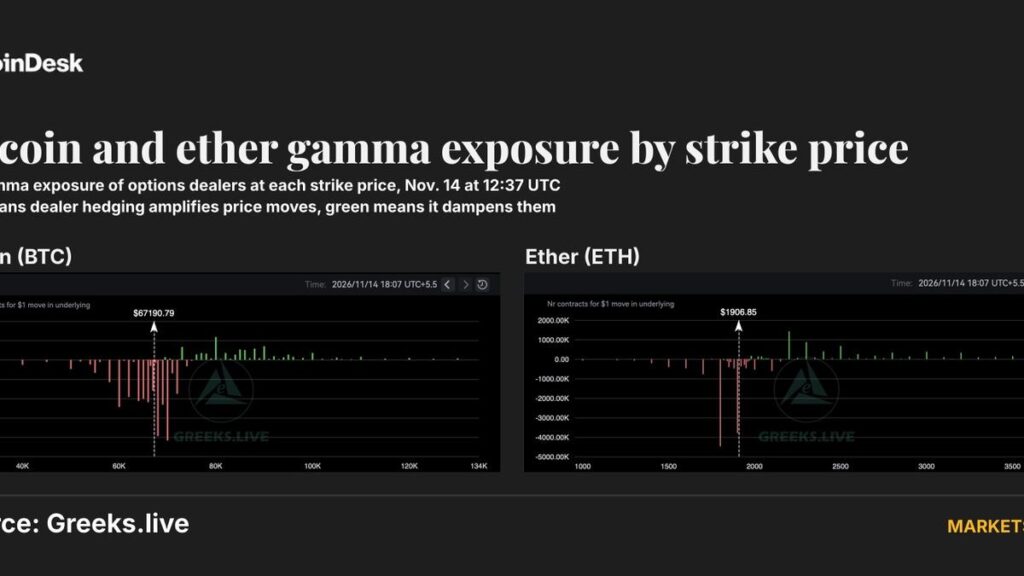
The options market for bitcoin displays negative gamma exposure, or GEX, throughout much of its existing trading band, with the heaviest concentrations centered near $68,000 and $70,000, based on the options platform. Ether demonstrates a comparable trend. Gamma exposure tracks the net gamma within market makers’ portfolios; positive GEX indicates dealers are net long gamma, which dampens the market through their hedging, whereas negative GEX shows dealers are net short gamma, which heightens volatility via their hedging activities.
This positioning can compel market makers to unload bitcoin or ether as prices drop and purchase assets as values climb, reinforcing the market trend rather than softening price movements. This impact might also spill over into leveraged futures markets, where sudden price shifts can spark mandatory liquidations.
“Both Bitcoin and Ether have slipped into deep negative gamma territory,” Adam, a macro analyst at options platform Greeks.Live, told CoinDesk. “Deep negative GEX means dealers are net short options—largely driven by traders bidding up downside puts or chasing breakout calls. To stay hedged in a short-gamma regime, dealers must trade with the prevailing momentum, not against it.”
Options represent contracts granting participants the privilege to purchase or dispose of an asset at a predetermined price. Call options benefit when prices appreciate, while put options generally increase in worth when values decline.
Market participants known as market makers frequently take the opposite side of these transactions, generating profit via the spread between acquisition and disposal prices. To mitigate their exposure to directional market movements, they acquire or liquidate bitcoin, ether, or futures contracts as valuations shift.
Whether those transactions attenuate or intensify volatility relies in part on their gamma exposure.
When dealers maintain short gamma positions, they typically need to offload assets during declining markets and acquire them during advancing markets to keep their hedges balanced. Positive gamma generally yields the inverse outcome, prompting dealers to buy market dips and liquidate during rallies.
The bitcoin GEX diagram from Greeks.Live highlights this danger. At 12:37 UTC Saturday, with bitcoin trading around $67,191, negative gamma spanned roughly from $58,000 to $72,000. The heaviest clusters were positioned near $68,000 and $70,000.
Such negative exposure implies that dealer hedging behavior might introduce extra selling pressure should bitcoin decline further, though it does not guarantee prices cannot discover support at lower levels.
The ether graphic from Greeks.Live similarly displayed negative gamma surrounding the asset’s current valuation.
The possibility for more severe movements extends into perpetual futures, which are derivative agreements lacking expiration dates that permit participants to establish leveraged positions. Adam cautioned that even a minor downturn could instigate liquidations, forcing trading venues to terminate losing positions and potentially contributing to additional selling.
The identical mechanism functions in reverse. A price surge in bitcoin or ether could encourage market makers to acquire higher volumes of the underlying assets or futures contracts, giving additional momentum to the upward trend.
Regarding bitcoin, the chart from Greeks.Live demonstrated gamma shifting to positive territory above approximately $73,000. Entering that price bracket could alter the hedging mechanics, with dealers potentially offloading assets during rallies and purchasing during pullbacks instead.
“Until BTC and ETH reclaim their respective ‘gamma flip’ levels—the price threshold where dealer positioning turns positive again—expect fragile order books, exaggerated intraday wicks, and momentum-driven price action.”
Related Assets
Originally published at https://www.coindesk.com/markets/2026/11/14/a-behind-the-scenes-force-may-amplify-bitcoin-and-ether-price-volatility.