Both the cryptocurrency sector and Wall Street might experience a robust rally following the November 3 U.S. midterm elections, assuming historical patterns hold true.
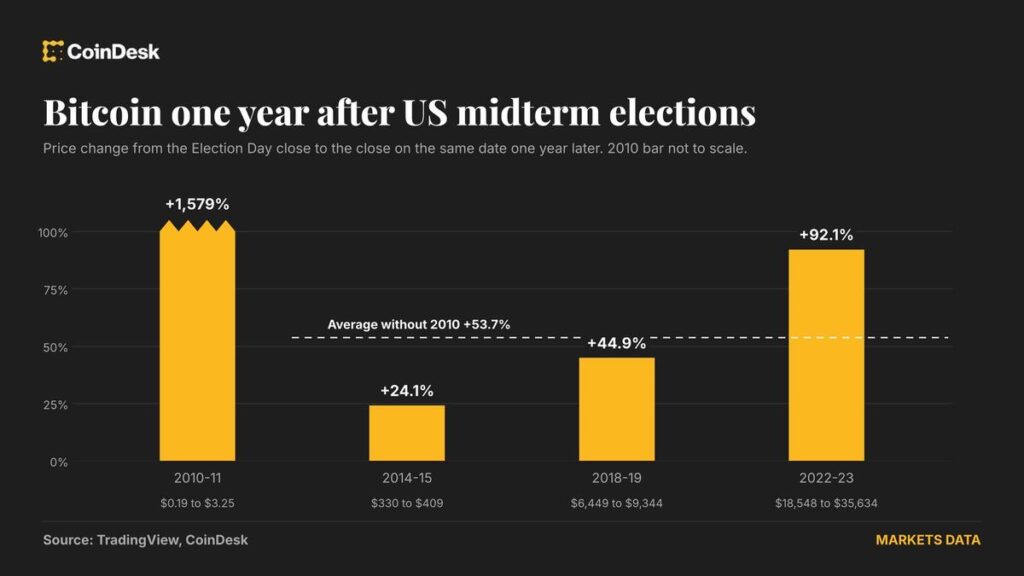
Ever since its inception back in 2009, bitcoin BTC$64,631.57, which stands as the leading cryptocurrency by market capitalization, has gone through four midterm cycles. Omitting the year 2010 when the ecosystem was extremely small and peripheral, the remaining three instances saw the asset’s valuation climb by an average of 53.7% over the course of the 12 months succeeding Election Day, based on research conducted by CoinDesk. These returns measure the percentage increase comparing the daily closing price at 00:00 UTC on Election Day against the close exactly one year later.
Bitcoin rocketed by 1,579% during the 12-month window after the 2010 midterms, yet that market was too nascent and compact for that specific metric to be considered dependable.
Should history repeat itself, the current quiet price behavior of bitcoin hovering near $80,000 could set the stage for another upward push past November 3. BTC has already rebounded more than 35% after hitting a low beneath $60,000 in June. Certain market observers argue that now is the time to buy and hold crypto, given that a fresh bull market appears to be underway.
Politics or halving cycle?
Nevertheless, historical records remain too sparse to formulate definitive conclusions, and the post-midterm price rallies observed in BTC throughout the years may relate more closely to the four-year schedule than to American politics.
Bitcoin typically operates in cycles lasting roughly four years, centered around the mining reward halving, which is a built-in mechanism within the Bitcoin network that cuts the quantity of newly minted BTC issued to miners in half every four years.
Following each of the four halving events completed thus far, BTC experienced aggressive surges, reached a peak between 12 and 18 months afterward, and subsequently descended into a bear market. Those bearish phases happened to coincide with midterm years—specifically 2014, 2018, 2022, and now 2026. Consequently, the recovery succeeding the midterms could simply mark the initiation of a brand new cycle rather than the influence of political events.
S&P 500 has a long bullish history
The S&P 500 features an extensively longer track record, and it also trends upward, offering an encouraging signal for bitcoin along with other speculative assets.
Starting from 1950, the index has registered an average increase of 15.17% during the year following midterms, compared to just 7.30% during all other years, according to data from Hartford Funds.
What’s at stake this time
The elections in 2026 possess the potential to alter how President Donald Trump functions throughout the remainder of his term in the White House.
If the Democratic party captures one or both houses of Congress, political friction regarding the massive national debt could escalate, seeing as the debt ceiling issue remains unresolved and future negotiations regarding it might grow complicated. Trump’s demand for $350 billion dedicated to mandatory defense appropriations might face severe resistance, according to Brookings. Furthermore, Democrats might leverage legislative barriers to halt funding allocated for escalations in the Middle East.
Regarding the digital asset sector, Democratic committee leaders could initiate investigations into potential conflicts of interest linked to personal financial gains Trump has made through crypto. Democratic politicians have already dispatched oversight inquiries concerning the president’s connections to digital assets and familial business endeavors. Additionally, the memecoin launched by Trump back in January 2025 has resulted in substantial financial damage for retail traders.
Even so, the Supreme Court decision in Trump v. Slaughter preserved executive oversight over the majority of financial regulatory bodies, meaning Congress will likely struggle to obstruct the administration’s supportive stance toward cryptocurrencies.
At present, financial markets have largely factored in a divided federal government, with projections pointing toward Democrats reclaiming at least a single congressional chamber.
Originally published at https://www.coindesk.com/markets/2026/10/28/bitcoin-averages-over-50-in-the-12-months-after-midterms-s-and-p-500-gains-15.