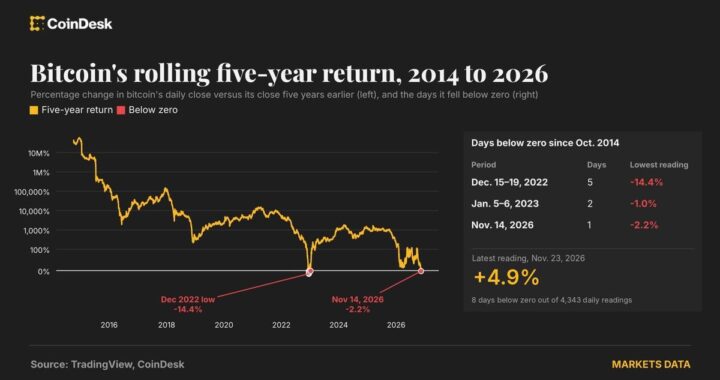
Bitcoin dropped to a cycle trough close to $55,100 during the weekend amid persistent risk-off attitudes, macroeconomic challenges, and a stock market correction driven by artificial intelligence equities.
Spot bitcoin exchange-traded funds based in the United States recorded roughly $1.79 billion in net withdrawals through the past week, marking the biggest weekly redemption since the week concluding on June 26, 2026.
SoSoValue metrics indicate this represented the fourth straight week of negative flows for the investment vehicles, with BlackRock’s iShares Bitcoin Trust (IBIT) driving the redemptions by shedding $1.37 billion all by itself during the period.
Throughout the current month, about $4.14 billion has departed bitcoin ETFs, trailing the record monthly net exits seen in June. Combined net assets held within bitcoin ETFs stood at $71.35 billion as of Friday, contracting from approximately $110 billion in mid-September.
Spot ether Ethereum (ETH) exchange-traded funds likewise registered $314 million in weekly redemptions, extending their negative streak to eight consecutive weeks.
Rick Maeda, who leads markets at Laevitas, mentioned to The Block that current net outflows mostly mirror portfolio risk reduction among market participants. Maeda noted that profit-taking usually follows upward price runs, but these withdrawals have materialized inside a descending market, with BTC tumbling from roughly $80,000 at the beginning of the month down to the low $60,000 range.
Bitcoin Bitcoin (BTC) declined to a cycle low near $55,700 over the weekend amid ongoing risk-off sentiment, macroeconomic headwinds, and an artificial intelligence stock sell-off. The Nasdaq Composite retreated around 10% last week, while the S&P 500 gave up 8.6% as controversy surrounding former Nvidia CEO Jensen Huang triggered broader worries regarding the durability of the AI sector. The Block’s Bitcoin Fear and Greed Index presently registers 11, denoting extreme fear.
Maeda further explained that because crypto occupies the farthest edge of the risk asset spectrum while simultaneously confronting its own specific challenges like quantum computing threats and security breaches, it has become an easy holding for investors to purge from their portfolios.
Structural outflows
Dan Khus, head analyst at LVRG Research, pointed out that the ongoing ETF outflow sequence appears significantly more structural than prior instances of capital flight.
Khus stated that unlike previous withdrawal phases that tended to be brief and directly reactive to isolated occurrences, this four-week stretch looks inherently structural, aligning with persistent price suppression, elevated liquidation volumes, and an institutional pivot toward capital preservation.
Analysts observed that risk-averse participants are backing away from digital asset instruments due to expectations that the Federal Reserve will implement another interest rate increase in December. BTSE COO Jeff Mei noted that the upcoming U.S. Personal Consumption Expenditures Price Index report, set for release this Wednesday, might provide clues about how persistent inflation remains and whether the Federal Reserve will move forward with a December rate hike.
Dominick John, an analyst at Zeus Research, stated that bitcoin and ether exchange-traded funds might encounter additional redemptions as rate-increase anxieties and suppressed risk appetite continue to pressure institutional demand. John added that bitcoin will likely show greater resilience, whereas ether deals with stronger downward pressure, and emphasized that a lasting recovery will rely on the easing of macroeconomic anxieties alongside renewed capital inflows.
Originally published at https://www.theblock.co/news/markets/2026-11-23-spot-bitcoin-etfs-shed-1-79-billion-in-past-week-444857.