Many people in the sector assume that cryptocurrency will naturally become the go-to payment method for independent artificial intelligence agents. The reasoning is that because AI bots lack the ability to open traditional bank accounts and must execute numerous payments, they will inevitably gravitate toward decentralized, instant, and inexpensive crypto transactions.
Yet, the credit card sector has no intention of permitting that outcome.
The Wall Street Journal reported on Nov. 19 that AI agents are already leveraging credit cards to purchase items for users, prompting financial institutions and payment processors to scramble to support them. Digital asset trader and co-host of the 1000x show Jonah Van Bourg shared a screenshot and commented:
“Agents will not use crypto rails. The book is closed on blockchain as a solution, outside of niche back office applications. Its only use cases are sov, privacy, and ledger stuff. Sad.”
Nevertheless, specialists suggest the debate remains open. David Krause, professor emeritus of finance at Marquette University, informs Magazine that while plastic offers distinct benefits, steep costs could prove problematic in certain contexts.
“Credit cards were built for a world where a human decides to pay, so when an agent pays $0.005 for an API call, the fixed fees on card rails are 50x the transaction itself.”
He notes that stablecoins make far greater sense when dealing with micropayments.
The payment rail depends on what the agent is buying
Credit card transactions serve as the default option for the majority of human-led web purchases. Consequently, an agent tasked with securing a flight or a hotel reservation will likely rely on this established payment method.
Related: DeepSeek developing AI agent requiring less human input: Report
“When an agent books your flight or reorders your groceries, it’s acting for a person, at a merchant that already accepts cards, with consumer protections people expect, like chargebacks,” Lewis Nurcombe, chief revenue officer at WalletConnect, tells Magazine.
A recent whitepaper by Visa concerning the expansion of agentic commerce states that tokenization permits agents to execute transactions without exposing the underlying financial details of the card owner, while spending restrictions limit the types of purchases they can perform.
Therefore, when a merchant already supports cards and features familiar frameworks for resolving transaction disputes, the motivation to adopt a brand-new financial network is minimal.
However, the financial dynamics shift when algorithms begin paying other machines.
Stablecoins make sense when machines pay machines
Artificial intelligence bots might foster an entirely new marketplace of machine-to-machine transactions, where programs purchase dataset access, rent computing power, or buy isolated bits of data. A large portion of these exchanges may involve fractions of a cent and could require happening thousands of times consecutively without human intervention.
“If an agent wants to pay a few cents for one API call or one piece of data, card fees don’t make sense,” Aitor Argomaniz, chief executive of AI payments company Nevermined, tells Magazine.
This occurs because legacy card networks were engineered for payments large enough to absorb fixed processing costs rather than tiny transactions.
Stablecoins present an alternative framework. Bots can maintain balances inside a digital wallet, execute programmatic transfers, and settle accounts onchain without navigating a standard checkout routine.
Nurcombe explains that stablecoins prove most advantageous whenever a payment is excessively small, repetitive, or international for conventional cards to handle.
Frameworks such as x402 allow digital services to request funds directly during a web interaction. This enables an agent to pay for specific resources on demand rather than paying for a monthly subscription or manually filling out a checkout form.
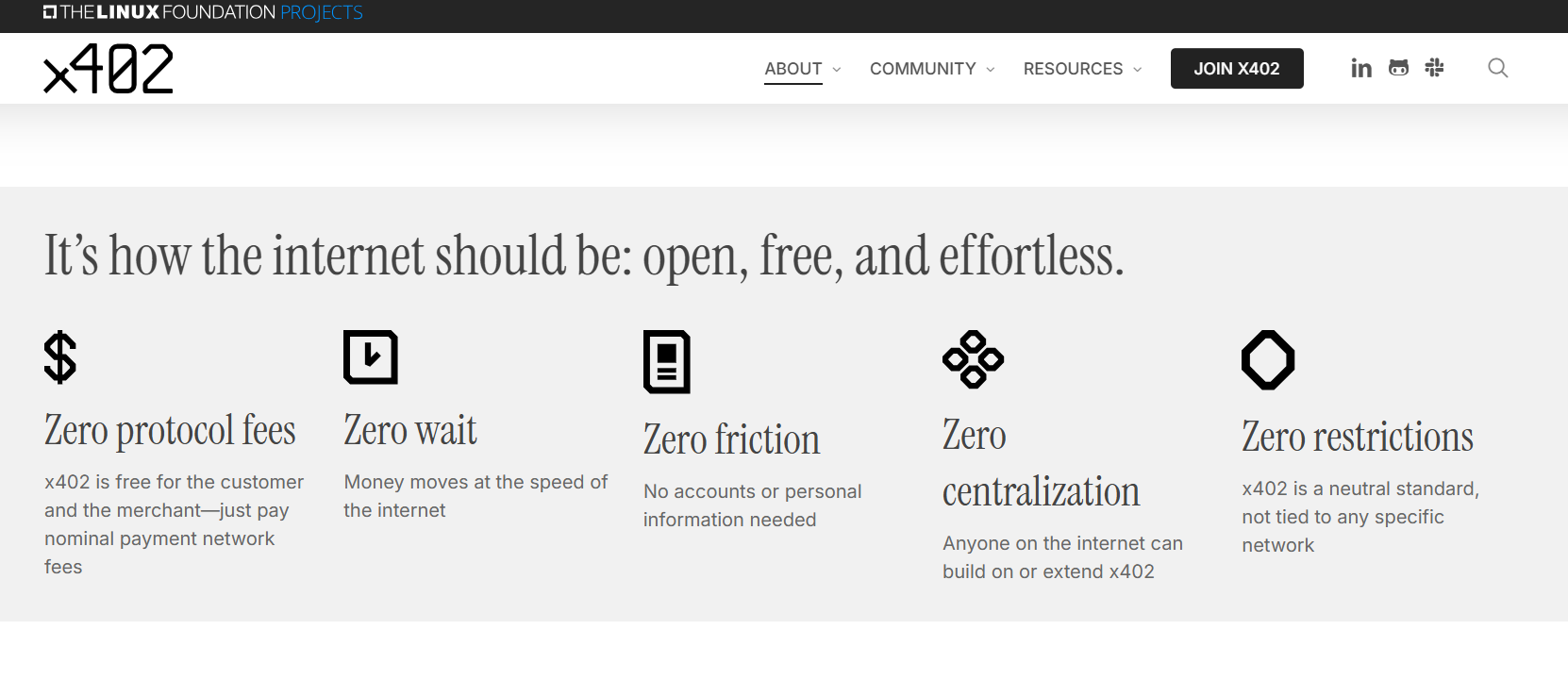
x402 is an open, neutral standard for internet-native payments. Source: x402
Nevermined contrasted 100 API queries valued at 10 cents each. Relying on a traditional card processor such as Stripe fails as an option because the underlying infrastructure rejects charges beneath $0.50. Conversely, utilizing stablecoins allows the business to calculate that the identical 100 transfers would total approximately 10 cents via Coinbase’s x402 tool operating on Base.
Nevertheless, that does not guarantee crypto assets will universally triumph, seeing as multiple micropayments can potentially be bundled into a single credit card transaction. Furthermore, stablecoin settlements involve expenses connected to technical architecture, currency conversion, custody, and liquidity.
The Bank for International Settlements (BIS) discovered that stablecoin movements can still attract trading, conversion, and cash-out expenses, whilst insufficient liquidity matching stablecoins to fiat currencies introduces additional friction.
Who takes responsibility when an AI agent makes a mistake?
During the evolution toward agent-driven finance, a fundamental hurdle remains: who bears the blame if a bot commits an error?
Related: Banks are banning AI agents over security… and competition concerns
“I tell my students the real question isn’t ‘crypto or cards,’ it’s who solves the agent identity and liability attribution issues,” Krause remarks.
“That’s because the first time an agent books the wrong flight, someone has to own that dispute, and that’s a 50-year competency the crypto world hasn’t built yet.”
One partial remedy involves maintaining a secondary wallet loaded with a restricted cash reserve, preventing a malfunctioning agent from emptying a user’s primary bankroll.
WalletConnect is currently building methods enabling users to grant software access to distinct wallets while keeping complete command over their remaining balances.
“The most an agent can ever spend is what the person chose to give it,” Nurcombe notes.
Still, spending thresholds merely minimize potential damages. They fail to establish legal responsibility if a bot executes an unapproved purchase, acquires the incorrect service, or falls prey to cyber scams. Neither do they supply the consumer grievance mechanisms expected from legacy financial providers.
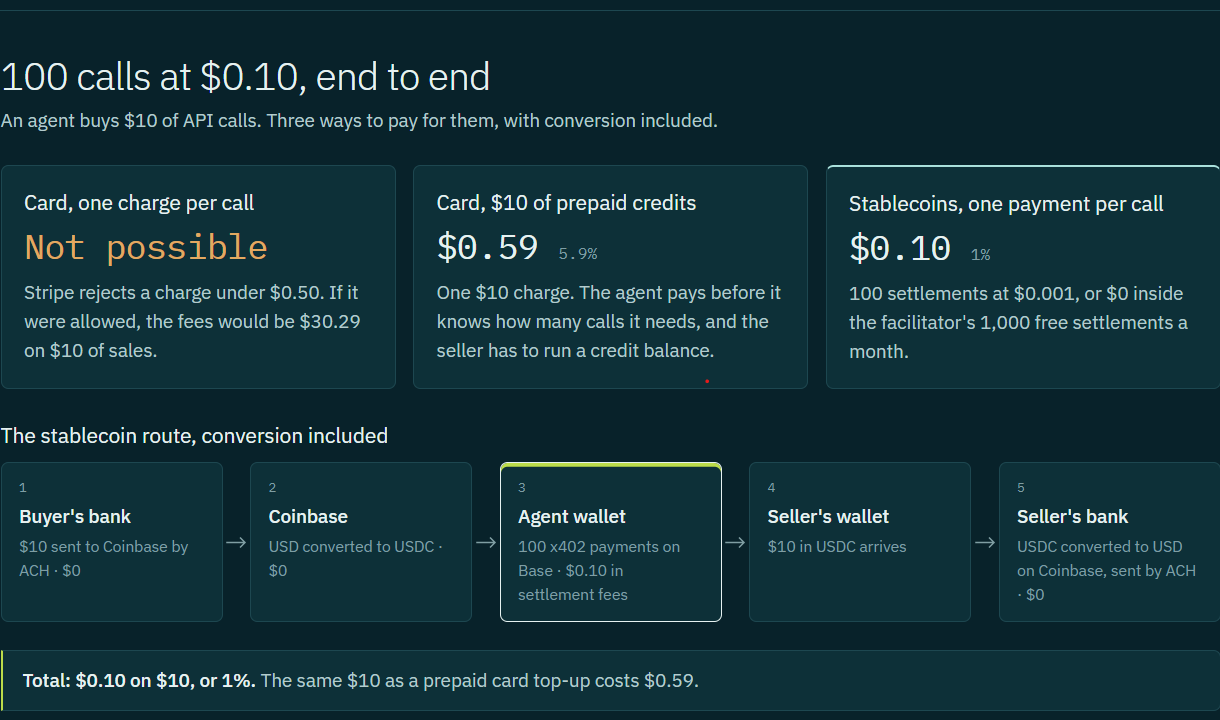
Nevermined compared 100 API calls priced at 10 cents each. Source: Nevermined.
Consequently, banks and payment networks may retain an advantage exceeding mere merchant saturation; they already hold active connections with consumers, merchants, and regulatory bodies alongside tested systems for managing transaction disputes.
Krause suggests this dynamic tilts probabilities in favor of traditional finance. “My bet is the large TradFi players will ultimately win,” he states. “They’re the ones with funding access and are positioned to straddle the divide and offer a hybrid version.”
Nevermined currently accommodates transactions utilizing both plastic cards and stablecoins, and Argomaniz anticipates both financial frameworks will exist side by side, “at least for the next few years.”
Crypto could power the plumbing without owning the market
This point highlights why Van Bourg’s perspective proves difficult for the digital asset sector to ignore: even when stablecoins prove valuable for machine-to-machine transfers, established financial rails could easily adopt them without relinquishing power over customer accounts.
Thus, an AI bot might interface directly with Visa or Mastercard while those legacy companies leverage blockchain technology behind the curtains.
Such an outcome would effectively convert distributed ledgers into background payment infrastructure without forcing businesses or retail users to possess cryptocurrency or navigate decentralized applications directly.
Mastercard concluded its buyout of stablecoin infrastructure creator BVNK in August through an agreement valued up to $1.8 billion, giving Mastercard the technical framework required to merge fiat funds and onchain transactions.
Therefore, while artificial intelligence agents may leverage blockchain networks where traditional channels fall short, the broader crypto market could find itself powering the automated agent economy without securing a dominant share of its financial rewards.
Magazine: How to preserve wealth and access funds during a national emergency
Originally published at https://cointelegraph.com/magazine/ai-agents-are-using-credit-cards-where-does-that-leave-crypto?utm_source=rss_feed&utm_medium=rss&utm_campaign=rss_partner_inbound.