Nov 23, 2026, 7:30 a.m. EST
4 min read
This is an excerpt from CoinDesk newsletter ‘Daybook.’ Sign up here, if you haven’t already.
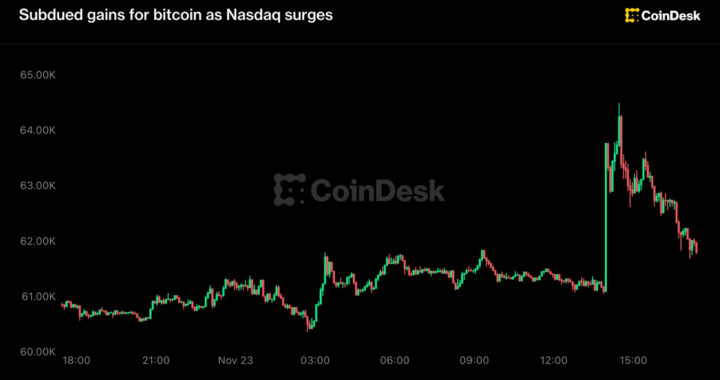
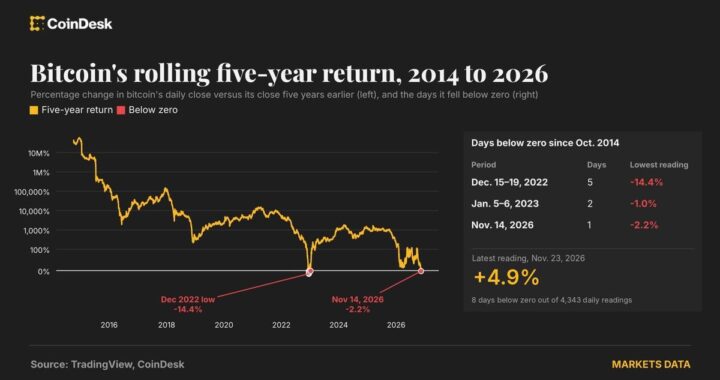
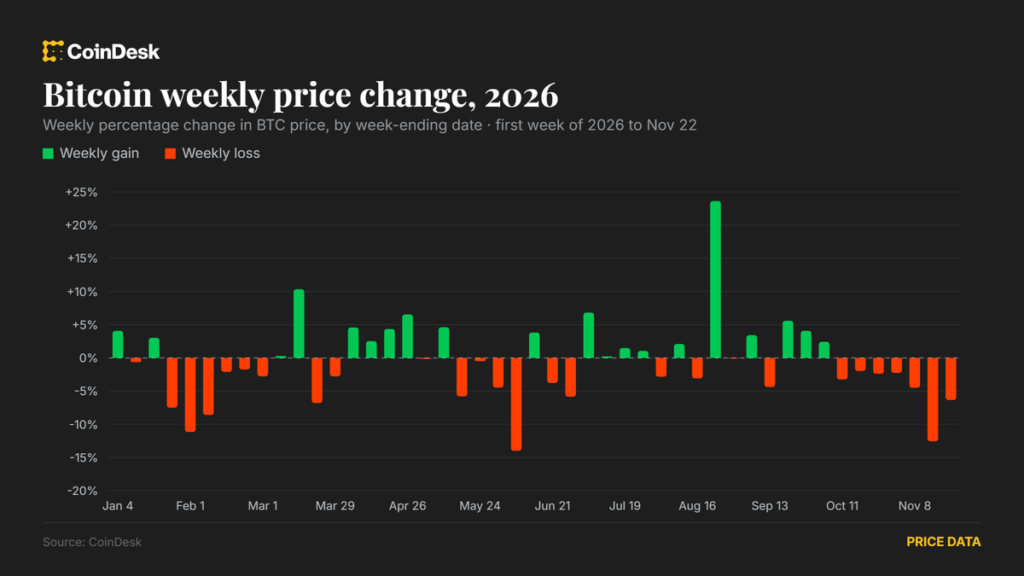
Bitcoin BTC$60,913.98 has experienced a seven-week consecutive decline, marking the second-extended weekly losing run in history.
Based on TradingView records extending back to 2009, this downward trend kicked off during the week of October 5, pushing values down roughly 29% from about $86,500 to $61,100 by November 22. Valuation touched a low of $55,500 on Saturday prior to bouncing back above $61,000 as Sunday concluded.
This drop transpired concurrently with investors pulling billions out of spot bitcoin exchange-traded funds (ETFs) based in the United States. According to metrics from SoSoValue, these funds currently reflect a net outflow total of $3.77 billion for the year.
The sole longer period of consecutive weekly losses for bitcoin took place in 2022, when BTC dropped for nine straight weeks, shedding 37% through late May amid market turbulence caused by the Terra network’s failure. The third most prolonged streak unfolded earlier in the year, spanning six weeks from mid-January until late February with a 30% loss.
A number of prominent analysts anticipate that prices will remain under pressure for a period, though they hold differing views regarding how severe the descent could become.
Michael Terpin, who wrote the 2024 publication “Bitcoin Supercycle,” envisions a market floor taking shape near present valuations. In a recent blog post, he pointed out that the Crypto Fear and Greed Index sank to 6 out of 100, which is lower than the score of 12 registered following the 2022 collapse of FTX.
“When there are no panic sellers left, the price eventually has to go up,” Terpin stated.
Even so, he estimates the odds are “close to 50/50” that bitcoin finds its bottom in the lower $50,000 range or upper $40,000 range, while assigning a 10% probability to a slide toward the lower $40,000s. He projects that valuation will persist beneath the 200-week moving average, situated close to $75,000, until at least March, mirroring patterns seen after historical market bottoms.
Mike McGlone, a strategist with Bloomberg Intelligence, forecasted significantly deeper declines. He characterized the ongoing crypto bear market that started in October 2025 as a precursor to a wider contraction encompassing U.S. equities, gold, commodities, and Treasury yields, while anticipating that most tokens lacking underlying utility, such as dogecoin DOGE$0.05683, will drift toward zero.
“Roughly $10,000 Bitcoin is a good gravity-pull pivot to stop out some of the silliness of expecting a space with unlimited supply to outperform,” McGlone remarked inside a post on X entitled, “The Everything Bubble Is Bursting.”
He cautioned that sharp rallies, comparable to bitcoin’s ascent from roughly $58,000 in June up to nearly $86,000 during September, could still materialize periodically. “Typically gotta keep false hope alive to feed the bear,” he mentioned.
Regarding bonds, McGlone maintains a contrasting perspective. Current yields sit at approximately 30-year highs, leading him to view them as a compelling purchase opportunity.
“The highest US Treasury yields in about three decades will be looked back upon as the gift of 2026 for investors,” he observed.
Other market participants are withholding judgment on direction, alternatively highlighting the Federal Reserve as the primary catalyst for bitcoin’s upcoming major move. Market participants continue to price in a 25 basis point rate increase by the U.S. central bank next month, with two additional hikes anticipated across January and March. These expectations remain subject to shifts depending on core PCE figures arriving Wednesday. Stay alert!
Read more: For analysis of today’s activity in altcoins and derivatives, see Crypto Markets Today . For a comprehensive list of events this week, see CoinDesk’s “Crypto Week Ahead.”
What’s trending
- Market rout kills 50 basis points December Fed rate hike bets (CoinDesk): The correlation between broader financial markets and anticipated Federal Reserve tightening has shifted completely. As indices decline, speculators are rapidly scaling back projections regarding a substantial December rate elevation.
- Bitcoin sold for $17,000 on Kraken’s Canadian dollar market, and the trades stand (CoinDesk): Bitcoin traded as low as C$24,250 ($17,000) on Kraken early Saturday following an overnight technical disruption within the exchange’s Canadian dollar order ledger.
- Treasury yields jump as stock futures rebound, investors await New York Fed President Williams speech (CNBC): U.S. Treasury yields advanced during early Monday trade, retracing part of the movement recorded late last week, as stock futures signaled a strong Wall Street recovery while participants awaited remarks from John Williams, President of the New York Fed.
- U.S. futures rally as AI rout pauses, Asian authorities prop up stocks (Reuters): U.S. equity futures climbed on Monday alongside efforts by Asian regulators to stabilize markets following the prior week’s severe sell-off in artificial intelligence-related equities, which had triggered a widespread retreat across risk assets.
Today’s signal
U.S. spot bitcoin ETFs: Weekly net flows. (CoinDesk, SoSoValue)
Spot-based bitcoin exchange-traded funds in the United States recorded collective net withdrawals totaling $1.79 billion throughout the prior week, marking a volume absent since July.
This ongoing four-week streak of capital departures highlights a rapidly diminishing institutional demand for the leading cryptocurrency, reinforced by negative year-to-date inflow metrics.
Numerous analysts emphasize the return of positive capital inflows as a fundamental requirement for achieving any enduring price recovery for the primary digital asset.
Originally published at https://www.coindesk.com/daybook-us/2026/11/23/bitcoin-s-losing-streak-is-second-longest-ever-and-some-observers-see-more-downside.