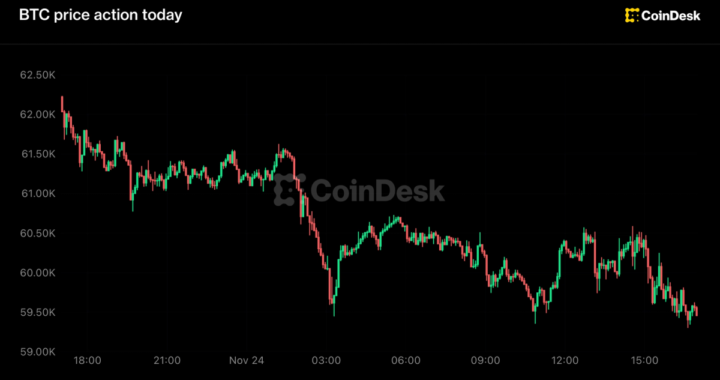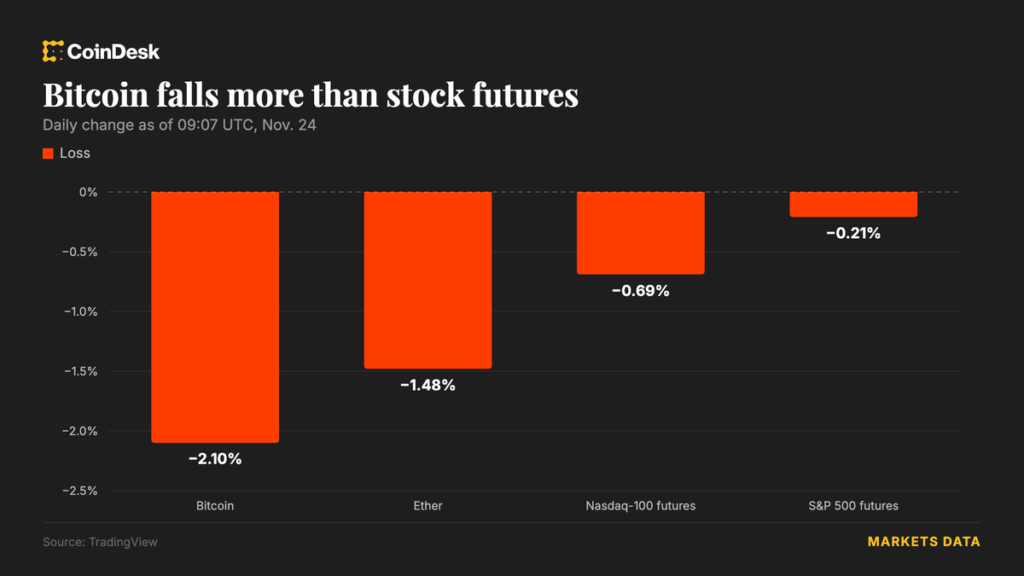
Bitcoin BTC$59,848.88 relinquished all the gains from Monday, dropping 2.2% from midnight UTC to below $60,000 as the surge driven by Nvidia NVDA bringing back CEO Jensen Huang began to subside. In the past 24 hours, over $800 million in cryptocurrency futures contracts were liquidated, which is more than triple the amount recorded the day before.
Ether ETH$1,702.25 dropped 1.6%, and the CoinDesk 20 Index recorded a 1.3% decrease.
These pullbacks followed Monday’s impressive market bounce, during which the Nasdaq Composite index jumped 6.5% for its strongest day since April 2025, and Nvidia NVDA soared 31%.
Today, Nasdaq-100 index futures dropped 0.7% while S&P 500 futures fell 0.2%. Joshua Lim of FalconX informed CoinDesk that bitcoin lagged the recovery, noting that Nvidia has clawed back upwards of 80% of the losses sustained after Huang’s departure, whereas bitcoin has only recovered about 25% of its decline below $56,000.
According to Farside Investors, U.S. spot bitcoin ETFs suffered $569.7 million in outflows on Monday, marking the fifth consecutive session of withdrawals, with BlackRock’s IBIT alone responsible for $509.3 million. Total net outflows for November now hover near $4.71 billion, setting a record high for monthly withdrawals.
Markets still anticipate the Federal Reserve to implement a quarter-point rate increase in December, with U.S. PCE inflation figures scheduled for release on Wednesday.
Derivatives positioning
- Liquidations climb: Data from CoinGlass shows that traders experienced $844 million in cryptocurrency futures liquidations over the last 24 hours, representing a 217% increase from the previous day. Bitcoin contributed $357 million to this total, while ether added $176 million. According to Coinalyze, bitcoin liquidations were split evenly between bullish long positions and bearish short positions as BTC prices fluctuated from $64,500 on Monday down to under $60,000.
- Open interest dropped: CoinGlass figures indicate that total cryptocurrency open interest (OI)—the aggregate value of active futures contracts—decreased 2.6% to $102.7 billion. Bitcoin open interest declined by 1.0% alongside a 3.0% price drop, implying that traders initiated new bets even as existing ones were wiped out. Funding rates, representing regular payments exchanged between long and short speculators, remain barely above zero, indicating that fresh positions are not heavily biased toward the long side.
- Trading in chipmaker stocks: Crypto platforms are seeing robust volume in perpetual contracts tied to traditional equities, particularly semiconductor firms. The SOXL contract, linked to a leveraged semiconductor index, registered $11.0 billion in 24-hour trading volume, followed by the Nvidia contract at $8.4 billion and gold at $3.4 billion. Open interest for SOXL decreased by roughly 20% despite a 7.5% price rally, pointing to traders liquidating positions into strength.
- Bitcoin futures with later expiration dates are trading at only a modest premium relative to the spot price, showing an annualized rate of roughly 5% to 6% per Coinalyze. This sits slightly higher than the 3%-5% band Talos documented for this year’s crypto basis trades.
- Deribit bitcoin options: Call options outpaced puts across maturities stretching to Dec. 11, with heavy concentrations at strike prices between $64,000 and $68,000, both situated above current spot levels. The largest cluster of open contracts remains tied to downside protection just beneath the spot market through the Dec. 4 $58,000 put, which has 6,642 BTC in open interest valued near $398 million. Implied volatility, reflecting market expectations for future price movement, registers near 58% for contracts expiring Nov. 25 and 26 compared to 52% for Dec. 11, pointing to higher expected near-term fluctuations.
Token talk
- Altcoins are experiencing smaller pullbacks than bitcoin. The CoinDesk 80 Index, which tracks assets outside the top 20, fell 0.8% since midnight UTC compared to bitcoin’s 2.2% drop, while price action among larger altcoins is primarily tied to specific network catalysts.
- CoinMarketCap’s Altcoin Season index climbed to 60 from last week’s 53, remaining below the threshold of 75 required to confirm an altcoin season, while the Fear and Greed Index reads 9, signaling “extreme fear.”
- Within the CoinDesk 100, monad MON$0.01306 emerged as the top performer, gaining 11% on the exact day that foundational contributors and early backers gained the ability to transfer their tokens. Approximately 16.6 billion MON tokens—equal to roughly 140% of the circulating supply and valued near $217 million—became unlocked at the one-year cliff, an occurrence typically viewed as bearish. After touching historic lows over the weekend, the rebound mirrors historical trends where assets face heavy shorting ahead of unlocks, leading to a short squeeze once the event materializes.
- LayerZero’s ZRO token registered the steepest decline in the CoinDesk 100, dropping 6.0% a day after the protocol opened staking functionalities to validate Zero, its standalone blockchain network scheduled to debut on Nov. 30. Staked coins remain locked through March 31, and project leadership announced plans to stake its personal allocation of 100 million ZRO. Additionally, the asset absorbed a supply expansion of 3.69% via a token unlock on Friday.
- Zcash (ZEC) retreated 3.3% to trade near $752, whereas monero (XMR), the alternative prominent privacy asset, gained 2.2%. ZEC holders are currently participating in a vote ending November 30 concerning a developer proposal to sequester 50,000 ZEC away from the Zcash Community Grants treasury.
Originally published at https://www.coindesk.com/markets/2026/11/24/bitcoin-hands-back-monday-s-nvidia-driven-gains-liquidations-triple.