Updated 9 hrs ago Published 9 hrs ago
2 min read

Summary
- Zcash jumped roughly 20 percent on Friday, temporarily crossing $1,000 while its overall market capitalization neared $17 billion.
- The upward surge wiped out approximately $36.6 million in leveraged holdings, featuring $34.5 million in short positions, which likely fueled additional upward momentum as investors purchased tokens to unwind their bets.
- Zcash has advanced about 94 percent over the past month and over 2,300 percent across the past year, establishing itself as a top-performing major digital asset.
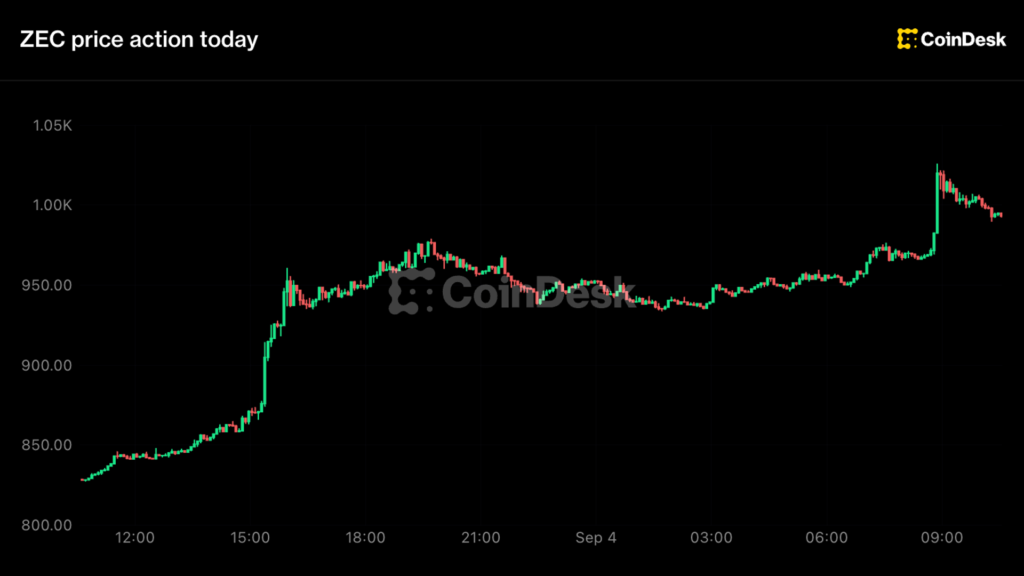
Zcash (ZEC) climbed roughly 20% in the last 24 hours to change hands near $1,000 on Friday, pushing forward a persistent surge that has nearly doubled the privacy-focused coin’s valuation over the preceding month.
ZEC touched a high of approximately $1,023 after opening the day close to $828, based on CoinGecko metrics. Daily trading turnover reached about $1.2 billion, while total market capitalization pushed toward $17 billion.
This sudden price surge caught bearish speculators off guard. Roughly $36.6 million worth of leveraged ZEC contracts were liquidated over the prior 24 hours, with $34.5 million originating from short positions, according to the liquidation statistics gathered. Short liquidations occur when appreciating values force trading platforms to automatically close out a speculator’s downward bet because insufficient collateral remains to maintain the position.

Such events can intensify an already ascending market because covering a short contract requires purchasing the underlying coin back. ZEC has appreciated roughly 94% across the last 30 days and exceeding 2,300% over the previous year, positioning it among the most robust large-cap cryptocurrencies during that period.
Open interest across ZEC derivatives expanded to about 2.3 million ZEC, representing an approximate value of $2.3 billion, as speculators flooded the futures market alongside the spot price rally.
Driving forces behind the price movement encompassed both technical upgrades and institutional catalysts observed throughout recent weeks.
Grayscale’s spot Zcash ETF commenced trading on NYSE Arca late in August under the stock symbol ZCSH, transitioning a vehicle previously restricted to accredited investors into an exchange-traded fund accessible to anyone possessing a standard brokerage account.
Concurrently, Digital Currency Group, the parent entity of Grayscale, engaged in non-binding discussions via a subsidiary to acquire 200,000 ZEC, as reported by CoinDesk at that time.
The underlying network has likewise experienced velocity enhancements. Developers supporting Zakura, a Zcash node client introduced in July, deployed cryptographic utilities earlier this month that reduced the duration a mobile wallet requires to generate a private transaction from over three seconds to under 200 milliseconds, forming part of a wider initiative to optimize the network for mainstream retail transactions.
Anvil: The Missing Collateral Layer

Anvil: The Missing Collateral Layer
Anvil is a shared on-chain collateral layer built on a programmable letter of credit: reserve assets as a guarantee -no loan, no interest, keep custody & yield.
Jul 29, 2026
Anvil is a shared on-chain collateral layer built on a programmable letter of credit: reserve assets as a guarantee -no loan, no interest, keep custody & yield.
Why it matters:
Anvil is a shared on-chain collateral layer built on a programmable letter of credit: reserve assets as a guarantee -no loan, no interest, keep custody & yield.
Originally published at https://www.coindesk.com/markets/2026/09/04/zcash-jumps-20-to-landmark-usd1-000-level-as-short-sellers-lose-usd34-million.