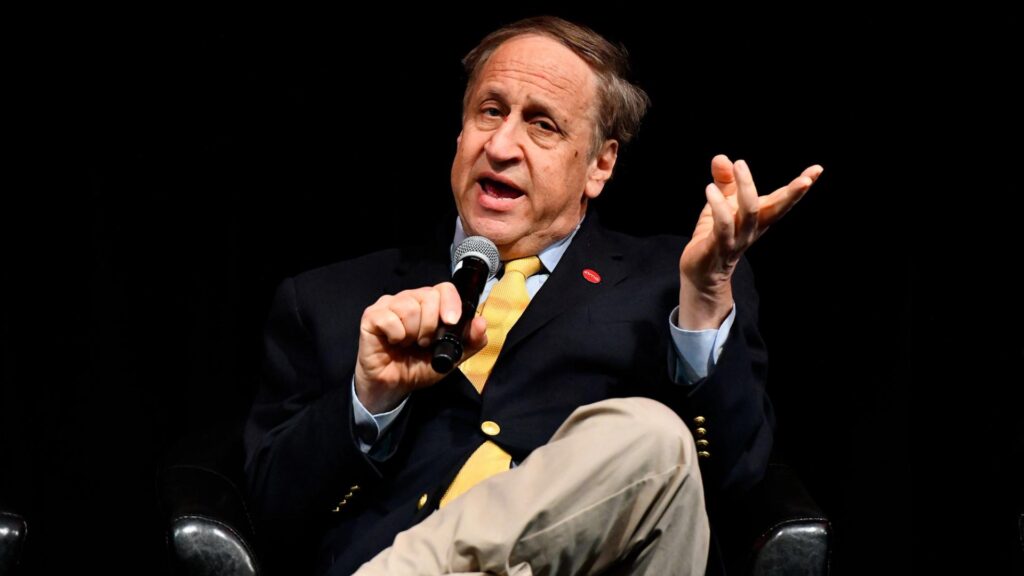
AMC Entertainment CEO Adam Aron stepped up his dispute with Robinhood regarding its tokenized stocks on Friday, urging the trading platform to halt the exchange of tokens tied to AMC shares and threatening legal action.
Aron made these remarks in reply to Robinhood CEO Vlad Tenev, who posted on X asking “what’s the concern?” after Aron initially criticized the assets on Thursday. Aron argued that the tokens could disrupt AMC’s capital-raising capabilities, strip investors of shareholder privileges, and establish an unauthorized parallel market using the company’s title.
“Your setting up some kind of fictitious synthetic equity market decouples stock token ownership from a company’s ability to control its own capital raising efforts,” Aron wrote on X.
Additionally, Aron questioned Robinhood’s reliance on an offshore structure and whether the offerings adhere to U.S. securities regulations. “This quasi-fake market you are creating on the island of Jersey sows distrust amongst the public about financial markets in general,” he wrote.
He urged Robinhood to “cease and decist” [sic] the trading of AMC stock tokens and stated that AMC intends to bring the matter to the U.S. Securities and Exchange Commission (SEC).
Dan Gallagher, Robinhood’s Chief Legal Officer and a former SEC commissioner, countered Aron’s threat and indicated the brokerage has no intention of discontinuing the offerings.
“We know a little something about the U.S. securities laws and will not ‘DECIST,'” Gallagher wrote in reply to Aron’s post, highlighting the AMC executive’s misspelling of “desist.” “Send your lawyers and we’ll educate them.”
Aron subsequently clarified that the typo was a deliberate “attempt at humor.”
Robinhood CEO Vlad Tenev reinforced the reply, sharing Gallagher’s post alongside the message: “We stand behind Stock Tokens.”
Not all stock tokens are created equal
This controversy highlights an escalating divide in stock tokenization as cryptocurrency enterprises, fintech firms like Robinhood, and Wall Street corporations compete to migrate equities onto blockchain infrastructure.
Stock tokens manifest in various configurations. Certain providers generate synthetic wrappers tracking stock pricing without transforming the token into an officially registered company share. Alternative frameworks tokenize shares maintained with a regulated custodian, whereas issuer-sponsored methods deploy actual corporate shares on-chain with accompanying shareholder entitlements.
Robinhood’s instruments belong to the initial category, granting investors exposure to U.S. equities independent of the companies whose shares are tracked. These tokens remain inaccessible to U.S. clients.
These distinctions are significant because a synthetic token might mirror AMC’s stock value while lacking voting privileges, ownership status, or inclusion on the company’s shareholder ledger.
Tokenization executives weigh in
Aron’s critique gained backing from select cryptocurrency executives who generally support migrating equities on-chain.
Armani Ferrante, co-founder and CEO of the crypto exchange Backpack—which provides tokenized U.S. equity trading on the Solana blockchain backed by custodied shares—noted that Aron’s worries regarding capital formation held “real substance.” He contended that Robinhood’s architecture could decouple demand for a stock token from demand for the underlying equity since purchasing a token does not inherently generate equivalent purchasing activity for the company’s shares.
“When you’re bidding Robinhood stock tokens, that buy pressure doesn’t necessarily hit the underlying stock market,” Ferrante wrote on X.
He also highlighted the redemption mechanics. Retail investors cannot directly redeem Robinhood stock tokens for actual shares, Ferrante explained, leaving that procedure to authorized participants.
Graham Rodford, CEO of Archax, a UK-regulated digital asset exchange and tokenization venue, established an even clearer delineation between tokenizing shares and producing instruments that merely track them.
“A tokenized stock should mean the stock, tokenized,” Rodford stated. He maintained that certain offerings advertised as tokenized shares are actually debt securities distributed via separate entities carrying a public corporation’s ticker symbol without its participation.
Rodford further argued that wrappers lack the automatic protections of traditional equities, including regulated trading venues, market surveillance, settlement mechanisms, and verifiable ownership.
Joris Delanoue, CEO of the regulated transfer agent Fairmint, which leverages blockchain for recordkeeping, distinguished between holding a stock and holding an instrument that tracks it.
“A token is not equity, but equity can be a token,” Delanoue remarked. “If the holder is not on AMC’s official ownership record, the token is not an AMC share.” He suggested that synthetic assets have a market role but should be explicitly designated as derivatives offering exposure to AMC rather than direct equity rights against the company.
Carlos Domingo, CEO of tokenization specialist Securitize (SECZ), also contributed to the discussion, highlighting a substantial price dislocation in an AMC-linked token. A specific trading pair for the token exchanged hands at roughly 60 times AMC’s reference share value, Domingo pointed out.
This case illustrates how thin liquidity, a fractured market, and restricted arbitrage avenues can cause a token and its target stock to diverge.
“Tokenization was meant to improve markets, not make them worse,” Domingo wrote.
The perspectives from these executives emphasize that the debate centers increasingly on how equities should transition on-chain and what investors truly possess when purchasing a tokenized stock.
The significance of these issues grows as the wider tokenized stock market attains $3.6 billion with rapid expansion, according to a CoinDesk Research report. Concurrently, Citi forecasts that $5.5 trillion in assets could be tokenized by 2030, encompassing $2.7 trillion in equities.
Originally published at https://www.coindesk.com/business/2026/09/04/amc-ceo-tells-robinhood-to-stop-issuing-stock-token-as-industry-executives-weigh-in.