South Korean financial regulators revealed policy measures geared toward creating the infrastructure necessary to tokenize securities for stablecoin settlement on Friday.
Representatives from the nation’s Financial Services Commission (FSC) and Financial Supervisory Service (FSS) indicated that the initiative aims to tokenize traditional financial instruments like equities, bonds, and funds, while broadening security token offerings (STOs) beyond fractional investment goods by February 2027.
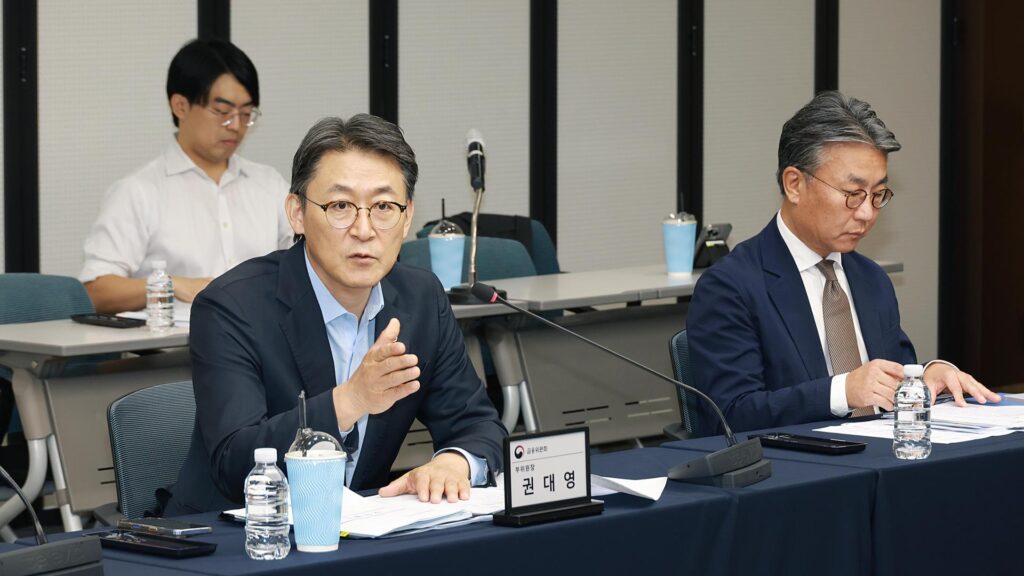
Kwon Dae-young, the vice chairman of the FSC, stated that authorities will endeavor to establish the groundwork that supports the tokenized issuance and trading of standard asset classes such as stocks, bonds, and mutual funds, with the ultimate objective of completely overhauling and enhancing capital market architectures for digital connectivity.
South Korea stands as one of the planet’s most vibrant retail investment sectors, featuring 11.3 million verified cryptocurrency participants alongside an equity market that frequently records daily trading activity comparable to digital asset platforms. Bringing tokenization to conventional financial instruments, rather than restricting it to fractional ownership products, steers the country toward a complete digital capital market ecosystem.
According to an Organization for Economic Co-operation and Development (OECD) study, Asia is assuming an increasingly prominent part in worldwide crypto economies, boasting the highest expansion rate among all territories and accounting for 30% of global stablecoin trading volume throughout 2025.
Last week, Japan announced plans regarding a nationwide blockchain settlement network for equities and government bonds, targeting deployment by the early 2030s. Meanwhile, Singapore finalized its stablecoin regulatory licensing framework this week.
The initial stage of South Korea’s plan launches in February 2027, coinciding with the Electronic Registration Act, a regulation covering money market funds and institutional bonds, unlisted equities via trust frameworks, and publicly offered fractional investment assets.
The second stage opens tokenization up to all publicly offered securities. The third and concluding portion implements onchain payment networks tied to stablecoins, although the schedules for stages two and three rely on the outcomes of stage one, technological uptake by industry stakeholders, and forthcoming stablecoin legislation.
Per the FSC announcement, individual buy-ins are capped at the lesser of 30 million won ($22,000) or 5% of the total issuance amount. Yearly net acquisitions on over-the-counter (OTC) trading desks are restricted to roughly $74,000.
Presently licensed financial institutions will be permitted to manage tokenized securities under their existing credentials. Issuers overseeing their own asset accounts are required to maintain a minimum of $3 million in equity capital while satisfying specific IT and cybersecurity criteria.
The FSC noted its intention to present proposals for amending subsidiary regulations before the conclusion of September.
Originally published at https://www.coindesk.com/business/2026/09/04/south-korea-targets-february-2027-rollout-for-full-tokenized-securities-market.