Bitcoin operates around the clock, seven days a week, granting traders and asset managers the ability to respond to news and manage risk at any moment, weekends and public holidays included.
Yet out of 365 days in a year, only a handful actually determine whether a given year results in a profit or a loss. This is why certain specialists argue that purchasing and holding is vastly superior to attempting to time bitcoin’s price fluctuations for profits.
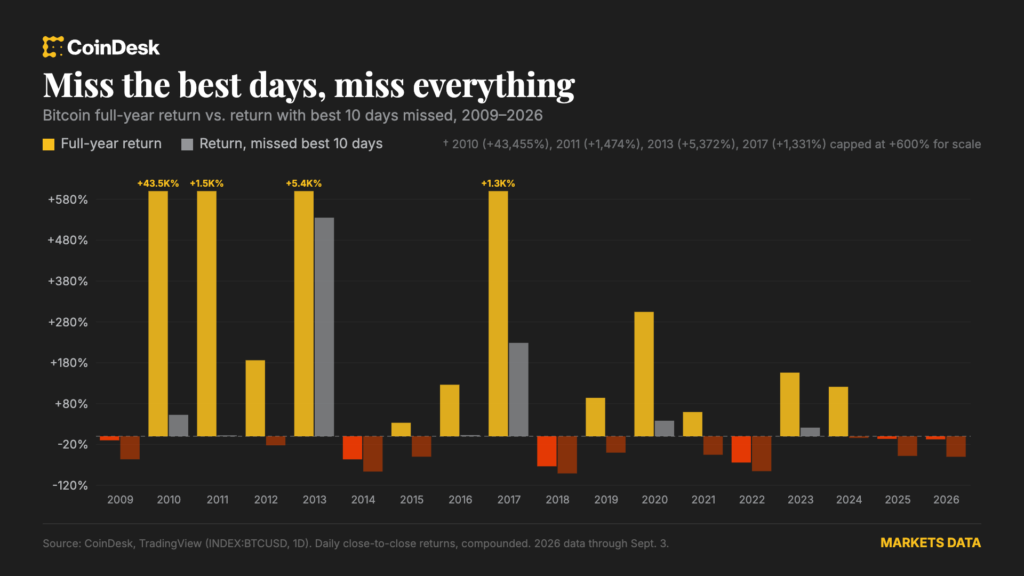
To illustrate, throughout 2026, bitcoin dropped roughly 9%, which counts as a modest decline rather than a catastrophe. Nevertheless, excluding the five top-performing days of that year leaves bitcoin down by 36%.
Andre Dragosch, research head at Bitwise Europe, explained that this behavior is simply inherent to bitcoin. “Bitcoin is actually a relatively boring asset,” he stated to CoinDesk.
“The majority of performance is usually made in a handful of days, while most of the time it moves sideways and consolidates.”
This phenomenon is not an isolated occurrence. Reviewing bitcoin’s history stretching back to 2010 when tokens exchanged hands for mere pennies, gains have consistently remained concentrated within just a small number of daily sessions.
Across 11 out of the previous 18 years, removing merely the 10 most profitable trading sessions out of roughly 365 suffices to turn a profitable year into a losing one.
The year 2019 concluded with a 94% annual gain, meaning values essentially doubled. However, eliminating the 10 strongest days from that timeline pushes the year down by 40%. In a similar fashion, 2011 generated an astonishing 1,474% return. Stripping away its 10 top days collapses that figure down to 2.2%, which is practically nothing.
Still, a few exceptions did occur.
Both 2013 and 2017 maintained firmly positive figures even after discarding their top 20 respective days, representing genuinely broad, steady climbs rather than sudden violent surges.
According to Dragosch, this specific pattern partially spawned the “c’mon, do something” meme—a running joke across crypto Twitter regarding bitcoin remaining utterly motionless for weeks on end.
Time in the market, not timing the market
This tendency for returns to cluster within a tiny window makes precise market timing extraordinarily difficult.
A trader would need to enter precisely as a rally begins, because missing the target by even a week or two typically translates to missing nearly the entire price movement.
The resulting conclusion, according to Dragosch, follows logically—spending time in the market outclasses trying to time it, since catching those few explosive days reliably is nearly impossible. Stated differently, acquiring and holding bitcoin over the long term is significantly simpler and frequently much more lucrative than actively trading around it or operating a fund evaluated on an annual basis.
Sustaining a long-term holding strategy also helps weather bear markets where losses are concentrated within a few days. Historical data indicates that the probability of finishing underwater diminishes the longer someone retains the asset, falling below 1% following a three-year holding duration, noted Dragosch.
Adam Haeems, asset management head at Tesseract Group, which oversees over $500 million in assets, concurred with this observed trend. He highlighted February 2026 as the most vivid demonstration of why executing precise timing is so challenging in reality.
Bitcoin slid approximately 14% on February 5, representing one of its largest single-session drops, before rebounding roughly 12% the very next day, February 6, marking one of its finest performances. “Anyone taken out of the position on Thursday had a day to get back in,” Haeems remarked.
Whether any specific mechanical strategy would have successfully captured that reversal remains a separate question that raw data alone cannot answer, he added. “It does show the exit and the recovery sitting close enough together, treating drawdown avoidance as a free option looks optimistic to me,” he informed CoinDesk.
Haeems also drew focus to bitcoin’s gradually shrinking volatility and the magnitude of single-day price fluctuations over time.
The premier single-day surge back in 2010 reached an astonishing 294%. In 2011, it still hit 53%. Throughout the past four years, the top single-day jump each year has fallen somewhere between 9% and 12%. He attributed part of this shift to a maturing market, expanded futures activity, spot exchange-traded funds (ETFs), and corporations holding bitcoin on their corporate balance sheets, a dynamic CoinDesk explored back in 2025.
Lighter daily volatility also signifies that the actual pain of missing the five or ten best days is no longer as severe as it was during the nascent years.
Back in 2010, missing those days cost a trader roughly 98% of the final wealth they would have otherwise secured. Nowadays, the impact is closer to a third, and that ratio has remained relatively stable across 2023, 2024, 2025, and 2026.
For his own organization, that reality redefines the entire undertaking.
Originally published at https://www.coindesk.com/markets/2026/09/05/why-crypto-experts-say-buying-and-holding-bitcoin-easily-beats-trying-to-time-the-market.