The upcoming Friday quarterly options expiries for both Bitcoin and ether represent massive multi-billion-dollar events heavily weighted toward bullish configurations.
Luuk Strijers, CEO of Deribit, noted that approximately $15.9 billion in bitcoin options and $2.1 billion in ether options are set to expire at 8:00 UTC. The Bitcoin expiration alone will eliminate 37% of Deribit’s total active BTC open interest, which currently stands at roughly $43.5 billion, with open interest representing the aggregate dollar value of live options agreements where each contract corresponds to one BTC or one ETH.
Strijers informed CoinDesk that the upcoming quarterly expiration on September 25 ranks among the largest on Deribit for the entire year. He added that the September contract remains call-heavy, featuring a put-to-call open interest ratio of 0.69, which reflects positioning tailored for higher market values.
A call option functions as a derivative agreement granting the purchaser the choice, but not the obligation, to acquire a baseline asset at a predetermined strike price prior to a designated expiration date.
Consider this as paying a $100 fee to secure the right to purchase a $1,000 laptop at any point during the upcoming four weeks. Should the laptop price climb to $1,200, you exercise the option and effectively save $200 after deducting your $100 fee. If the valuation remains at or below $1,000, you allow the reservation to expire and forfeit only the initial $100.
Market participants utilize call options to capitalize on anticipated upward movements in the underlying asset, which in this context involves BTC or ETH. Conversely, put options serve the opposite function by shielding the buyer against potential market downturns in the underlying asset.
The cryptocurrency options sector has grown exponentially since 2020, with investors blending call and put instruments alongside spot and futures allocations to express outlooks regarding price trajectories, market turbulence, and time decay. This expansion has transformed quarterly options settlements into essential spectacles for crypto traders.
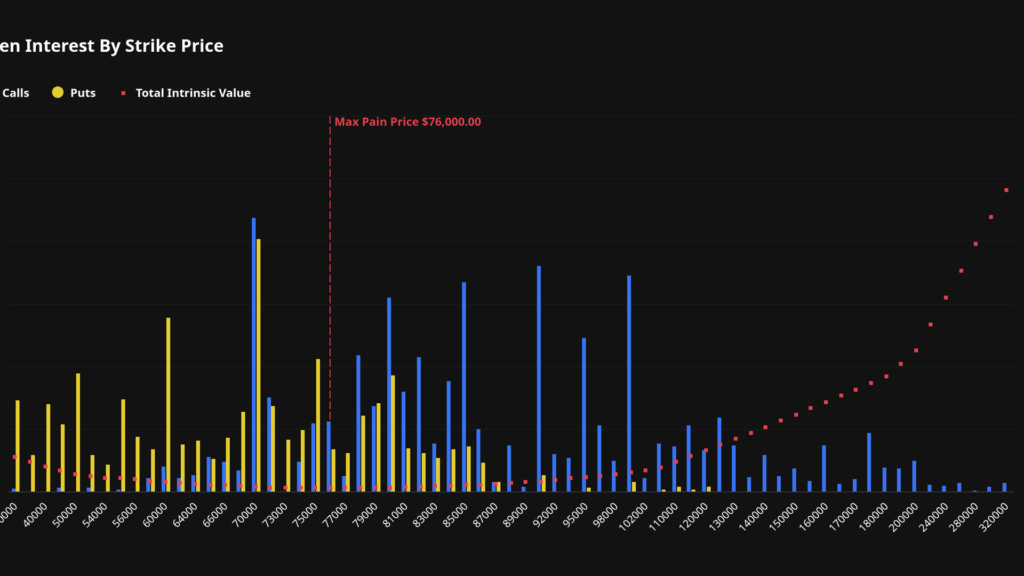
A primary metric monitored closely by market participants is the max pain threshold for expirations, representing the spot valuation where option purchasers face the greatest financial losses on expiry day. Although the concept remains a subject of ongoing debate and skepticism, the prevailing theory suggests that options sellers attempt to push the spot price toward this maximum pain level to inflict severe losses on buyers.
For bitcoin, the maximum pain level rests at $75,000, sitting considerably lower than the spot price of $85,500. Deribit characterized this specific price tier, where options buyers experience aggregate peak losses, as a soft magnet pulling prices toward expiration.
Open interest distribution
The $70,000 strike tier holds a greater number of active contracts than any other level, with the associated call options currently sitting deeply in the money.
Strijers stated that 55% of the $9.4 billion in call options scheduled for expiration are currently in the money, whereas put contracts hold virtually no value at present. Combined, roughly one-third of the entire $15.9 billion book sits in the money today.
Being in the money signifies a profitable state where an option maintains intrinsic value because the current market valuation sits on the advantageous side of its strike price. For call options, the underlying asset trades above the strike, while for put options, it trades below the strike.
Jean-David Péquignot, Chief Commercial Officer at Deribit, explained that the distribution of open interest across various strike prices points to a solid price floor near $75,000.
Péquignot noted that open interest heavily clusters around the $85k, $90k, $95k, and $100k call strike prices, highlighting the ongoing impact of massive 85k/90k/95k/100k call condor blocks coming directly into play as spot values hover near $86k. On the put side, defensive structures anchor firmly at $60k, $70k, and $75k, establishing a multi-layered support base.
What happens on the expiry day?
Friday’s settlement could generate short-term market volatility before ultimately redefining the trading boundaries for the spot price of BTC.
According to Strijers, this outcome stems from the expiration clearing out dealer-associated hedging activity.
Strijers explained to CoinDesk that as Bitcoin pushed through the $80k to $87k range, dealer hedging linked to short call positions likely fueled the upward trajectory, since dealers holding short calls must purchase spot assets during rallies to maintain balanced hedges.
He added that once those gamma and hedging flows dissipate following settlement, the pinning effect subsides, short-term volatility may rise, and the established trading channel can undergo a reset.
Additionally, Strijers mentioned that traders will closely monitor price movements near the $85,000 threshold and observe how positions roll over into the October and December settlement dates, a process where participants close existing options while simultaneously establishing comparable positions for later expiration periods.
Originally published at https://www.coindesk.com/markets/2026/09/23/bitcoin-s-usd16-billion-quarterly-options-settlement-arrives-with-a-call-heavy-book.