Reporting concluded on September 1, 2026, at 5:00 p.m. EDT. Bitcoin exchange-traded funds brought in $217 million on Monday, immediately following a single session of outflows that interrupted a nine-day acquisition period. Meanwhile, Ether exchange-traded funds have avoided net negative flows since the middle of August.
Treasury Secretary Scott Bessent remarked yesterday that the Federal Reserve would commit an error by raising borrowing costs to counter inflation driven by a supply shock. Ample data supports Bessent’s stance, and former Fed Chair Alan Greenspan undoubtedly shared that perspective. Whether six or more members among the twelve voters on the current Federal Open Market Committee share this view remains an open question. Following Tuesday afternoon’s rebound in crude oil prices toward summer peaks after President Trump announced fresh military strikes against Iran, interest rate speculators are pricing in a stronger likelihood that the Fed will implement a rate increase during its policy gathering in two weeks. According to the CME FedWatch instrument, the probability of a rate hike at the September meeting is presently near 70%, climbing from 65% yesterday and resting below 40% only a week ago.
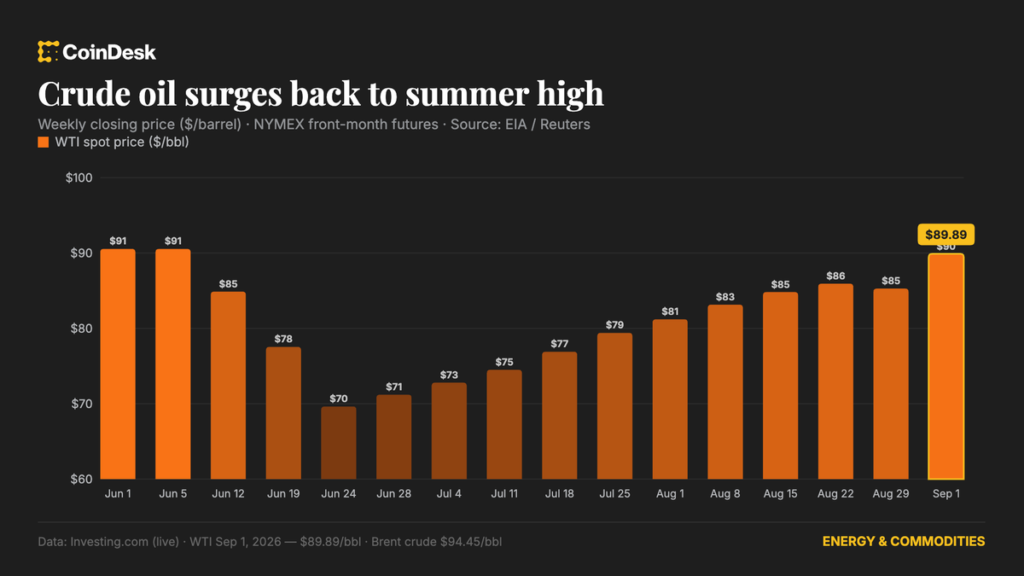
“The United States is, as we speak, striking Iranian Targets near the Strait of Hormuz,” stated President Trump moments ago via Truth Social. “The strikes are large and powerful, and in retaliation for the Iranians’ failed attempt at adding sea mines to the Strait. If the failed Nation of Iran retaliates for this very justified attack, they will be hit again at a much harder and higher level.” West Texas Intermediate crude oil has advanced by 5%, crossing the $90 per barrel threshold for the first time in approximately three months. Brent crude has gained 7%, moving to $94.50 per barrel. Bitcoin has retreated to its daily minimum, dropping 2.1% to $77,200, while the Nasdaq index has declined by nearly 1%.
“It’s like watching the death of fiat in a slow-motion train crash,” remarked prominent cryptocurrency figure James Lavish, referencing a key international bond metric yield climbing to its highest mark since 2008. “The higher the 10-year Treasury yield rises in anticipation of rate hikes, the less likely the Fed will hike,” expressed Peter Schiff. “Even if it does hike 25 basis points, it’ll be too little to reduce inflation. Plus, higher rates increase future budget deficits, raising both bond yields and inflation.” “Literally EVERYONE thinks yields go higher,” stated Caleb Franzen. “It’s clear that markets are differentiating and going hardest after those with pre-existing conditions,” wrote Robin Brooks. “There’s great urgency for policy makers to get fiscal policy under control. Otherwise things will get a lot worse before they get better.” Bitcoin trades steadily near $78,000, whereas equities have pared initial losses, leaving the Nasdaq down by a mere 0.4%.
United States JOLTS Job Openings for July reached 7.271 million compared to analyst expectations of 7.3 million. June’s previously published figure of 7.359 million experienced a downward revision to 7.182 million. Although this information is historical, it nevertheless offers an indication of an employment deceleration during the U.S. summer season. The primary focus for the current week arrives on Friday, when federal authorities publish the Nonfarm Payrolls figures for August.
The ISM Manufacturing Purchasing Managers’ Index dropped to 54.6 during August, down from July’s reading of 55.6. Market forecasters anticipated a decline to 55.2. The Prices Paid subindex sustained an elevated level at 71.1, performing slightly better than the 72 consensus projection. The New Orders subindex, frequently viewed as a leading indicator, slipped to 53.7 from 56.7. The Employment subindex decreased from 52.8 to 51.2.
“If trends in the data give me some confidence that inflation is moderating on a path to 2%, then I think we can take a bit more time to assess our policy stance,” noted Federal Reserve Governor Michael Barr during a Tuesday morning address. “If inflation appears not to be moderating sufficiently, then I think we should act decisively to raise rates,” he added. Considered alongside Fed Chair Kevin Warsh’s commentary at Jackson Hole, Barr’s statements imply that the August Consumer Price Index report will likely serve as the determining element regarding whether the central bank implements a rate adjustment at its September 15-16 gathering. That publication is scheduled for release on September 11.
With bond yields across the maturity curve persistently ascending throughout the United States and the broader Western region, Jim Cramer has offered his perspective. “I don’t see how rates can go down now that we see Warsh as a serious practitioner, the president unable to stop the war, the allies in the region depending almost entirely on us, and oil stocks headed back up quickly,” declared the former hedge fund manager turned network television anchor. Cramer’s public forecasts over recent years have transformed into essential following material for certain contrarian traders who count on his tendency to miss the mark completely. His Tuesday morning remarks coincide with an additional three basis point increase in the U.S. 10-year yield, pushing it to a fresh cycle peak of 4.79%.
“We see increasing evidence that broader product capabilities are improving the economics of HOOD’s installed customer base, supporting more assets per customer, more activity per customer, and greater economics captured per activity,” explained analyst Michael Cyprys while elevating Robinhood (HOOD) from equal-weight to overweight. He raised his valuation target from $124 to $150, indicating an approximate 50% upside potential relative to the previous evening’s closing price of $104.81. Equities advanced 2% during pre-market trading to reach $106.88. Robinhood Chain surpasses Ethereum in daily revenue as memecoin trading takes over. “Rather than relying primarily on funded-account growth or a stronger retail trading environment, HOOD increasingly has multiple ways to grow revenue from its 28 million customers already on the platform,” Cyprys continued. “HOOD has made substantial progress broadening the platform, with 13 business lines now generating $100 million+ of annualized revenue, while newer businesses across retirement, banking, credit card, advisory, and prediction markets continue to scale, and a host of other initiatives that remain nascent or on the come offer additional growth vectors across the value chain.”
Ether exchange-traded funds absorbed roughly 12% of their cumulative capital inflows since inception during the month of August alone, leading Bitfinex analysts to conclude that ether currently offers a superior gauge of trader risk tolerance. When adjusted for respective market sizes, demand for ether instruments ran roughly four times more robust than bitcoin’s over the preceding week. This discrepancy is significant because bitcoin’s accumulation sequence occurred during a quiet summer period, whereas ether’s figures represent absolute record highs. Bitcoin’s price movement appears unleveraged. Open interest, representing the aggregate monetary value of active futures positions maintained by traders, expanded gradually rather than surging vertically, while the basis—the premium at which futures trade above spot valuations representing a conventional metric of crowded long positions—remained subdued. “We are in a market driven by spot buying,” the organization’s trading desk expressed via electronic mail, designating $77,100 as the technical support floor. A financial market propelled by physical spot purchases instead of borrowed leverage encounters fewer forced liquidations during downturns, which explains why analysts view this configuration as operating room for upward drift rather than an overextended advance. Ether ETF fund flows represent the critical metric to monitor this week. Should they maintain historic velocity while bitcoin’s accumulation streak falters, capital risk appetite remains genuine rather than functioning merely as portfolio rotation into the primary digital asset.
Bitcoin appreciated by 25% during August, securing its most successful monthly performance since November 2024. The asset concluded August trading near $78,000 and registers a 33% advance throughout the third quarter to date. Ether achieved a 25% gain in August and shows a 56% improvement for the quarter, currently changing hands just under $2,500. Should both assets sustain these gains through the conclusion of September, it would signify the initial quarter wherein both units finished in positive territory since the third quarter of 2025.
Brazil’s primary electoral magistrate suspended presidential contender Renan Santos’s political campaign—which advocated for establishing a national bitcoin reserve—after his campaign committee revealed 16 social media profiles 12 days subsequent to submitting his official candidacy paperwork. Magistrate Dias Toffoli indicated that the delay might have provided Santos with an unfair competitive advantage since registered political profiles are excluded from platform recommendation algorithms. The judicial directive halted online promotional activities and debate participation while freezing additional disbursements and expenditures from the 3.3 million reais ($630,000) of public election financing already acquired. Santos attributed the late disclosure to technical difficulties and announced intentions to challenge the ruling.
International sovereign bond liquidation intensifies further, with the U.S. 10-year Treasury yield climbing to 4.78%, nearing its January 2025 apex. The United Kingdom’s 10-year gilt yield established a fresh cycle high at 5.235%, while 10-year yields across Japan, Germany, and France likewise ascended to cycle peaks amid mounting anxieties concerning escalating national debt burdens and stubborn inflation metrics. West Texas Intermediate crude oil secured an additional 2% advancement to $88 per barrel, whereas the DXY dollar index drifted higher to 99.58. The convergence of appreciating bond yields, rising petroleum prices, and a stronger dollar has exerted downward pressure on risk-on instruments. Gold retreated below $4,400 per ounce, bitcoin trades immediately below $78,000, and the Invesco QQQ trust registers a decrease approaching 1%.
DeFi Development Corp., maintaining the second-largest solana (SOL) digital reserve, is preparing to acquire roughly $20 million via a perpetual preferred stock issuance. Capital proceeds are designated for additional SOL acquisitions, alternative cryptocurrency allocations, and general corporate requirements, according to regulatory filings. The enterprise presently maintains 2.23 million SOL valued in excess of $226 million. The Solana reserve entity intends to issue 2.2 million “CHAD” units at $9 per share, featuring a stated par value of $10. The equity instruments would initially distribute cumulative dividend yields at an annual rate of 13% relative to the stated value, disbursed each business day when formally declared, with the corporate board retaining authority to adjust the percentage at least monthly.
Risk-oriented assets face sustained downward pressure as the petroleum price rally accelerates and the worldwide sovereign bond market liquidation deepens. Bitcoin retreated to $77,900 from an Asian trading session peak surpassing $79,000. At the time of reporting, the digital currency experienced a decline approaching 1% since midnight universal coordinated time, referencing metrics provided by CoinDesk. Futures contracts linked to Wall Street’s technology-focused Nasdaq index retreated by 0.9%. Simultaneously, New York Mercantile Exchange WTI crude contracts advanced 2.5% to $87.90, marking the highest valuation since July 24. Sovereign debt yields are expanding across developed economies, presenting risks to fiscal and financial market stability.
The sell-off in Japanese government bonds continues to push yields higher, threatening to destabilize financial markets. On Tuesday, the yield on the 10-year Japanese Government Bond advanced to 3%, a valuation unrecorded since 1996. The most recent upward expansion developed in the wake of statements delivered by U.S. Treasury Secretary Scott Bessent expressing expectations for corrective measures from Tokyo and the Bank of Japan to stabilize the depreciating yen.
United States spot bitcoin ETFs secured approximately $217 million on Monday, initiating a recovery of capital inflows after roughly $202 million departed the investment funds on Friday, according to data from SoSoValue. That capital withdrawal terminated a nine-day acquisition period originating on August 19, matching the most extended inflow sequence observed throughout the year. Ether exchange-traded funds maintained uninterrupted momentum. Monday’s influx of $88 million signified an 11th consecutive session of net capital allocation totaling $1.6 billion, representing the longest sequence for these instruments since a 20-day streak concluding in July 2025. Bitcoin ETF total net assets finished August just under $100 billion, having breached that benchmark on August 27 prior to Friday’s liquidation activity pulling valuations downward. Cumulative net deposits since the funds initiated operations in January 2024 currently hover around $55 billion. August concluded as the most productive month of 2026 for bitcoin exchange-traded funds by a substantial margin, achieving more than double the volume recorded in April. The investment vehicles maintain a net capital deficit for the calendar year of approximately $2.5 billion. Friday’s isolated negative session transpired after Warsh’s Jackson Hole commentary propelled rate-increase projections upward. Monday’s market recovery indicates portfolio managers interpreted the downturn as a single-session adjustment rather than the initiation of a trend reversal, and this week’s data releases will determine which interpretation prevails.
Originally published at https://www.coindesk.com/business/2026/09/01/live-updates-bitcoin-etfs-resume-buying-as-ether-funds-stretch-streak-to-11-days.