Reporting concluded on October 29, 2026, at 11:50 p.m. EDT.
Live updates: Binance indicates security breach likely stemmed from a compromised DevOps workstation
More than $5 billion appears to have been taken from Binance, the leading global digital asset platform, with approximately $2.5 billion successfully locked.
Binance states the breach may trace back to a compromised developer laptop
Binance communicated via its Telegram channel that the security compromise may have originated from an engineer’s affected laptop rather than a leaked wallet private key.
“The initial findings by Binance indicate that the security event could involve an impacted DevOps specialist’s laptop, granting an unauthorized party entry to a service container to execute unapproved withdrawal requests,” the official release noted.
“We have uncovered no proof pointing to any compromised wallet private key. A comprehensive technical investigation summary will be published once the inquiry concludes and all details are verified.”
Arbitrum secures 74.56 million tokens located inside the Binance attacker address
The Arbitrum Security Council, a designated committee possessing emergency authority to safeguard the network, executed an urgent intervention to retrieve and freeze 74.56 million Arbitrum coins residing within the Binance exploiter wallet.
“Following thorough technical evaluation and discussion, the Security Council successfully devised and deployed a technical strategy to shift funds into a secure state without disturbing any other blockchain state or external Arbitrum participants,” the council announced through an X update.
“As of October 30, 2026, the assets have been safely relocated to an intermediary frozen address. They remain outside the reach of the original holding account and are exclusively transferable through subsequent Security Council actions or an official Arbitrum DAO governance vote coordinated alongside relevant stakeholders,” the message continued.
Previously on April 21, the council implemented a comparable measure to freeze $71 million in Ether associated with the Kelp DAO incident.
Major digital assets slide further as fallout from the Binance security breach spreads across markets
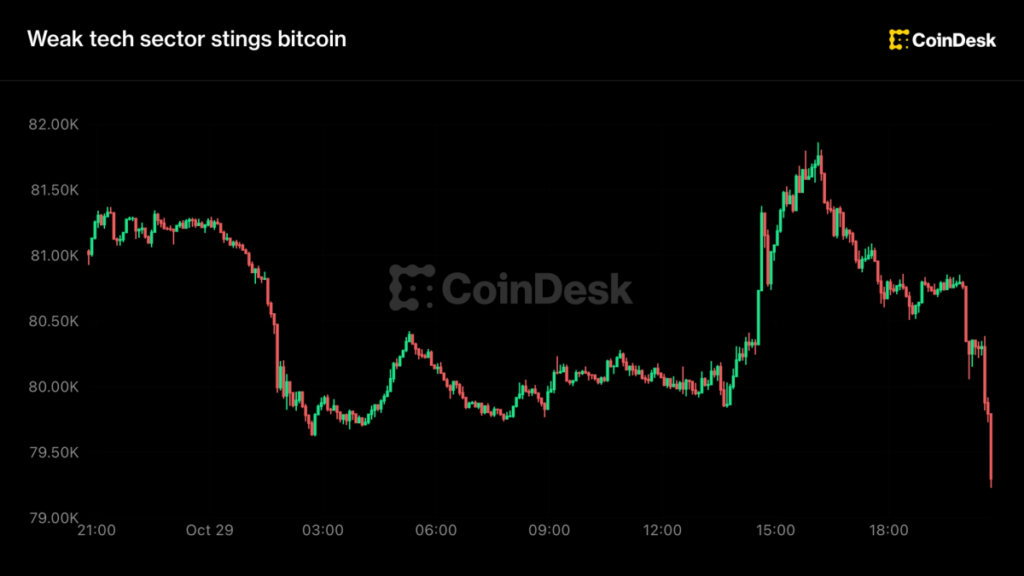
Across the board, assets hit session lows, with bitcoin BTC$78,278.97 retreating 5% across the preceding 24 hours down to just under $77,000, representing its lowest valuation in over a month.
Ether ETH$2,274.19 slipped 5.7%, BNB BNB$712.06 declined 8.2%, XRP dropped 7.4%, and solana lost 7%.
Beyond the Binance incident, legacy financial markets appear to be faltering as well. After surrendering over 1% during Thursday’s normal trading hours, Nasdaq 100 futures dropped an additional 2% that evening following another disappointing technology earnings slate.
Borrowing costs are dropping sharply. The two-year U.S. Treasury yield retreated all the way down to 4.56%, remaining well under the rates recorded prior to the Federal Reserve’s September rate increase, which implies that market participants might be pricing out any additional hikes for this cycle.
Arkham’s Morel highlights potential attack entry points
Miguel Morel, chief executive officer of blockchain analysis firm Arkham, informed CoinDesk that blockchain records indicate the breach initiated roughly around 4:30 p.m. ET.
Morel explained that the attacker might have capitalized on an Ethereum capability known as EIP-7702, which permits wallets to grant external software authority to execute actions on their behalf. EIP-7702 enables accounts to transfer execution capabilities to contract code, introducing substantial vulnerabilities if those delegations are compromised. Consequently, if these authorizations fall into malicious hands, bad actors could seize command over capital, he noted. Another possibility involves the attacker acquiring access to private keys or operational systems utilized for transaction approvals.
“Based on our current visibility, the security breach appears to remain active,” he stated.
Binance commits to absorbing all exploit losses while collaborating with law enforcement
Yi He, co-chief executive officer of Binance, stated in an X post that the organization will reimburse all losses stemming from the security event. “User balances are secure,” she added.
“As a precautionary step, all deposits and withdrawals are temporarily paused while our team performs security verifications, secures assets, and coordinates alongside law enforcement authorities,” she pointed out.
Cryptocurrency trading houses GSR and Wintermute report minimal Binance exposure
Wintermute, a digital asset trading firm and liquidity provider, verified that it maintains exposure to Binance, though CEO Evgeny Gaevoy mentioned in an X statement that it accounts for “less than 20% of net equity.”
“I anticipate zero operational interruptions across any timeframe under any possible circumstance,” he remarked.
Market maker and trading enterprise GSR maintains “minimal exposure” to Binance, according to CEO Xin Song via an X message. He quantified the exposure at “under 5% of our net equity,” noting that the firm “does not foresee any significant disruption to standard operations.”
Aave halts its lending platforms
Aave notified users that it was pausing its decentralized borrowing and lending markets, though clarifying that its smart contracts remained “unharmed, with positions staying overcollateralized.”
Bybit refutes social media claims suggesting it was impacted by the hack
Bybit, another exchange rumored across social media networks to have suffered breaches alongside Binance, confirmed it remained unaffected.
“We acknowledge reports spreading online regarding security incidents hitting multiple platforms. Bybit is completely unaffected. Our systems function normally, trading and withdrawals remain accessible, and user funds stay protected,” according to the official X announcement.
Binance stands as the leading crypto platform by trading volume.
Ripple locks $200 million associated with the Binance breach, while World Liberty verifies $27 million in USD1
According to Binance co-founder Yi He, digital asset firm Ripple froze $200 million, presumably consisting of RLUSD linked to the attack, while World Liberty co-founder Zach Witkoff verified that approximately $27 million in USD1 was locked.
Binance pauses withdrawals and commits to restoring access once security concerns are addressed
Binance announced it would re-enable withdrawals upon resolving the security vulnerability that left over $5.7 billion in funds impacted during Thursday’s breach.
“Our staff is executing security audits,” the exchange stated. “User capital continues to be protected.”
Meanwhile, BitGo shared that it was moving to freeze specific USD1 amounts located at an address identified by World Liberty Financial as receiving stolen funds.
Prominent stablecoin issuers secure assets connected to the Binance security breach
The chief executives of leading stablecoin operators Tether and Circle both confirmed they were monitoring the incident. Paolo Ardoino of Tether stated his organization locked in excess of $1.57 billion worth of USDT, whereas Jeremy Allaire of Circle reported freezing more than $800 million in USDC.
CZ asserts that user funds remain secure during major Binance incident
Changpeng ‘CZ’ Zhao, founder and former chief executive of Binance, declared “User assets are secure!” via an X publication.
“It appears to be a security breach targeting Binance. I appreciate the swift asset locks executed by Tether (roughly $971m) and Circle (roughly $823m). I no longer manage Binance (.com), but as an equity holder, I anticipate all user capital will be comprehensively covered,” he commented.
Read more: Binance loses $5.7 billion in largest crypto hack to date
Bitcoin dips under $80,000 as weak technology earnings point toward extended Nasdaq pullbacks
Substantial earnings and outlook misses originating from Intel and Amazon pushed both equities downward during after-hours trading.
Starbucks, Roblox, and Illumina also experienced declines after sharing their third-quarter financial updates.
These developments pulled Nasdaq 100 futures down by 1% following a 1.4% drop in the Nasdaq during regular hours. Bitcoin moved downward in tandem, trading roughly $2,000 below its daily peak at $79,750.
Bond yields continue moving downward, with the 10-year U.S. Treasury dropping 12 basis points to settle at 4.93%, and the 2-year yield falling 13 basis points to 4.60%.
Coinbase third-quarter revenue comes in slightly soft, though adjusted EBITDA surpasses projections
Coinbase COIN$143.21·Market Closed posted $1.22 billion in third-quarter turnover, marking a 35% year-over-year reduction and landing just shy of analyst consensus predictions of $1.23 billion.
Transaction turnover totaling $590 million exceeded forecasts of $575 million, while subscription and service revenue of $570 million outperformed the anticipated $564 million. The corporation indicated that prediction market income currently operates at an annualized run rate exceeding $200 million.
Adjusted EBITDA reached $332.9 million, outperforming expectations of $282.9 million.
Earnings per share of $2.51 outpaced estimates of -$0.10 by a wide margin, aided significantly by a $715 million increase in digital asset valuations.
The enterprise now anticipates full-year adjusted operating costs between $4.15 billion and $4.30 billion, revised downward from prior projections of $4.25 billion to $4.6 billion.
Equities registered slight gains in after-hours dealings.
Amazon drops 6% following earnings shortfall and conservative outlook
Amazon AMZN$240.45·Market Closed reported third-quarter revenue totaling $201.9 billion, falling short of Wall Street estimates of $202.3 billion, while earnings per share of $1.89 missed the projected $1.96.
Operating profit reached $28.1 billion, beating forecasts of $26.2 billion.
Capital expenditures during the period hit $77.3 billion, substantially higher than the forecasted $57.4 billion.
The midpoint of fourth-quarter revenue guidance, projected between $240 billion and $247 billion, remained below analyst estimates of $244.5 billion. Operating income guidance spanning $28.5 billion to $33.5 billion missed the consensus target of $33.1 billion.
Shares traded down 6% during active extended hours.
Intel drops following cautious guidance
Intel reported third-quarter revenue of $16.5 billion, matching consensus expectations, while adjusted earnings per share of $0.52 outpaced forecasts of $0.40.
However, fourth-quarter revenue projections between $15 billion and $16 billion fell notably below expectations of $17.1 billion. Non-GAAP earnings per share were guided at $0.25 compared to estimates of $0.43, with non-GAAP gross profit margins projected at 30% against the expected 42.4%.
Company shares experienced an immediate 16.4% drop in after-hours markets.
‘Their strategy is absurd’: Senator Murphy comments on potential U.S. plans to resume strikes against Iran
“Certain members have received briefings regarding the military strategy,” stated Senator Chris Murphy (D-CT) at the Middle East Institute on Thursday.
“I will state simply: their strategy is absurd. It will trigger destructive escalation and likely dismantle our adherence to the rule of law.”
“Public reports have outlined the civilian infrastructure we might target… In my opinion, the strategy they formulated will result in a prolonged and escalated conflict that damages our core security interests.”
While Murphy is generally opposed to the current administration, his statements are drawing widespread attention and may account for oil prices erasing earlier losses to trade higher during the session at $102.33 per barrel.
Bitcoin surrenders initial gains as Nasdaq extends losses
Mirroring trends observed across recent weeks, even modest upward movements in bitcoin BTC$78,278.97 continue to encounter persistent selling pressure.
After testing the $82,000 threshold merely two hours prior, bitcoin quickly retreated to $80,600, reflecting minimal change across the preceding 24 hours.
This reversal unfolded as equities accumulated morning losses, pulling the Nasdaq down to a session low representing a 1.6% decline, led downward by Google dropping 13%, Micron falling 4.8%, Intel shedding 4%, and Amazon declining 3.7%.
Both Amazon and Intel are scheduled to release quarterly reports following the market close.
Musk reacts to ICE and Trade[XYZ] agreement
“Fascinating,” remarked Elon Musk in response to Stan Druckenmiller sharing enthusiasm regarding the ICE and Trade[XYZ] partnership introducing Hyperliquid perpetual futures to the United States.
HYPE sustained its upward trajectory, increasing 17.3% over the past 24 hours.
Bitcoin catches mild buying interest as Nasdaq and borrowing costs decline steeply
Cryptocurrency advocates often envision BTC evolving into a decoupled, secure haven asset that investors utilize when traditional structures encounter distress.
While this dynamic largely failed to manifest during the current severe bear market, a glimpse of it emerged on Thursday morning.
As the Nasdaq tumbled 1.5% amid growing anxieties surrounding artificial intelligence, capital naturally redirected toward secure fixed-income assets, pushing the U.S. 10-year Treasury yield downward by nine basis points to 4.96%.
Simultaneously, a portion of investor capital flowed into digital assets, lifting bitcoin above $81,000 following an overnight dip under the $80,000 mark.
Saylor and Strategy could soon restart heavy bitcoin acquisition activity
Strategy’s MSTR$130.49·Market Closed high-yielding preferred equity instrument STRC climbed to $99.94, marking its peak valuation since May and sitting merely six cents beneath its $100 face value.
Throughout 2025 and early 2026, Strategy issued in excess of $10 billion worth of STRC, deploying the capital to accumulate bitcoin.
When STRC dipped substantially beneath $100 in May and remained depressed for subsequent months, Saylor and his team directed billions—exceeding $2 billion to date—toward repurchasing STRC instead, effectively pausing their automated bitcoin acquisition strategy.
Should STRC retest or exceed $100, Strategy can revert to its primary objective by issuing STRC shares to purchase additional BTC.
Kalshi secures $1 billion at a $40 billion valuation to broaden operations beyond forecasting markets
Event contract provider Kalshi completed a $1 billion financing initiative co-led by Wellington and Sequoia, establishing a company valuation of $40 billion.
This financing coincides with Kalshi’s strategic expansion beyond sports-related wagering into broader financial sectors, reporting annualized revenue surpassing $1 billion outside sports markets alongside over $1 trillion in annualized trading volume across its exchange infrastructure.
Institutional involvement continues to scale, with non-market-maker entities accounting for approximately 25% of overall trading activity in September.
Kalshi intends to deploy the capital to engineer novel offerings, encompassing single-stock perpetual futures, financial indices, and computing power markets, alongside regional expansion into Europe and Latin America. The platform recently revealed an alliance with S&P Dow Jones Indices to build prediction-market-driven benchmarks.
U.S. price growth and economic expansion accelerate while borrowing costs decline
Government reports released earlier Thursday indicated another expansion in core price growth alongside third-quarter economic output that outpaced projections and accelerated sharply relative to the previous period.
This outcome aligns with Federal Reserve Chair Kevin Warsh’s post-meeting media briefing on Wednesday afternoon, where he noted that available indicators point toward broad-based resilience within the U.S. economy.
Nevertheless, interest rates are dropping rapidly as equity benchmarks signal that conditions may be less robust than surface indicators suggest.
Mega-cap technology equity Google declined 12% following disappointing metrics, while Microsoft dropped 1% despite exceeding analyst projections across all metrics. Cloud service provider ServiceNow experienced a steep 23% drop following its earnings miss.
Within traditional industrial sectors, manufacturing benchmark Caterpillar (CAT) retreated 8% after missing third-quarter revenue expectations by a narrow margin. Comparable to major technology entities, CAT has increasingly functioned as an AI-linked asset due to its role in constructing data centers and supplying power generation machinery.
The U.S. 10-year Treasury yield dropped seven basis points to return beneath the 5% threshold at 4.98%, while the 2-year yield fell 7.5 basis points to 4.66%. Expectations for a December Federal Reserve rate hike pulled back beneath 80% after approaching nearly 90% during the previous session.
European Central Bank maintains borrowing costs unchanged as expected; euro softens following cautious communication
The European Central Bank maintained its monetary policy unchanged on Thursday, leaving its primary refinancing rate at 2.65% and the deposit facility at 2.5%.
Financial markets widely anticipated the ECB would pause following successive 25-basis-point rate increases implemented in June and September.
“The expanded scale and duration of the energy shock, along with implications for indirect and secondary consequences, will likely drive inflation upward and suppress growth,” the institution stated within its official statement. “Financing conditions have tightened following the Governing Council’s previous gathering, which is expected to create headwinds for inflation and economic expansion.”
The euro softened in response to dovish phrasing, slipping 0.45% against the U.S. dollar to $1.1008.
A press conference led by ECB President Lagarde is scheduled to begin shortly.
Stan Druckenmiller makes an uncommon X appearance focused on Hyperliquid
“I am thrilled to participate as an investor in tradeXYZ$76.27·Market Closed as they collaborate alongside ICE to introduce 24/7 perpetual futures centered on Hyperliquid to the United States market,” billionaire hedge fund manager Stan Druckenmiller posted via X moments ago. “As an active market participant, I look forward to utilizing their innovative solution to refine my investment workflow.”
Read more: NYSE owner takes steps to bring Hyperliquid perpetual futures to U.S.
Although Druckenmiller has occasionally used his X profile in the past for reposts and replies, he had never published an original post, making this morning’s message a notable milestone.
HYPE reached a session high, advancing 11.25% across the past 24 hours.
U.S. economic output expands beyond projections during the third quarter
The preliminary reading for U.S. third-quarter GDP growth reached an annualized pace of 3.4%, exceeding analyst forecasts of 3.2%, compared to a 2.2% growth rate in the second quarter.
The GDP Domestic Product Price Index rose 2.2%, registering softer growth than the anticipated 3.1% and the prior quarter’s 6.1%.
In separate macroeconomic updates, initial jobless claims maintained historically subdued levels, decreasing to 194,000 last week from the previous week’s 195,000.
September personal income climbed 0.2%, falling short of the 0.3% projection, while personal spending advanced 0.5%, beneath expectations of 0.6%.
Recent U.S. price growth metrics align with analyst consensus
The U.S. Core PCE Price Index—the inflation measure favored by the Federal Reserve—increased 0.3% in September, matching economic forecasts and accelerating from 0.2% in August.
On an annual basis, core PCE rose 3.1%, also meeting projections and ticking upward from 3.0% in August.
Headline annual PCE prices grew 3.6% in September, satisfying estimates and rising from 3.4% in August.
These figures appear unlikely to alter prevailing market anticipations regarding an additional Federal Reserve rate increase in December.
Bitcoin continues trading near the $80,000 threshold.
ECB leader Lagarde to depart ahead of schedule
Christine Lagarde revealed plans to step down from her role as European Central Bank president in February, nine months prior to completing her official term.
This update did not come as a major surprise, given her earlier indications regarding an early departure, alongside widespread speculation that she will assume leadership of the World Economic Forum.
Nevertheless, the announcement initiates a succession race for her replacement, who must navigate persistent inflationary pressures and France’s stressed sovereign bond market, among other challenges.
The euro registered minimal change following the announcement.
Google and Samsung financial updates pressure broader markets
Google GOOG$278.39·Market Closed dropped nearly 11% in pre-market dealings following disappointing third-quarter metrics, while South Korea-based Samsung retreated 4% overnight in response to its earnings.
South Korea’s Kospi index fell 1.25%, and Nasdaq 100 futures declined 1.1%, while bitcoin pulled back toward the $80,000 level, marking a 1.5% decrease over the past 24 hours.
Pullbacks for ether, solana, and XRP hovered near 2%.
Instability within equity markets generated demand for fixed-income instruments, pushing the 10-year U.S. Treasury yield down four basis points to 5.01%.
Later in the day, the government will release September PCE price metrics. Although this data represents historical information as the calendar transitions into November, the metric remains the Federal Reserve’s preferred inflation gauge.
Economists project core inflation at +0.3%, rising from +0.2% in August, with the annualized rate expected to increase to 3.1% from 3.0%.
Strategy bitcoin reserve buffer narrows to approximately 6% ahead of third-quarter earnings
Strategy is scheduled to release its third-quarter financial figures following the U.S. market close on Thursday, with bitcoin trading merely 6% above the average purchase price paid by the firm.
The leading corporate holder of bitcoin owns 848,517 BTC acquired at an average cost of $75,446, according to an October 26 regulatory filing. With bitcoin positioned near $80,000, this digital asset reserve holds a valuation of approximately $68 billion, resulting in an unrealized gain of roughly $4 billion against $64 billion invested.
The fourth quarter has experienced a difficult beginning; Strategy’s October 5 filing valued its holdings at roughly $83,500 per coin at the conclusion of September. Bitcoin’s subsequent retracement translates into approximately $3 billion in unrealized losses, with two months remaining in the quarter.
A tax consideration also applies. In June, when coin valuations dipped below acquisition costs, Strategy wrote down a $4.12 billion tax asset credit applicable against future obligations. The firm reversed this credit during the third quarter, adding roughly $4 billion to net income. According to CoinDesk calculations, this tax credit begins re-engaging if bitcoin dips beneath $75,446, with the entire $4 billion value fully reinstated near $58,500.
Exchange-traded fund participants currently experience negative positions, with Glassnode estimating that U.S. spot bitcoin ETF investors maintain an average acquisition cost around $81,500, roughly 2% above current bitcoin trading valuations.
Strategy acquired zero bitcoin during the weekly period ending October 25, directing available capital toward repurchasing its STRC preferred equity shares instead.
Originally published at https://www.coindesk.com/business/2026/10/29/live-updates-bitcoin-clings-to-usd80-000-as-strategy-s-cushion-thins-before-earnings.