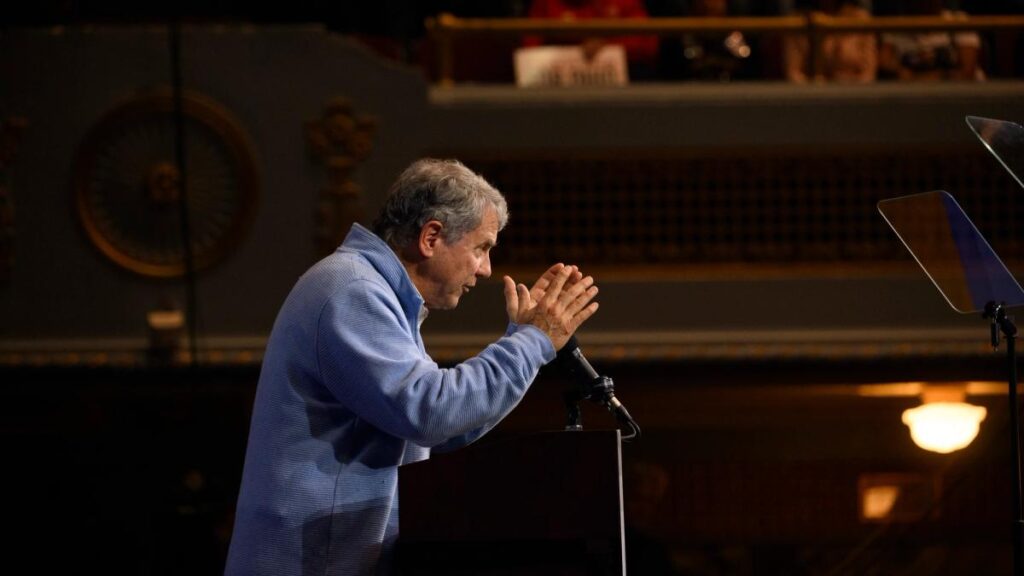
The digital asset sector has never invested this much capital to derail the political ambitions of an individual: former U.S. Senator Sherrod Brown.
A single political action committee, which serves as the sector’s premier Fairshake super PAC, is channeling nearly $56 million into suppressing Brown’s political momentum. The prior instance of comparable spending occurred two years ago against the exact same politician, when about $40 million was deployed to assist Bernie Moreno in defeating the entrenched Senate incumbent, who previously led the Banking Committee.
Combined with the $7.2 million contributed independently by Tyler and Cameron Winklevoss via their own PAC to thwart Brown this cycle, according to recent federal disclosures, the industry has staked roughly $63 million on Tuesday’s Ohio election. This brings the total sector expenditure against one veteran lawmaker in Ohio to more than $100 million over the past two years.
Why is the digital asset industry going to such lengths to eliminate Brown from the political landscape? It wants to prevent history from repeating itself. The senator spent years heading the committee responsible for approving digital asset legislation, yet he consistently blocked it, causing House crypto initiatives to stall. During the two years since his removal, the Senate successfully advanced a major stablecoin bill and neared the completion of a market structure measure.
Current polls now place the Ohio showdown among the tightest Senate tossups of the year, with Brown holding a narrow advantage over incumbent Jon Husted while remaining within the margin of error across most surveys. Nonetheless, prediction markets on Kalshi assign Brown a 68% probability of returning to the Senate. That same platform gives the broader Democratic Party a 68% likelihood of recapturing the chamber.
Should he secure a Senate comeback while Democrats hold congressional control, political strategists in the crypto sector anticipate he will secure an influential assignment, potentially chairing the Senate Agriculture Committee, where he previously directed a subcommittee. Senate leadership assignments are dictated by seniority, and because Brown’s consecutive service was interrupted by his prior defeat, his party would need to grant an exception for him to hold a high-profile post.
Within the Senate Banking Committee he formerly directed, Senator Elizabeth Warren steadily accumulated seniority under Brown and is now positioned to claim the gavel as chairwoman if Democrats secure the majority. With Warren, one of the legislature’s fiercest opponents of digital assets, directing that panel, alongside Brown in a powerful position with decisive authority over relevant legislation—such as the agriculture committee overseeing derivatives oversight—the Senate could prove an adverse environment for cryptocurrencies.
Despite a significant faction of Senate Democrats willing to negotiate a digital asset market structure bill, evidenced by prolonged discussions over the Digital Asset Market Clarity Act this year, that willingness might fall short if the leaders controlling essential committee agendas refuse to revisit the topic. The past two years of Banking Committee Democrats bypassing Warren’s stance on the Clarity Act might not persist if she holds ultimate authority over the panel’s agenda. A similar approach could be anticipated from Brown.
Through Fairshake’s allocation of tens of millions, the sector’s political arm may further ensure that a Brown victory elevates an outspoken critic—whom Tyler Winklevoss once labeled a “crypto public enemy”—into office, while simultaneously reinforcing the impression that this self-described nonpartisan movement favors Republicans. (In Fairshake’s other major general-election expenditure, it committed nearly $11 million to defend Republican Senator Pete Ricketts in Nebraska.)
During his tenure leading the Senate Banking Committee, Brown was not nearly as vocal an adversary of the asset class as his Democratic colleague Warren. However, throughout his ongoing campaign, he began regularly criticizing the cryptocurrency and data-center sectors after they commenced deploying massive funds to influence Ohio voters.
In a recent address, he stated, “They know I’m going to take them on.”
Politically, this locks both factions into a high-stakes confrontation. The existential clash has been integrated directly into Brown’s platform, with him rallying supporters to stand against technology billionaires.
“This is a staggering strategic blunder,” observed Dennis Porter, CEO and co-founder of the Satoshi Action Fund, who has actively campaigned for crypto-supportive regulations in statehouses and before Congress. “The crypto industry desperately needs bipartisan support to pass durable legislation, yet its super PACs are spending tens of millions attacking Sherrod Brown at the very moment Democrats could reclaim power.”
During 2024, digital asset executives were more transparent regarding their opposition to Brown, with Coinbase CEO Brian Armstrong publicly designating him “one of the most anti-crypto senators out there” and claiming responsibility for his defeat, implying that other legislators would subsequently exercise caution before targeting the sector. This time around, executives are refraining from making such direct remarks about politicians, yet Coinbase, a16z, and Ripple Labs have maintained robust funding for Fairshake, allowing the super PACs to voice their message.
“Political power changes hands,” Porter contended. “Burning bridges with the party you may soon need to negotiate with isn’t just shortsighted. It’s political malpractice that could set the industry back for years.”
A newer advocacy organization, the Digital Sovereignty Alliance, argued that the capital deployed by Fairshake and allied PACs does not necessarily reflect the broader ecosystem.
“The money being spent against him comes from a handful of very well-funded players,” DSA Managing Director Adrian Wall mentioned in a statement provided to CoinDesk. “It doesn’t speak for the developers, entrepreneurs, small businesses and everyday users who make up the vast majority of this community, and who mostly want what any industry wants, which are clear rules, fair treatment and a seat at the table.”
“We’d urge Senator Brown not to judge an entire industry by the ad budgets of a few,” Wall added, pointing out that Brown has acknowledged crypto maintains a valid function in the U.S. economy, calling it a “welcome perspective, and one we don’t take for granted coming from one of the industry’s most prominent critics.”
Originally published at https://www.coindesk.com/news-analysis/2026/11/01/sherrod-brown-s-ohio-edge-threatens-a-rough-go-for-crypto-next-year.