Right around the time of the Binance exploit and the US midterm elections, Paul Sztorc deployed his long-anticipated Bitcoin hard fork, designated as the eCash network.
On October 29, LayerTwo Labs founder and the primary advocate behind the Bitcoin Drivechain proposals BIP300 and BIP301, Sztorc released a separate Bitcoin fork intended to introduce payments, privacy features, and alternative applications onto a network derived from the codebase of Bitcoin.
“We need to actively fight against the stagnation mindset hurting Bitcoin,” Sztorc informed Magazine.
“We want to identify the authentic Bitcoin creators and provide them with the apparatus to genuinely innovate. We simply require open-minded, risk-embracing contrarians to step forward and construct.”
This hard fork grants qualified Bitcoin owners a fascinating bonus: an identical balance of the new network’s native asset, ECX, matching their BTC holdings.
Consequently, what advantages does eCash offer creators, and what can Bitcoin HODLers actually do with their newly acquired coins?
What is eCash?
Engineered by Sztorc’s LayerTwo Labs, eCash functions as a distinct hard fork of Bitcoin that emerged from Sztorc’s frustration regarding specific complacency narratives and dogmatic toxicity he believes have hindered Bitcoin’s progress.

Sztorc dismisses criticism of Drivechains’ security. Source: archive.ecash
The core innovation revolves around Drivechains, an architecture granting developers the autonomy to construct independent sidechains equipped with diverse functionalities without altering Bitcoin’s underlying base-layer protocol (or, in this scenario, the eCash base layer).
Builders can experiment with various use cases addressing payments, privacy, digital tokens, and prediction markets, while miners can boost their profits by collecting extra transaction fees.
Five sidechains debuted alongside the eCash mainnet: BitNames, BitAssets, Thunder, Truthcoin, and zSide, with two additional options, the quantum-resistant Photon and the decentralized platform CoinShift, scheduled for future release.
Related: Blockchain developer Paul Sztorc announces BTC hard fork eCash
Sztorc has spent over ten years campaigning for Drivechains, maintaining that Bitcoin’s famously rigid development philosophy has restricted its true capabilities.
“Anything failing to maximize network utilization is merely a distraction,” he states. “End users, the individuals funding miner transaction fees, emerge victorious in the long run.”
Getting access to the new coins
The eCash fork occurred at Bitcoin block 973,728, meaning anyone maintaining custody of their private keys during that snapshot obtained an equivalent ECX amount.
“If you managed your own BTC keys at that precise block height, you currently possess the exact same quantity of ECX,” LayerTwo Labs explained to Magazine. “It remains that straightforward, and those tokens are available to you immediately.”
Much like beauty, simplicity is subjective, meaning Bitcoin supporters utilizing self-custody must employ a wallet supporting eCash and rigorously execute the steps required to separate ECX from BTC.
Because both networks share a common transaction record, an unprotected transaction on one network risks being replayed on the other.
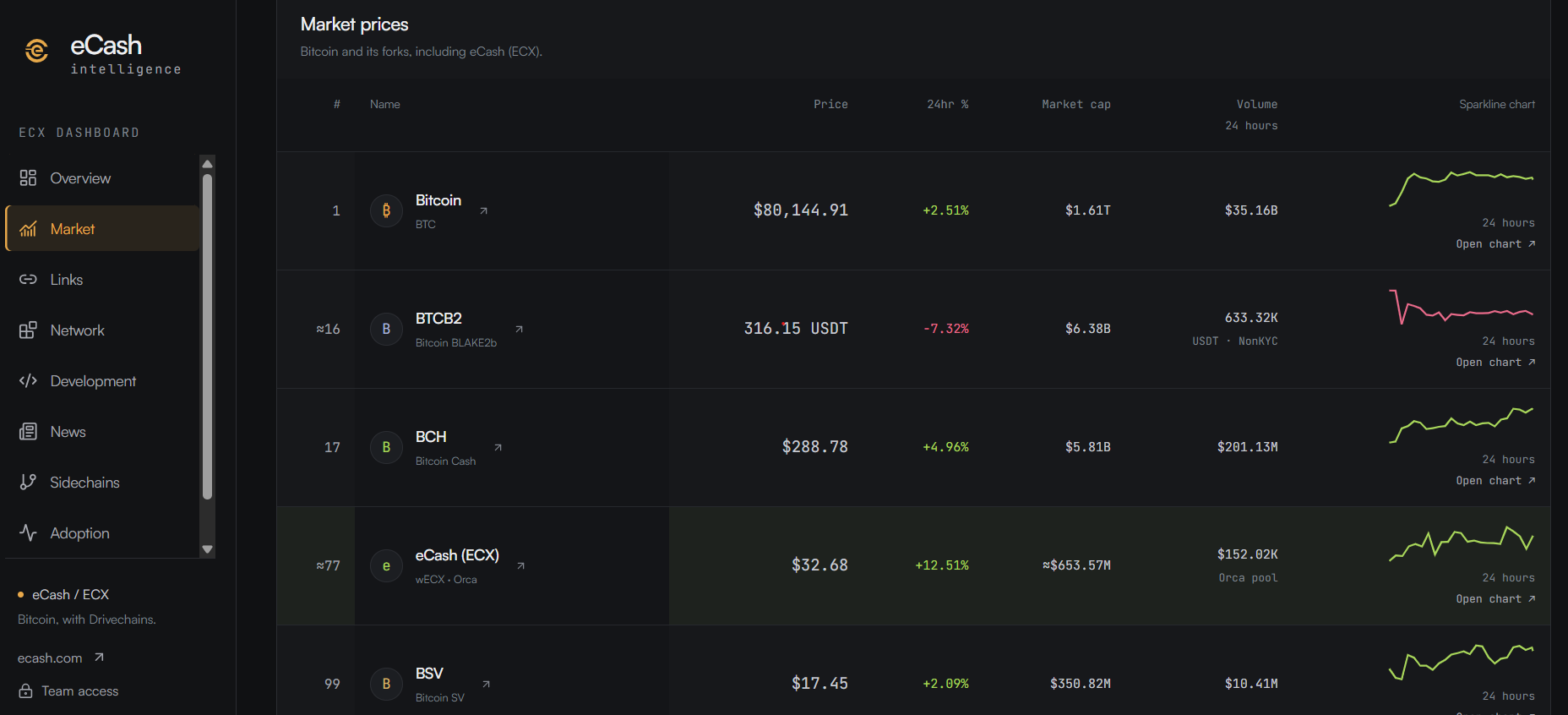
eCash Market prices. Source: eCash.
“Avoid transferring your BTC first, because a standard, unsecured BTC transfer can easily be replicated across the ECX network,” LayerTwo Labs cautioned. While anti-replay defenses are integrated into the protocol framework, the enterprise recommends transferring ECX holdings prior to spending any BTC.
Individuals keeping BTC on centralized trading venues remain completely dependent on those platforms regarding token distribution, and must verify whether their chosen exchange supports the fork or has scheduled an ECX airdrop.
Where can holders trade ECX?
Securing access to ECX is distinct from liquidation capabilities, and these tokens remain absent from major centralized cryptocurrency exchanges. Depending on your jurisdiction, cryptocurrency forks can trigger distinct tax consequences, making it wise to research regulations prior to submitting your upcoming tax filings.
NeoxaEX reported the opening of direct ECX deposits, withdrawals, and trading on October 29 featuring ECX/USDT, ECX/USDC, and ECX/BTC trading pairs, whereas CoinW revealed intentions to distribute ECX to qualifying Bitcoin owners, with deposit, withdrawal, and trading schedules to be shared later.
Orca, a decentralized exchange operating on Solana, allows traders to exchange USDC for wrapped ECX (wECX) utilizing a liquidity pool. This supplies an alternate method to gain exposure to ECX price action, although it involves a wrapped token on an alternate blockchain instead of native ECX trading within the eCash architecture.
Related: Binance, Polymarket seek Polygon hard fork to recover $6.8M in stolen crypto
What is the financial valuation of these tokens? CoinMarketCap valued ECX around $32.63, with roughly $355,000 in 24-hour trade volume as of November 5, whereas CoinGecko lists the asset as a preview asset with no current price feed or monitored exchange venues. Digital asset metrics tracker Kaiko notes that it does not monitor ECX, restricting access to external market data.
LayerTwo Labs notes that early sessions saw ECX swing between $40 and $50, though it did not disclose order book depth or trade volume metrics, pointing instead to the total value locked inside the Orca liquidity pool as an indicator for users to evaluate available liquidity.
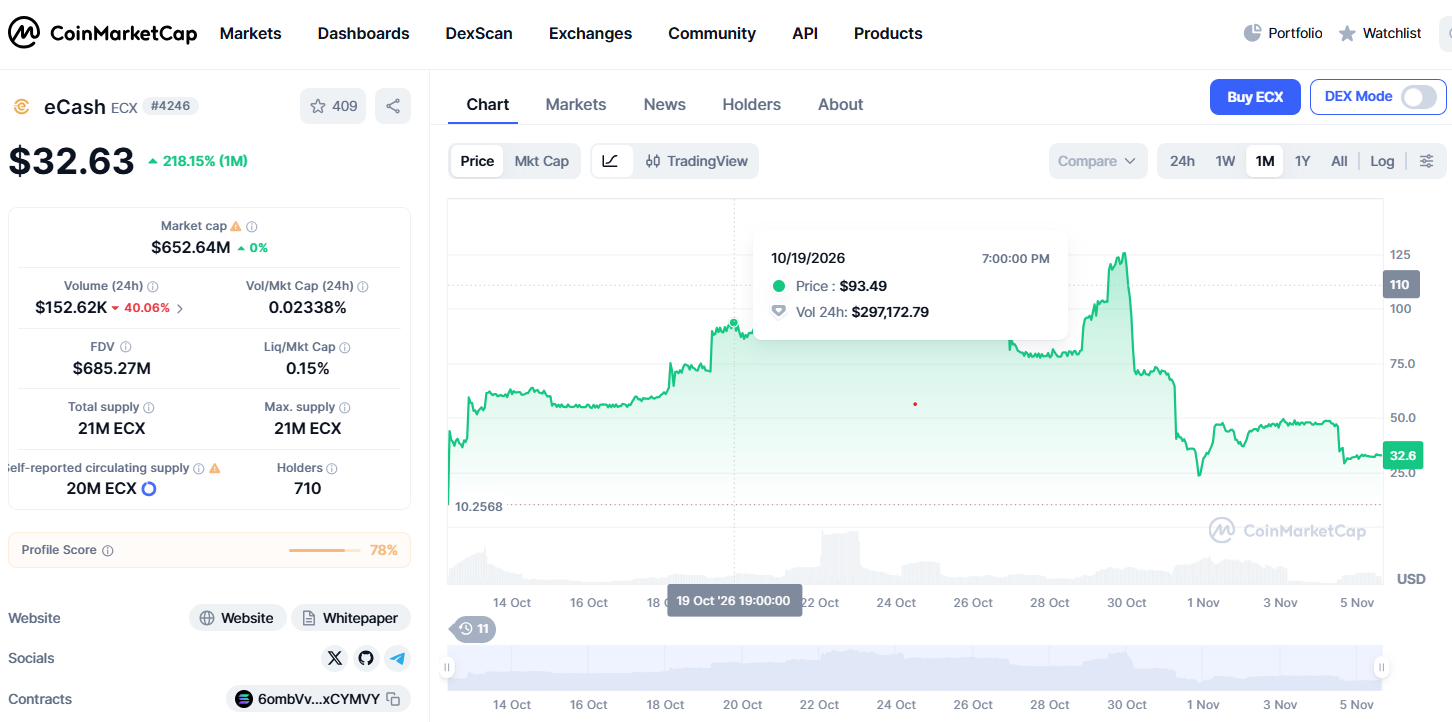
eCash is $32.63 on CoinMarketCap as of Nov. 5
“Should our fork duplicate even a small percentage of Bitcoin Cash’s early performance,” Sztorc remarks, “the ensuing liquidity will prove monumental,” adding that anyone anxious about thin liquidity can keep their tokens and determine their actions later.
“We are actively onboarding new trading platforms and pairs, meaning the user journey will only get better,” he asserts. “Otherwise, individuals are free to accept their complimentary assets and depart.”
A different vision for Bitcoin
Sztorc mentions that the true worth of eCash will ultimately hinge upon whether programmers construct functional utilities and whether users prove willing to pay for them. Active customers and collected transaction fees serve as the primary metrics for evaluating the initiative during its initial operational year.
He remains unconcerned regarding criticisms directed at the security architecture of Drivechains, specifically the fear that miners could collude to steal capital stored on sidechains.
“If someone genuinely believes miners will sabotage their own billion-dollar businesses for a quick theft on a layer-two network, they shouldn’t trust Bitcoin’s base layer either,” he declares.
Therefore, at present, eCash supplies Bitcoin enthusiasts with a novel asset and developers with an experimental landscape — though whether ECX evolves into something greater relies entirely on whether anybody chooses to utilize it.
Magazine: Bitcoin turns 18: Has the original rebel grown up?
Originally published at https://cointelegraph.com/magazine/bitcoin-holders-have-received-ecash-what-can-you-with-it?utm_source=rss_feed&utm_medium=rss&utm_campaign=rss_partner_inbound.