Nov 12, 2026, 6:30 a.m. EST
4 min read
Summary
- ETF withdrawals now amount to approximately $1.44 billion across five consecutive days, with BlackRock’s IBIT maintaining a nine-session streak.
- Nasdaq-100 futures decline by 0.6%, surrendering a portion of the gains from Wednesday’s CoreWeave-driven surge.
- Zcash participants will cast votes between November 16 and 30 regarding an initial proposal to eliminate 50,000 ZEC, valued at roughly $50 million, from the community grants reserves.
Bitcoin BTC is lower by 0.7% since midnight UTC, trading near $73,400 and hovering close to its daily minimum as a broader equity selloff in technology shares widens. Ether ETH drops 0.5% to approximately $2,044, while the CoinDesk 80 Index records a 1% decline. Across a 24-hour window, bitcoin has dropped 0.8% and ether has fallen 0.7%.
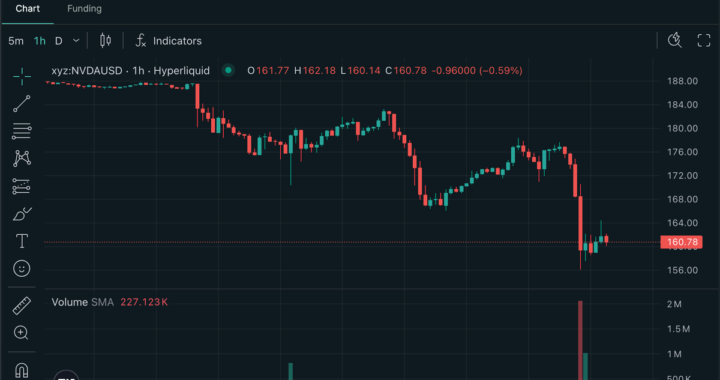
Nvidia acts as the primary catalyst, with its equity dropping roughly 7% in pre-market activity following a New York Times report indicating that CEO Jensen Huang maintained an involvement with a corporate executive, alongside a Wall Street Journal report stating that the board is preparing to dismiss him. Nvidia has not issued an official determination. Nasdaq-100 futures slide 0.6%, giving back some of the momentum generated by Wednesday’s CoreWeave-led advance.
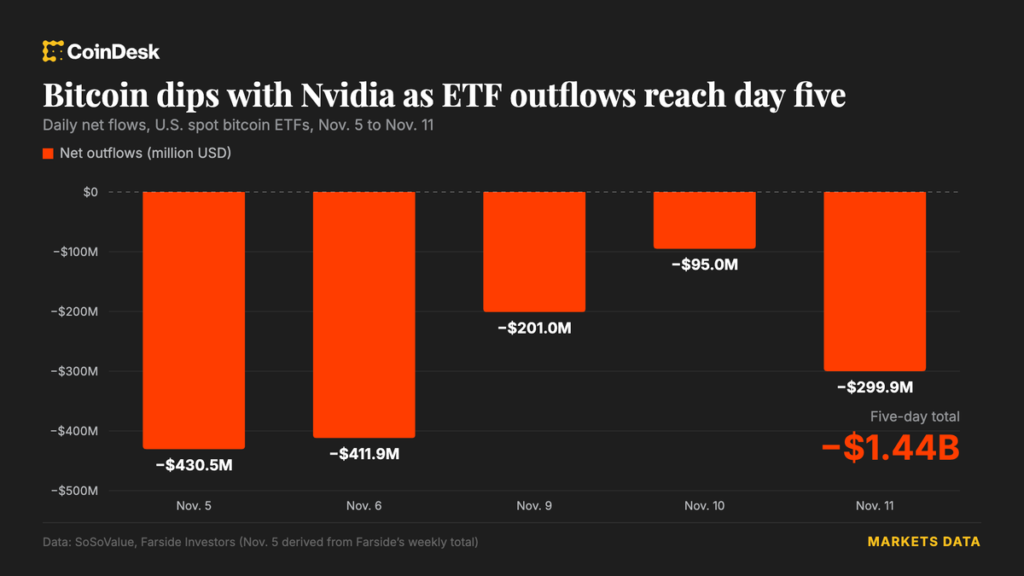
A lack of demand within the digital asset sector compounds the pressure, as U.S. spot bitcoin exchange-traded funds registered $299.9 million in net withdrawals on Wednesday, according to SoSoValue metrics. This marks a fifth uninterrupted day of outflows, bringing the cumulative total to roughly $1.44 billion beginning November 5. BlackRock’s IBIT contributed $269.7 million to that total, marking its ninth successive session of redemptions.
Initial jobless claims are scheduled for release at 13:30 UTC, while market participants also monitor developments regarding any decision from Nvidia’s board. The Federal Reserve convenes from December 8 through 9, with CME FedWatch probabilities pricing in roughly a 90% likelihood of a rate increase.
Derivatives positioning
- Crypto futures trading slows: Over the past 24 hours, futures turnover dropped 20.64% to reach $168.6 billion, while open interest (OI) contracted by 2.92% to settle at $125.8 billion. This indicates cooling participation and capital exiting the sector as positions closed out. Liquidations shrank 63.67% down to $263.7 million, though long positions comprised 64.5% of the aggregate, pointing to a heavier flush of longs compared to shorts.
- BTC futures volume drops: The bitcoin futures market observed capital departures, reflected by a 2.9% drop in open interest alongside a 0.6% price retreat. Turnover declined by 27.6%, and cumulative volume delta (CVD) remains negative, indicating that market orders skewed toward selling pressure. Funding rates hold moderately positive, meaning long traders compensate short traders. Furthermore, BTC registered the highest liquidations across all tokens at $62.9 million.
- ETH OI drops slightly: Ether futures likewise experienced capital outflows, albeit milder, with open interest dipping 1.8% against a 0.6% price decline. Turnover dropped 37.2%, representing the steepest contraction among major assets, signaling significantly thinned activity. Cumulative volume delta is neutral, suggesting market-order purchases and sales balanced out, while funding remains moderately positive, requiring longs to pay shorts.
- XMR funding overheats: The annualized average funding rate for privacy-centric Monero (XMR) perpetual swaps across trading venues sits near 80%, outpacing every other digital asset and continuing an upward trajectory since early morning. Consequently, long positions are paying substantial fees to shorts. Most other assets, including bitcoin and ether, remain moderately positive where longs pay shorts, yet without extreme deviations. GRAM, formerly Toncoin, stands apart on the negative spectrum, meaning short positions compensate long holders.
- CVD leans to selling: Open-interest-adjusted cumulative volume delta points negative for the majority of major cryptocurrencies, including bitcoin, signaling a proclivity for market-order sales. This reflects overarching bearish sentiment across the broader marketplace. GRAM, NEAR, and ZEC represent positive exceptions.
- DOGE and ZEC futures see large capital outflows: Capital retreated from Dogecoin (DOGE) futures, with open interest decreasing 5.9% alongside a 1.5% asset price reduction. Zcash exhibited a parallel trend, as open interest fell 5.4% against a 0.4% price dip. ZEC’s cumulative volume delta is positive, indicating that market orders favored buying even amidst capital withdrawals.
- BTC options show put skew: The bitcoin options skew—denoting the pricing premium of puts over calls—remains positive and ticked upward to approximately 11% looking at a one-week horizon. Simultaneously, one-week implied volatility, representing expected price fluctuations anticipated by options traders, moderated to roughly 35% compared to Tuesday’s 38%. Four out of the six most actively traded contracts are call options, spearheaded by the $80,000 strike expiring on December 25. The remaining two comprise put options at the $73,000 and $74,000 strikes expiring November 13.
- Put skew intact in ETH: The one-week skew for ether crept up to approximately 12%, preserving the cost advantage for protective put options. Four of the six highest-volume contracts are puts, although the single most active agreement is the $2,200 call expiring on November 20.
Token talk
- Gram (GRAM), the rebranded toncoin, claims the top position on the CoinDesk 100 for a second consecutive day, advancing 5.2% since midnight UTC as Telegram’s integration push continues gathering attention. Founder Pavel Durov noted earlier in the week that over 700,000 wallets were established within the application in a 48-hour span.
- Zcash (ZEC) stages a recovery, moving up 2.4% following a difficult commencement to the week. A proposed draft framework aims to extract 50,000 ZEC, valued at roughly $50 million, away from the Zcash Community Grants treasury, with token holders scheduled to vote between November 16 and 30.
- Render (RENDER), the decentralized GPU network, experiences a 3.1% decline in tandem with Nvidia’s downward movement.
- Avalanche (AVAX) records a 2.0% gain as market participants continue evaluating Monday’s disclosure that a clearing entity associated with a planned New York Stock Exchange-linked tokenized securities platform intends to utilize its blockchain infrastructure, pending regulatory clearance.
- DeFi remains an area of weakness. The CoinDesk DeFi Select Index (DFX) pulls back 1.6%, with Aave AAVE, ether.fi (ETHFI), and Ethena (ENA) all dropping between 2.5% and 3.3%. Monero (XMR) displays even greater weakness, shedding 4.5% as the poorest performer within the CoinDesk 100, though no definitive catalyst accounts for the movement of either.
- Altcoin season appears distant. CoinMarketCap’s metric rests at 39 out of 100, dropping from yesterday’s reading of 40 and remaining far below the threshold of 75 that indicates such a phase, while the fear and greed index registers at 26, residing firmly in fear territory.
Related Assets
Originally published at https://www.coindesk.com/markets/2026/11/12/bitcoin-dips-with-nvidia-as-etf-outflows-reach-day-five.