The artificial intelligence trade remains active, according to a pair of traders who view the recent technology stock sell-off as a healthy market correction rather than the conclusion of an investment wave that has led financial markets.
As excitement for both artificial intelligence and cryptocurrencies quickly faded on Tuesday following a strong rally on Monday, at least a couple of market participants stay positive about the outlook for artificial intelligence equities and potentially the wider market.
When questioned if the return of Huang signaled a resurgence of the artificial intelligence trade, Mark Connors, chief investment officer at Risk Dimensions, rejected the notion that it had ever disappeared. “It never died,” he stated. “What this demonstrates is that this is a competition that must be won, seemingly at any expense.”
In Connors’ view, the implications extend far beyond Wall Street. Corporations and sovereign nations are competing to secure leadership in artificial intelligence, while retail participants seek avenues to monetize the innovation.
He highlighted Palo Alto Networks’ planned $4.5 billion purchase of Applied Compute as a prime illustration. This transaction expands the cybersecurity firm’s footprint in artificial intelligence, enabling it to assist enterprises in training, tailoring, and running artificial intelligence models rather than solely protecting the underlying architecture.
"We are only beginning to understand what this sector will evolve into and, more significantly, how deeply it will transform traditional industries and their financial models," Connors remarked.
He likened the present financial climate to the year 1995, implying that the artificial intelligence investment surge resembles the nascent phase of the internet rather than the peak of the dot-com era.
At the same time, Chris Sullivan, co-portfolio manager at Hyperion Decimus, noted that Huang’s comeback supports the market, though technology shares had simply become excessively pricey.
"Pricing levels were completely absurd," he noted. "The pullback was undoubtedly harsh and necessary, and I certainly anticipate a rally lasting multiple weeks at minimum."
Sullivan maintains that a significant portion of the worries that previously pressured the market is now priced in, leaving corporate revenue and macroeconomic conditions to dictate future equity directions.
The timing might also favor investors as financial markets enter what Sullivan characterized as a historically robust seasonal timeframe. He is wagering against another monetary policy tightening move by the Federal Reserve.
"Should the central bank refrain from hiking rates, which is my forecast despite market consensus suggesting otherwise, a substantial rally is approaching across the majority of asset classes," he stated.
That condition involves substantial uncertainty. Government bond yields stay high, and projections for continued Federal Reserve policy tightening remain strong, according to Joel Kruger, market strategist at LMAX Group.
Market participants will gain a clearer picture regarding the trajectory of monetary policy on Wednesday with the publication of the core personal consumption expenditures price index, which serves as the central bank’s favored gauge for core inflation.
"A robust print would validate forecasts for additional central bank tightening and might introduce fresh headwinds for rate-vulnerable technology equities," Kruger mentioned.
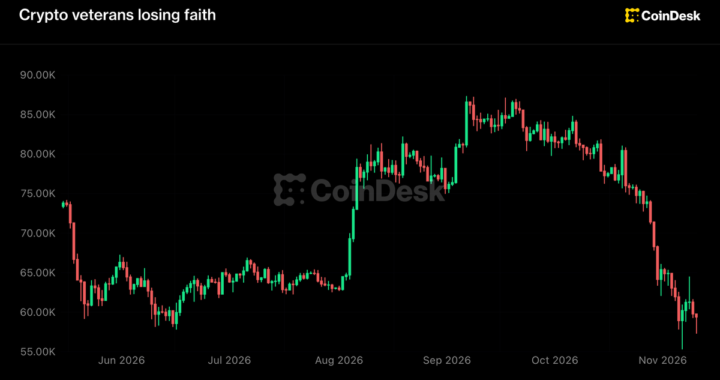
Regarding bitcoin, however, a rebound in technology equities might prove insufficient. Although the digital asset generally thrives during periods of strong market risk appetite, it additionally faces competition against artificial intelligence equities for capital allocation from investors.
Connors stated he is monitoring whether bitcoin continues to be "ignored by marginal purchasers occupied with the artificial intelligence commotion."
Originally published at https://www.coindesk.com/markets/2026/11/24/ai-trade-never-died-traders-see-room-for-market-recovery-despite-bitcoin-s-weakness.