Nov 25, 2026, 12:38 p.m. EST
4 min read
Summary
- Bitcoin fell to as low as $57,300 early Wednesday as tech stocks slid and hotter-than-expected U.S. inflation added concerns about tighter monetary policy.
- Investors are building cash reserves and reducing leverage, strategist said, while some longtime crypto investors say concerns about artificial intelligence and blockchain security are adding to their reluctance to buy.
- Galaxy withdrew its call that bitcoin’s bear market had ended, warning that a close below $58,525 could signal further declines, with historical patterns pointing toward $48,500.
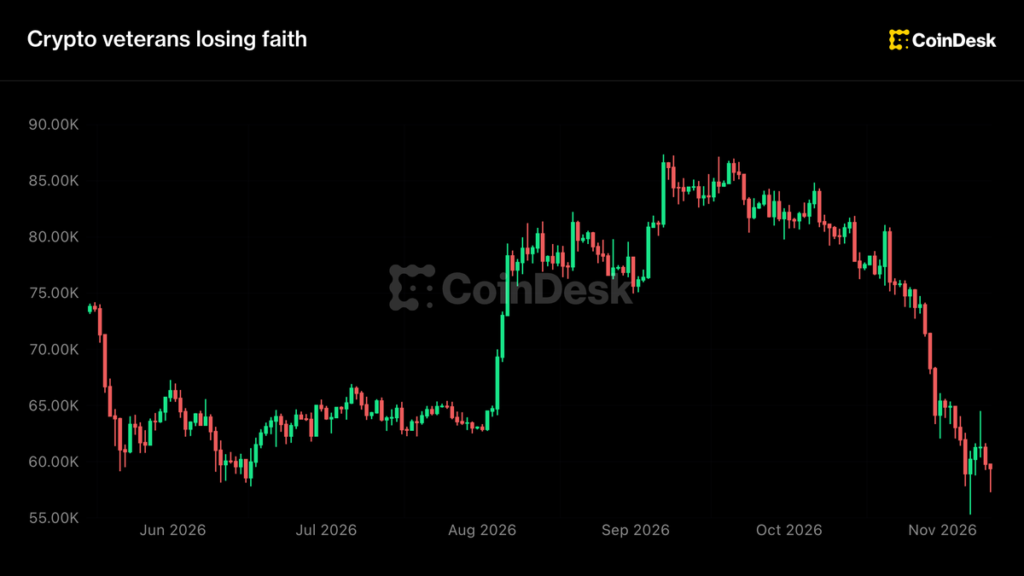
Bitcoin BTC $58,586.33 plunged past $58,000 on Wednesday as another heavy tech stock selloff and stronger-than-projected U.S. inflation placed digital asset traders facing potential new bear market bottoms.
BTC dropped as far down as $57,300 near the opening of the U.S. session before rebounding slightly above $59,000. It now hovers near the $55,100 low observed last weekend, prompting analysts who previously anticipated a rebound to rethink their positions.
The equities market suffered comparable damage, erasing a significant portion of the rally triggered by Jensen Huang resuming his role as Nvidia CEO on Monday. Early U.S. trading saw the Nasdaq 100 drop 4.2% and the S&P 500 lose 2.8%, though both indices managed to recover a portion of these losses by afternoon.
Selling pressure continues to mount.
“Core PCE came in hotter than expected, complicating the Fed’s job heading into 2027,” stated Matt Mena, senior crypto research strategist at 21Shares.
Following the inflation report, bitcoin experienced an additional 1% drop, he observed. Mena points to $53,000, which is close to bitcoin’s realized price, as the next critical support level. A persistent breakdown below this threshold could expose the asset to $48,500.
Paul Howard, senior director at trading firm Wincent, mentioned that the selloff has driven traders to increase short positions in perpetual futures as a hedge against continued losses.
He also highlighted reports regarding upcoming U.S. tariffs and potential selling pressure stemming from end-of-month MSCI index rebalancing linked to Strategy, the bitcoin treasury company MSTR $75.76.
“I expect the current momentum to continue driving majors lower,” Howard stated.
Where the money is going
Investors appear to be shifting capital into the U.S. dollar, government bonds, and other safe-haven segments of the equities market while preparing for stricter monetary policies.
Chris Sullivan, co-portfolio manager at Hyperion Decimus, noted the strength of the dollar index (DXY) alongside demand for longer-dated U.S. Treasury bonds, even while short-term debt continues to face selling pressure.
Current market pricing reflects expectations of a 25-basis-point interest rate increase by the Federal Reserve in December, though Sullivan anticipates cooling inflation and believes financial conditions have already tightened sufficiently.
Meanwhile, Mark Connors, chief investment strategist at bitcoin investment advisory Risk Dimensions, reported that Treasury bill inflows over the previous week ranked inside the top 20% of historical observations.
Interest in small-cap stocks and broader market equity funds remains robust, whereas capital flows into Nasdaq 100 futures have softened despite selective accumulation of semiconductor equities.
Within the digital asset space, Connors indicated that ongoing bitcoin ETF redemptions seem to stem from the unwinding of futures-based carry trades rather than bullish sentiment, though the broader trend shows market participants amassing cash, cutting leverage, and rotating away from tech and crypto without completely abandoning risk assets.
Galaxy takes back its bitcoin bottom call
A primary indicator of this shifting sentiment came from Galaxy, where head of firmwide research Alex Thorn retracted the company’s October prediction that the bitcoin bear market had concluded in June.
The initial hypothesis relied partly on bitcoin reclaiming its 50-week moving average, a threshold that previously signaled the end of historical bear markets.
That indicator has since failed. Following seven consecutive weekly closes above the average, bitcoin dipped below it, surrendered its 200-week moving average, and dropped past the summer intraday low.
“Previously, no reclaim of this kind had been followed by a new low,” Galaxy’s research report stated.
The institution now views a daily close below $58,525, which was bitcoin’s closing low on June 30, as an indicator that a significantly lower bottom could be approaching.
Galaxy’s analysis of seven previous bear market cycles—where bitcoin fell past a low that had remained intact for at least 60 days following a recovery of 20% or more—revealed that prices ultimately declined by at least another 17%. Applying this metric to the June low yields a target of roughly $48,500.
Furthermore, bitcoin’s pullback from its 2025 peak has been relatively mild compared to previous bear markets, despite extending over a longer duration than past cycles.
“The clock says this bear is overdue to end, the depth says it has further to fall,” Galaxy noted.
Nevertheless, not everyone has abandoned hope for a recovery. 21Shares strategist Mena still projects a potential climb toward $72,000–$80,000 before the conclusion of the year if inflation subsides.
Even crypto veterans are reluctant to buy the dip
Typically, extreme pessimism prompts seasoned crypto investors to seek out discounted assets. However, current market conditions have instilled fear even among veterans, driven by concerns that extend beyond equity market downturns and Federal Reserve actions.
“I’ve been in crypto since ’17 and sentiment [right now] seems about as bottomed as I’ve ever seen it,” said José Maria Macedo, co-founder of Delphi Digital. “In any other cycle this is where I’d look to start buying, but this time actually seems different.”
Macedo expressed anxiety that advancements in artificial intelligence could expose vulnerabilities in smart contracts, multi-signature wallets, and the underlying cryptography of blockchains. Even in the absence of a confirmed exploit, anxieties regarding the capabilities of advancing AI systems could deter market participants, he maintained.
“It’s hard for me to see a sustained recovery while there’s so much uncertainty about whether crypto’s security can withstand increasingly capable AI,” he stated.
“My guess is the next 12-24 months will be brutal, but the networks that survive and harden could emerge as some of the safest places in the world to keep your money.”
Joshua Lim, global co-head of markets at institutional crypto brokerage FalconX, voiced comparable anxieties, referencing reports about breakthroughs in decryption methods, ongoing quantum computing threats, and questions surrounding long-term bitcoin security.
“Crypto has historically served as a haven from traditional financial markets breaking, but the thesis is muddled now,” Lim told CoinDesk.
Related Assets
Related Stocks
Originally published at https://www.coindesk.com/markets/2026/11/25/this-time-actually-seems-different-crypto-veterans-brace-for-more-pain-as-bitcoin-tumbles.