Throughout most of the past year, gold maintained an advantage over bitcoin as a safe-haven asset, delivering positive risk-adjusted returns instead of the negative figures recorded by the leading cryptocurrency.
That advantage has now disappeared, and gold is similarly failing to reward investors for the price fluctuations they endure.
To understand why this is significant, consider how investors determine which assets to keep. When they assume additional risk, they anticipate higher compensation. Equities, for instance, ought to deliver superior returns through capital appreciation and dividends compared to government-issued bonds.
One standard metric is the Sharpe ratio, which evaluates an asset’s return above the yield on the United States three-month Treasury bill—deemed a risk-free investment—divided by its volatility. A positive figure indicates that investors were rewarded for a more turbulent journey, whereas a negative value suggests they were not.
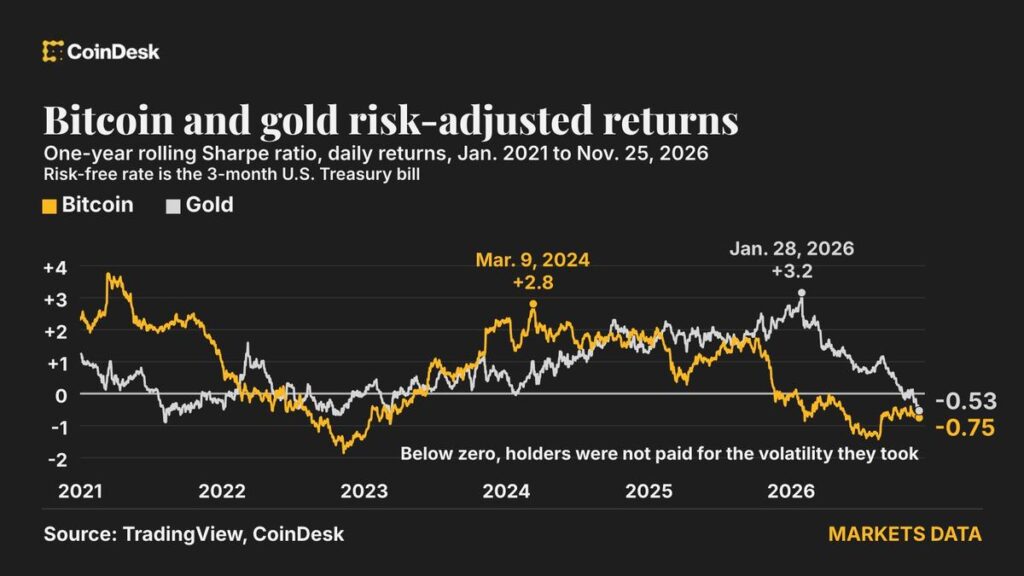
Based on CoinDesk’s computations, gold’s one-year Sharpe ratio recently stood at -0.53, while the figure for bitcoin, regarded by some analysts as digital gold, was -0.75. This implies that neither asset is adequately rewarding investors for their volatility relative to high-yielding, highly liquid cash equivalents, signaling a broader investor rush toward cash.
Nevertheless, this alignment in metrics does not signify a convergence in the foundational drivers of the precious metal and the digital currency. Instead, it highlights a cyclical shift in capital deployment, according to Tim Sun, senior researcher at HashKey Group.
“A drop in gold’s Sharpe ratio does not mean Bitcoin is evolving into a superior safe-haven instrument,” Sun shared with CoinDesk. “On the contrary, it likely indicates that market participants are re-evaluating the allocation value of the entire non-yielding asset category. Consequently, the primary competition facing both gold and Bitcoin right now may not be each other, but rather cash-equivalent instruments and premium bonds capable of delivering relatively dependable yields.”
Gold’s Rapid Decline
Historical figures illustrate how swiftly the environment has transformed over the course of the year.
Gold’s one-year rolling Sharpe ratio had remained securely positive since April 2023, discounting a brief two-day decline in January 2024, and reached an exceptional peak of 3.2 on January 28, 2026.
For bitcoin, the ratio has stayed negative since November, following a peak of 2.8 recorded in March 2024.
“The chart does not demonstrate that bitcoin has matured into digital gold. If anything, it illustrates gold drifting downward toward bitcoin regarding trailing risk-adjusted returns, following a sharp reversal in gold’s exceptional trend,” noted Griffin Ardern, co-founder and portfolio manager at Primal Fund, in a statement to CoinDesk.
“When distinct assets are held by identical leveraged market participants and governed by matching risk frameworks, margin constraints, and derivatives allocations, their valuations can temporarily respond more to balance sheet limitations than to underlying fundamentals,” he explained.
Severe Price Declines
This deterioration has been propelled by steep drops in the valuations of both assets.
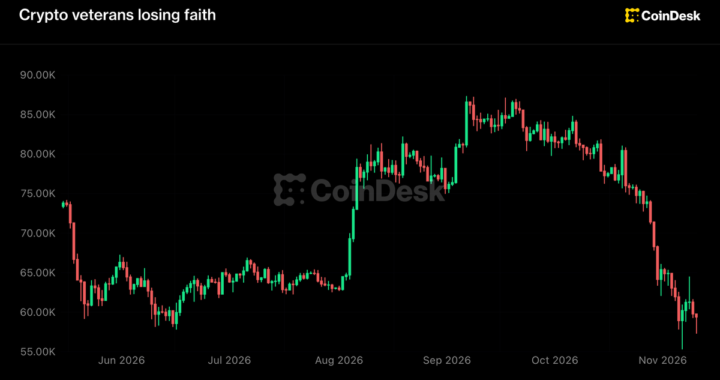
Gold peaked at $5,589 per ounce on January 28 prior to experiencing a 37% retreat. Meanwhile, bitcoin has fallen roughly 33% since the beginning of the year, trading near $59,000.
Because bitcoin’s price fluctuations typically run about 50% larger than those of gold, it continues to represent the higher-risk instrument of the pair.
“Both gold and Bitcoin face downward pressure from a strengthening U.S. dollar, which mirrors shifting expectations regarding the Federal Reserve that commenced with Kevin Warsh’s nomination as Fed chair in January, followed by the central bank’s decision to drop its easing bias in June and progressively embrace a more hawkish stance,” remarked Markus Thielen, founder of 10x Research. “This evolution in monetary expectations is weighing on both assets, and it is no coincidence that their trajectories have been remarkably parallel.”
The underlying mechanics remain straightforward. Because both assets are denominated in dollars, a strengthening U.S. currency elevates costs for international buyers.
Additionally, a hawkish Federal Reserve committed to maintaining elevated interest rates diminishes the appeal of holding assets like gold and bitcoin that generate no yield.
Gold Surpasses Over the Long Term
While the short-term tactical outlook appears challenging, an extended historical perspective underscores the structural advantage gold retains over its digital alternative.
Evaluated over a three-year timeframe, gold’s Sharpe ratio registers at a steady 0.77 compared to just 0.46 for bitcoin. Over five years, gold leads by 0.60 to 0.21. Across both primary institutional benchmarks, gold has significantly outperformed bitcoin on a risk-adjusted basis.
In fact, the sole extended period where bitcoin holds an advantage began back in 2020, when the Nasdaq-listed enterprise MicroStrategy initiated purchases of bitcoin as a long-term treasury reserve.
Yet even with that historic bull market incorporated into the data, bitcoin’s long-term Sharpe ratio surpasses gold by a mere 0.17.
Originally published at https://www.coindesk.com/markets/2026/11/25/bitcoin-hasn-t-paid-its-holders-for-the-risk-it-carries-and-now-gold-is-doing-the-same.