This is an excerpt from CoinDesk newsletter ‘Daybook.’ Sign up here, if you haven’t already.
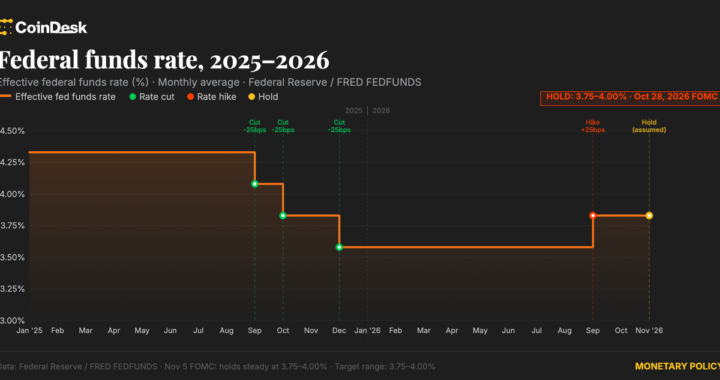
Wednesday’s U.S. core personal consumption expenditures price index figures for October are set to land with a December Federal Reserve interest-rate hike already fully accounted for, leaving bitcoin BTC$58.586,33 and other pressured markets with minimal cause for worry.
Core PCE, which excludes food and energy costs, serves as the central bank’s favored inflation metric. Projections tracked by WSJ indicate the annual rate will climb to 3.2% in October compared to 3.1% in September. Meanwhile, headline inflation is projected to have accelerated to 3.8% annually in October, advancing from 3.6% the previous month.
The data release is scheduled for 8:30 a.m. ET.
Financial markets have already factored in a 25-basis-point rate increase for December, which would push the Fed’s benchmark borrowing rate into the 4% to 4.25% bracket. An additional increase in January is currently priced at roughly a 60% probability, while JPMorgan anticipates yet another hike in March.
Such expectations have already inflicted damage upon risk-on assets, driving bitcoin down near $55,000 over the weekend and leaving it trading under $60,000—marking a roughly 24% drop for the month and a 29% decline for the quarter. Concurrently, the Nasdaq has retreated more than 7% this month and 13% across the quarter.
Consequently, the threshold for a hawkish surprise remains notably high. With so many anticipated rate increases already built into market pricing, it is difficult to gauge how much further assets might drop based solely on this report unless core PCE prints significantly above expectations.
Should the figures align with projections or come in softer, market reaction could be muted or potentially prompt an oversold recovery.
Here is how various analysts are interpreting the incoming information.
Dick Lo, founder of quantitative trading firm TDX Strategies, expressed that the data point on its own is unlikely to alter the Fed’s trajectory.
The core PCE figure is unlikely by itself to force a dovish shift from the Fed, though an in-line print could provide much-needed relief. If credit conditions worsen throughout the capital-expenditure-heavy AI sector and wider markets, the defining trigger could materialize during the December FOMC meeting if the central bank pivots its focus away from past inflation toward forward-looking credit risk, he stated.
Neil Steinhardt, head of Nexo U.S., highlighted the specific technical levels traders are monitoring on Tuesday.
The dollar, rate outlooks, and fund flows remain steady, and the upcoming core PCE release directly influences the first two metrics. The price band between $62,000 and $64,000 represents the territory buyers must reclaim, while the weekend low close to $55,000 serves as the primary downside reference level, he pointed out. Stay alert!
Today’s signal
The accompanying chart illustrates XRP’s daily price movements using candlestick formatting since the month of May. Plotted directly over the chart are the 50-day and 200-day simple moving averages.
The 50-day moving average, depicted in light blue, is declining after moving below the 200-day average over the weekend. This downward shift, recognized in technical analysis as a death cross, indicates that the short-term trend is lagging behind the longer-term trajectory and may foreshadow an extended bear market.
Bitcoin’s 50-day moving average is likewise dropping rapidly, though it has yet to cross underneath its 200-day counterpart.
Originally published at https://www.coindesk.com/daybook-us/2026/11/25/fed-s-preferred-inflation-gauge-lands-with-a-december-rate-increase-already-priced-in.