Nov 24, 2026, 11:50 p.m. EST
3 min read
Summary
- Twelve months after initiating a $1 million digital-asset test, the Czech National Bank refuses to reveal its bitcoin inventory, purchase price, or current portfolio value.
- Although bitcoin has dropped significantly since the test began, the secrecy surrounding the acquisition price and total allocation makes any financial losses impossible to calculate.
- The institution relies on a third-party custodian and books bitcoin at historical cost rather than fair market value, keeping this test portfolio separate from official foreign reserves.
Twelve months after the Czech National Bank (CNB) made headlines by purchasing bitcoin, it still declines to disclose how much it owns, the acquisition cost, or the current value of the investment following the digital currency’s severe drop.
The CNB launched a $1 million pilot portfolio on November 13, 2025, comprising bitcoin, United States dollar-pegged stablecoins, and a tokenized dollar deposit representing a blockchain-based bank deposit.
This acquisition was celebrated as a major milestone for central banking. However, one year later, CoinDesk discovered that the bank employs an external custodian to protect its bitcoin, while its audited financial documents lack any distinct market valuation for these assets.
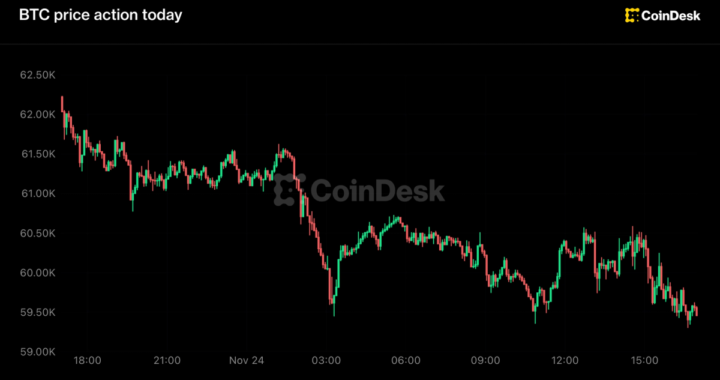
The central bank’s board authorized the trial on October 30, 2025, when bitcoin changed hands near $110,670. By the time the portfolio went public on November 13, the cryptocurrency had dropped to roughly $98,000. It hovered near $61,000 on Monday, sitting roughly 44% lower than its value at the time of the announcement.
This drop does not clarify the extent of the CNB’s losses, because the bank has consistently withheld the purchase date, acquisition price, and the precise proportion of the $1 million fund allocated to BTC versus other digital assets.
“Neither Governor Michl nor the CNB has ever commented on the price at which bitcoin was acquired,” stated Jakub Holas, head of the CNB communications division, speaking to CoinDesk earlier this week.
Furthermore, the CNB refused to state whether its bitcoin holdings have shifted since the initial acquisition or if it anticipates writing down their book value by the end of the year.
“The CNB does not disclose the detailed composition of the pilot portfolio, including individual allocations, prices, transaction dates, trading venues or counterparties,” Jaroslav Krejčí, a bank spokesperson, noted in an email to CoinDesk.
Krejčí added that the initial bitcoin acquisition “was executed on a regulated foreign exchange” and that the coins are maintained “through external custody arrangements,” indicating that an outside entity stores the assets and private keys on the bank’s behalf.
The bank withheld the names of both organizations. Utilizing a third-party custodian does not imply that the CNB lacks ownership of the bitcoin, but it confirms that the monetary authority does not manage the custody entirely internally.
Previously, the CNB evaluated self-custody options—where it would independently manage the cryptographic keys securing the holdings—alongside external custody models. It characterized establishing its own custody infrastructure as a complicated endeavor.
These funds reside within the institution’s research and innovation department, known as CNB Lab, rather than among the roughly $180 billion in international reserves overseen by Governor Aleš Michl. The central bank stated it has no plans to expand the original $1 million investment.
At cost, not market value
The bank’s audited 2025 financial statements clarify why the valuation of its bitcoin stake is not immediately transparent.
Note 2.25 in the report divides the portfolio into two separate accounting classifications. Stablecoins and the tokenized dollar deposit are treated as foreign-currency claims, whereas bitcoin falls under intangible assets, grouping it alongside items like computer software.
Note 2.17 explains that intangible assets are booked at historical cost and explicitly notes that digital assets are not subject to amortization. Unlike financial instruments regularly updated to current market prices, the bitcoin stash is consequently not automatically adjusted for daily price fluctuations.
Additionally, the financial records do not individually specify the bitcoin position, its purchase cost, or its fair market value. They also reflect the fiscal year ending December 31, 2025, which preceded much of bitcoin’s subsequent decline.
This leaves another accounting question open: whether the bank would recognize an impairment loss if bitcoin’s market price dropped below its carrying value. Earlier CNB research explored such potential allowances, yet the bank declined to specify to CoinDesk how it plans to account for a downturn in the test portfolio.
Ultimately, these figures are negligible for the central bank. The entire $1 million pilot represented approximately 0.0006% of its total assets when established, according to the CNB.
Nevertheless, the experiment aimed to educate the institution on acquiring, securing, accounting for, and administering digital assets. One year later, fundamental details regarding its personal bitcoin investment—such as the purchase volume, acquisition cost, and current market worth—remain completely unreleased.
- 1
- 2
- 3
- 4
- 5
- 6
- 7
- 8
- 9
- 10
Originally published at https://www.coindesk.com/markets/2026/11/23/a-year-after-buying-bitcoin-czech-central-bank-won-t-say-what-it-s-worth.