Bitcoin and the Nasdaq index commenced the week weakly after President Donald Trump hinted at potential additional military actions against Iran ahead of the approaching early November midterm votes.
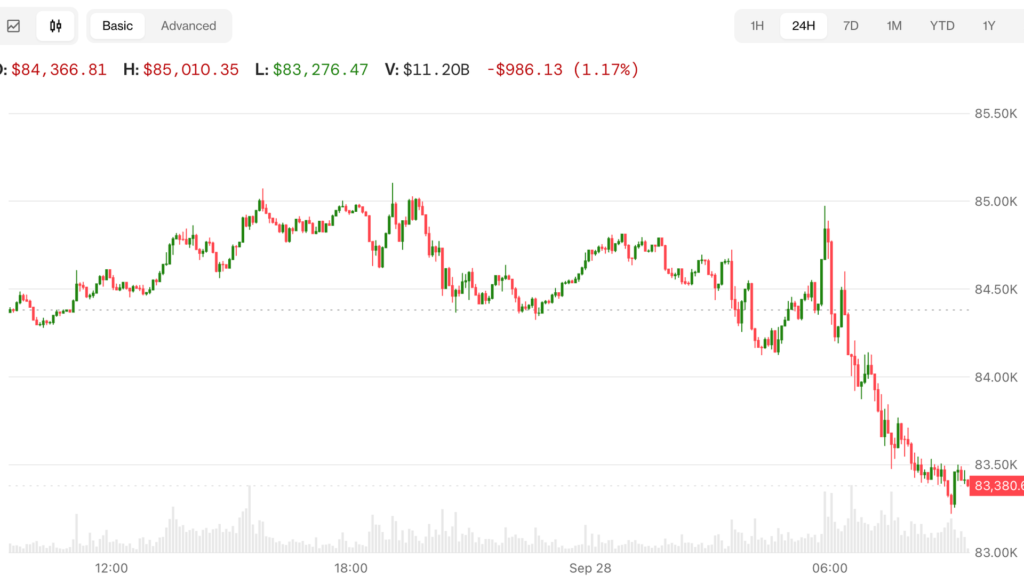
By 03:30 UTC, bitcoin experienced a 1.3% decline, resting at $83,324, while major alternative coins such as ether, XRP, and solana faced comparable declines. Meanwhile, futures tied to the technology-centered Nasdaq benchmark on Wall Street dropped by 0.7%.
West Texas Intermediate (WTI) crude oil futures climbed nearly 1%, reaching $93.28, accompanied by similar upward movements for Brent crude.
Trump mentioned on Sunday that he anticipates the conflict involving Iran to conclude shortly, though he declined to dismiss the possibility of supplementary military attacks on the country prior to the midterms.
When questioned about whether military operations might restart, he stated to Fox News that he would rather not make that statement, noting it remains a possibility while avoiding a definitive commitment.
He further remarked that the United States will achieve victory in the conflict through a combination of military force and financial pressure.
Conversely, Abbas Araghchi, Iran’s Foreign Minister, stated that his nation is thoroughly prepared for ongoing hostilities, cautioning that it can endure even a worst-case scenario conflict.
During sessions at the United Nations General Assembly, Tehran suggested an agreement to unblock the Strait of Hormuz—a vital petroleum transit route impacted by the hostilities—for a seven-day interval alongside a temporary halt to combat, paving the way for broader discussions.
Nevertheless, Trump dismissed the proposition, asserting that Tehran seeks an arrangement because it faces intense pressure. Furthermore, Trump emphasized via Truth Social that Iran is barred from acquiring a nuclear weapon.
This persistent geopolitical tension has fueled concerns regarding inflation ever since the conflict commenced in early March, driving Treasury yields upward. Driven by inflation anxieties, expectations of Federal Reserve rate increases, and national debt concerns, the 10-year yield has climbed 127 basis points to reach 5.20%, marking its highest point since 2007.
Although bitcoin dropped earlier in the year, it has staged a robust recovery through the third quarter, brushing off these uncertainties. Over a three-month span, prices have advanced 42%, outperforming every major financial instrument, including gold and the Nasdaq.
Market analysts are currently monitoring incoming statistics for indicators regarding the digital asset’s subsequent trajectory.
Vikram Subburaj, CEO of India-based exchange Giottus, communicated via email that market participants should view the $83,800 to $84,000 range as a critical near-term support level, whereas the $85,000 to $85,800 threshold serves as immediate resistance, advising that chasing the upward trend at present prices is unwise.
He added that maintaining low leverage and employing incremental position entries can assist in navigating market swings while investors react to exchange-traded fund activity, Treasury yields, and forthcoming U.S. inflation figures.
The upcoming release of U.S. Personal Consumption Expenditures (PCE) inflation data, Institute for Supply Management (ISM) manufacturing reports, and nonfarm payroll figures this week could shape expectations surrounding Federal Reserve rate policies and the wider financial markets.
Originally published at https://www.coindesk.com/markets/2026/09/28/bitcoin-and-nasdaq-futures-decline-as-trump-won-t-rule-out-more-iran-strikes.