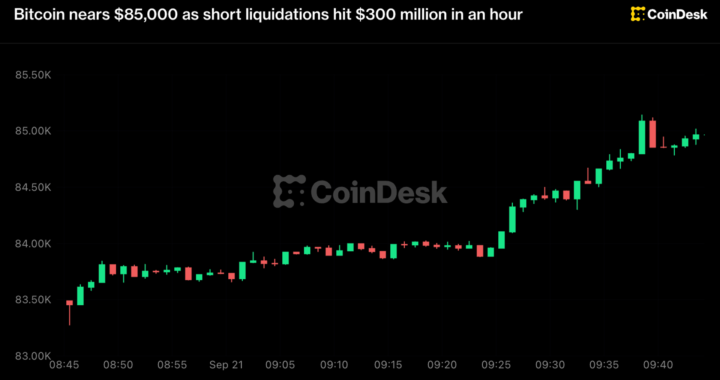
The recent upward surge of Bitcoin (BTC$85,947.24) has paused, with a group of experts pointing out that a single price marker will determine whether the next directional shift heads upward or downward.
The leading digital asset reached a peak surpassing $87,400 on September 21, but has since retreated, testing the $82,000 to $83,000 range. This specific bracket is significant because it represents the peak Bitcoin reached in May before dropping down to roughly $57,000 in June.
At present, Bitcoin continues to exchange hands near that particular threshold. Most observers anticipate another upward push shortly, with select predictions pointing toward a climb reaching $100,000.
Nonetheless, certain analysts are monitoring the bearish scenario, which begins with a fall underneath the $82,000 mark.
From a trading perspective, $82,000 acts as a support level—a price floor where buying demand is anticipated to outpace selling pressure. Historical resistance levels frequently transform into emerging support floors. Bitcoin encountered difficulty surpassing $82,000 during May and once again at the beginning of September. Once it finally broke through, that threshold converted into the boundary that purchasers are expected to protect.
"The level to watch is $82k," noted Jeff Anderson, the U.S. head at the digital asset trading firm STS Digital. He highlighted the double top formation at that threshold, a chart formation resembling an M shape that develops when valuations touch an identical peak twice and fail on both occasions.
"A breakdown will probably yield a slip back into the high 70s," Anderson stated.
Even so, he does not view such a descent as the conclusion of the bullish trend. Domestic inflation alongside wavering trust in U.S. sovereign debt represent pressures that historically tend to benefit Bitcoin over time. "Any move like this would be well supported," he added.
Instead of blaming Bitcoin itself, Anderson attributes the recent softness to conditions within the bond market. U.S. Treasury note values are dropping while yields push higher. When returns on secure government debt increase, riskier alternatives such as cryptocurrencies can appear less appealing.
"Current softness this week is a direct result of yield markets unravelling and volatility exploding in fixed income space," Anderson explained. "At the current pace it feels like treasuries will keep selling off until equities finally crack out!"
Lacie Zhang, a research analyst associated with Bitget Wallet, identifies the $81,500 up to $83,000 interval as the critical zone.
"Holding that region would keep the market structure constructive," Zhang remarked.
Breaching that tier constitutes one of three warning indicators she is closely observing. "A deeper correction would become more likely if ETF flows turn negative for several sessions, the 10-year Treasury yield continues to rise and support below $82,000 fails," she mentioned.
Exchange-traded fund flows monitor capital moving into and out of American investment funds holding Bitcoin. Consistent capital withdrawals would indicate that institutional players are stepping back.
Iliya Kalchev, an analyst at Nexo Dispatch, established his critical boundary slightly lower. "A sustained break below $80,000 would suggest the market isn’t ready to push higher for some time," he expressed.
A subsequent rebound could still reverse the overall outlook. "Renewed momentum from here could carry price well above $90,000," Kalchev added.
The upcoming challenge might stem from macroeconomic conditions instead of technical charts. Anderson remarked that the Personal Consumption Expenditures index, which serves as the Federal Reserve’s favored inflation metric, "will be the market’s next guidance" regarding how long price pressures are likely to remain elevated.
Originally published at https://www.coindesk.com/markets/2026/09/30/bitcoin-bulls-have-one-price-level-to-defend.