
Summary
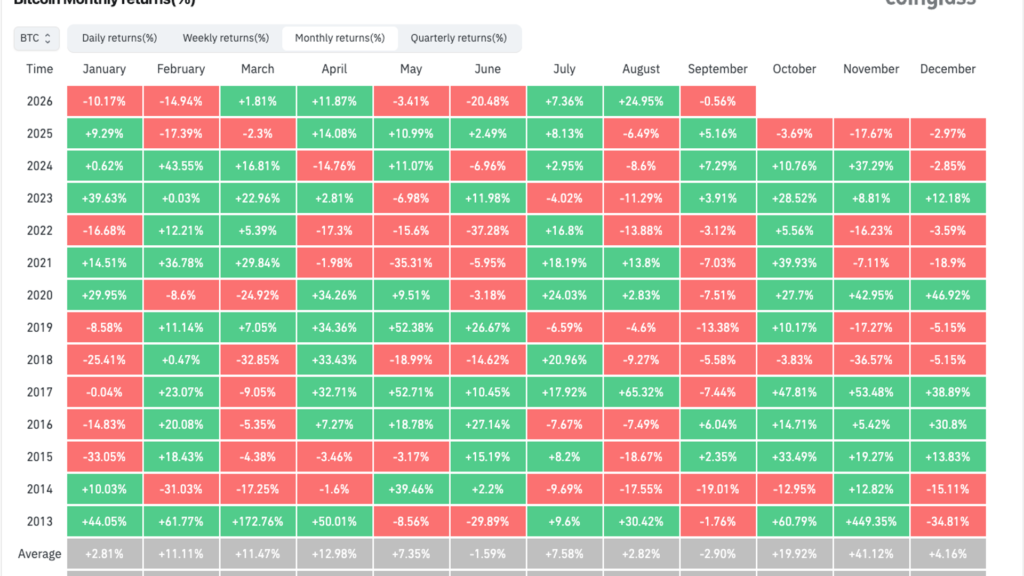
- September has delivered an average bitcoin drop of around 3% since 2013, earning it the moniker “Rektember.”
- Financial markets are currently pricing in a 66% probability of a September Federal Reserve rate hike, introducing a fundamental driver for potential weakness this year.
Bitcoin has kicked off September on a slightly lower note, dropping 1% to slip below $78,000 as it enters the phase widely dubbed “Rektember.” Ever since 2013, September has marked bitcoin’s weakest historical month on average, yielding an average loss near 3% alongside only five positive monthly closes.
Nevertheless, the past three Septembers have all generated positive returns, providing some optimism for bitcoin proponents. Following a 25% surge in August—its best monthly performance since November 2024—the market may be primed for a phase of consolidation or even a downward correction.
The macroeconomic environment also introduces notable headwinds. Fed Chair Kevin Warsh’s hawkish commentary during his Jackson Hole address last Friday, which underscored persistent inflation, has fueled a broader sell-off in global bonds. Numerous sovereign bond yields have climbed to fresh cycle peaks, with the U.S. 10-year Treasury yield advancing to 4.784%.
Traders are currently pricing in a 66% probability of a 25-basis-point interest rate increase at the central bank’s September 16 gathering, followed by the possibility of another rate expansion before year-end. Such a move would bring the federal funds target band to 4.00-4.25% by the conclusion of 2026.
Elevated borrowing costs generally exert downward pressure on risk-on assets by tightening monetary conditions and boosting the U.S. dollar index. Bitcoin is not facing this pressure alone, as gold dropped over 2% on Tuesday. Simultaneously, ongoing U.S. military strikes against Iran have intensified geopolitical tensions in the Middle East, pushing WTI crude oil up to $88 per barrel, a 2% increase over a 24-hour window and its peak level since late July.
Additionally, September proves to be a difficult timeframe for traditional financial markets. Since 1975, it has stood as the sole month where the S&P 500 has recorded a negative average return.