The market downturn caused a massive cascade of forced liquidations throughout the cryptocurrency derivatives sector, with total liquidations hitting $1.09 billion across 211,000 traders over the preceding 24 hours.
Bitcoin, Ethereum, and various other digital assets wiped out their post-election gains on Thursday because a steep decline in American technology and artificial intelligence equities spread into the crypto ecosystem, prompting upwards of $1 billion in leveraged stake liquidations during the last day.
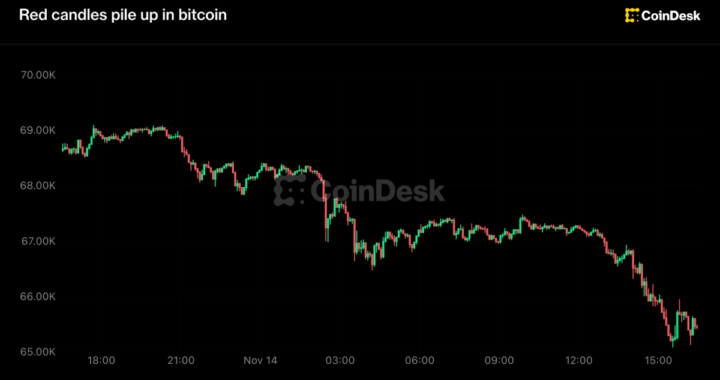
Bitcoin (BTC) dipped 6% down to $75,700, after touching a daily low of $75,568, whereas ether (ETH) slid in excess of 7% to $2,247. These reductions undid Wednesday’s recovery, a period when bitcoin bounced back above $80,000 following the U.S. midterm elections alongside indicators that the Binance security breach had not caused wide-ranging market disruption.
Midterm poll outcomes seemed to spark short-term hope, but market experts note they failed to resolve broader macroeconomic uncertainties.
By 2 p.m. ET, both the Dow Jones Industrial Average and the S&P 500 were down approximately 3% for the session, while the tech-focused Nasdaq Composite had fallen 4.7%. The Cboe Volatility Index, otherwise known as the VIX, shot up around 60%, signaling intensified investor panic.
Artificial intelligence and bitcoin-linked mining shares ranked among the hardest hit, with Bitdeer and Keel Infrastructure both tumbling roughly 20%. American Bitcoin retreated 17% despite revealing a quarterly profit of $126 million. Prominent crypto equities Strategy and Coinbase each registered losses near 10%.
Significantly, the Official Trump (TRUMP) memecoin reached an all-time low after dropping more than 20% over the preceding two days.
The selloff likewise provoked a wave of mandatory liquidations across the cryptocurrency derivatives landscape. Approximately $879.92 million in holdings were liquidated across a four-hour window, comprising $818.90 million in long positions and $61.02 million in short positions, according to data from CoinGlass. Aggregate liquidations across the past 24 hours approached nearly $1.1 billion, impacting close to 211,000 traders.
It is worth mentioning that liquidation metrics typically rely on publicly accessible data, which can heavily underestimate the actual scope of market liquidations.
Why bitcoin’s post-election rally faded
This reversal implies that Wednesday’s bounce might have stemmed more from temporary optimism rather than any genuine enhancement in underlying market fundamentals, according to Wintermute.
The trading institution explained that the advance reflected a mix of relief subsequent to the Binance hack, enthusiasm regarding the election outcomes, confidence surrounding a potential deceleration in AI expenditure, and declining oil quotations. Nonetheless, those drivers proved fleeting as larger macroeconomic challenges endured.
“It’s probably a blend of all of them in some capacity. What counts is that all of them appeared to be so brief that it genuinely didn’t matter,” remarked Jasper De Maere, an OTC trader at Wintermute. “Trump is still president for two years, the Middle East is still seeing escalation, and inflation remains elevated amid a resilient U.S. economy.”
What the midterms mean for crypto regulation
Aside from immediate market pressures, the electoral outcomes may additionally complicate the trajectory for crypto oversight, potentially dampening some of the positivity that propelled Wednesday’s recovery.
Paul Howard, senior director at Wincent, stated that the Democratic party’s bolstered standing in Congress could render bipartisan teamwork essential for substantive progress on digital asset regulation over the coming two years. With the Clarity Act’s outlook uncertain, Howard anticipates that the current regulatory structure will largely stay in place until the subsequent election cycle.
Ryan Kirkley, CEO of Global Settlement Network, indicated that the vote could postpone digital asset legislation yet would not fundamentally alter long-term institutional demand for cryptocurrencies.
“Investors remain concentrated on liquidity, interest rates, and the broader economy, and those elements will keep shaping the market regardless of which political faction governs Congress,” Kirkley explained.
Should the downward momentum persist, Wintermute pointed to $73,000 and $68,000 as the upcoming thresholds to monitor for bitcoin. The firm noted it would need to see bitcoin definitively recapture and sustain $80,000 before adopting a more bullish outlook.
Originally published at https://www.theblock.co/news/markets/2026-11-05-bitcoin-erases-post-election-gains-wall-street-selloff-liquidations-435434.