The Federal Reserve increased interest rates by 25 basis points on Wednesday, pushing its baseline target band to 3.75% up to 4.00% during its initial upward adjustment in over three years. Financial markets currently price in an extra 75 basis points of tightening spanning the upcoming half-year period.
Historical data indicates that a solitary hike remains unlikely. Ever since 1994, the central bank has executed a “one and done” approach on only one occasion, while single adjustments also stay exceptionally rare across all 12 tightening phases going back to 1955.
Concerning bitcoin BTC $81,269.44, the available historical playbook is noticeably briefer. While bitcoin traded through the monetary cycle starting in 2015, lower market liquidity and a less advanced ecosystem render comparisons much less dependable. The tightening cycle of 2022 delivers the most equitable parallel involving a significantly more sophisticated market architecture.
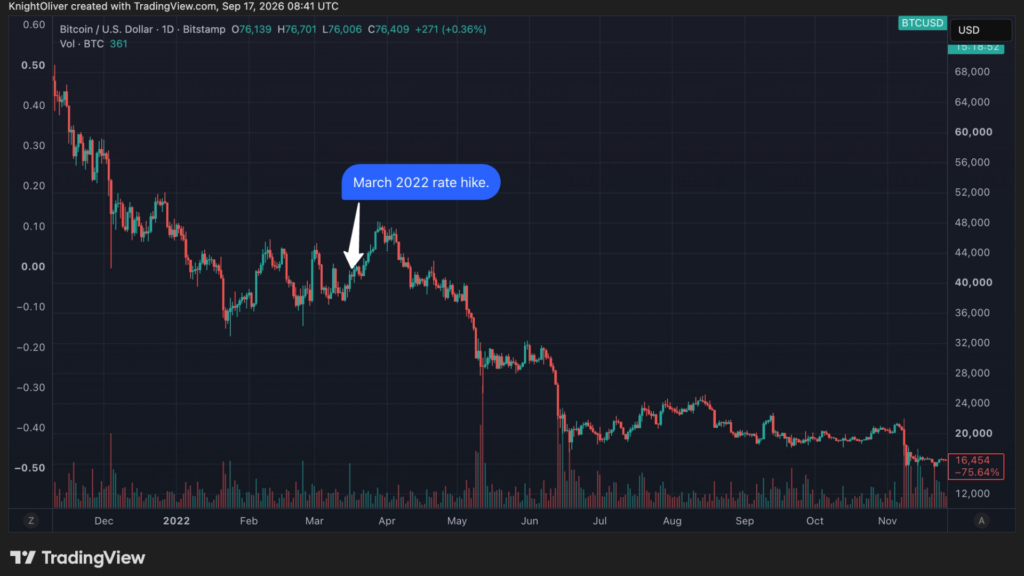
Strong similarities with 2022 have materialized already. Bitcoin reached a peak around $69,000 back in November 2021 and traded roughly 40% lower when the Fed implemented its initial rate increase in March 2022. Today, the asset trades about 40% beneath its October peak of $126,000.
Following that initial March 2022 rate hike, bitcoin experienced a rally of approximately 18% throughout the subsequent 12 days before dropping nearly 50% afterward. This sequence introduces the possibility that another relief bounce might precede an extended bear market. Nonetheless, relying on a single comparable cycle supplies scarce evidence, and the 2022 downturn for bitcoin coincided broadly with declines across equities, bonds, and precious metals alongside heavy distress within the crypto sector itself.
The catalyst behind Wednesday’s central bank rate increase was persistent inflation. Annual headline inflation figures have stayed above the 2% threshold for more than five years, though core inflation—which strips out food and energy costs—softened down to 2.4%, marking its lowest point in five years. Consequently, tangible progress is evident.
Yet, this recent progress currently encounters a major energy shock. Ongoing geopolitical friction throughout the Middle East has driven both WTI and Brent crude oil prices significantly higher past $100 per barrel, presenting risks of reigniting inflation pressures and dampening economic growth. Global sovereign bond yields have likewise surged, with the United States 10-year Treasury yield hitting 5%, thereby introducing heightened strain onto overall financial conditions and risk-oriented assets.
As bitcoin’s ongoing bear market approaches its one-year duration, one must wonder whether a fresh rate-hiking cycle will serve to prolong the current slump.
Originally published at https://www.coindesk.com/markets/2026/09/17/bitcoin-faces-2022-parallels-as-federal-reserve-resumes-rate-hikes.