November 23, 2026, 6:51 a.m. EST
4 min read
Summary
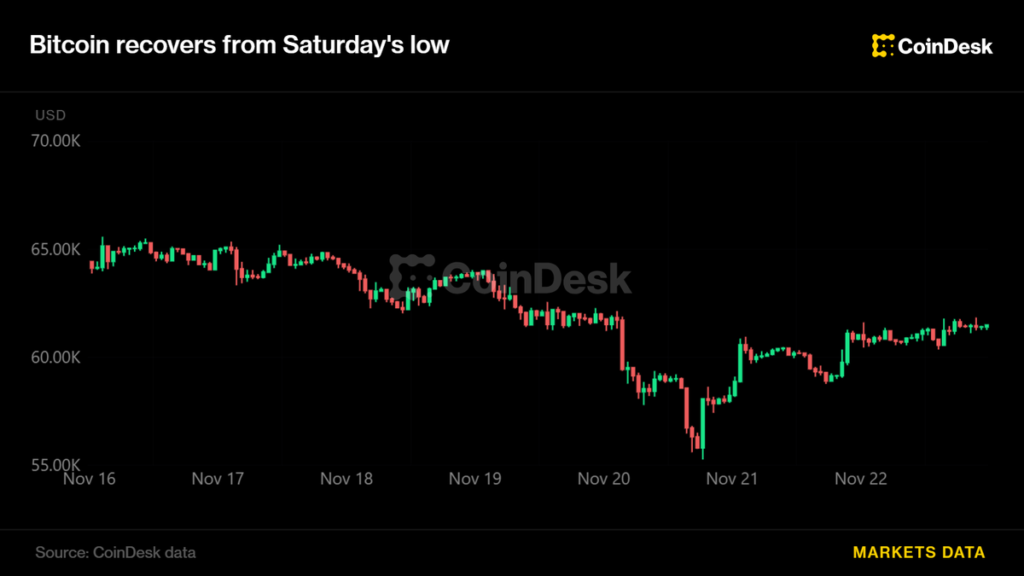
- Bitcoin changed hands close to $61,500 as American stock index futures advanced, establishing a test for whether its weekend recovery from $55,130 can sustain itself when Wall Street opens again.
- Bitcoin encounters overhead resistance between $62,000 and $65,000, while a breakdown under recent troughs could push it toward $53,000, according to KuCoin.
- Spot bitcoin exchange-traded funds have shed nearly $3 billion throughout November, making any return of net inflows a critical indicator of buyer demand.
Bitcoin BTC is exchanging near $61,500 while U.S. stock index futures climb, creating the initial test of whether the digital asset’s weekend recovery will endure once Wall Street resumes trading.
Nasdaq 100 index futures have climbed nearly 3% following the index’s worst week since March 2020. S&P 500 futures trade roughly 2% higher. Last week’s equity market selloff forced the S&P 500 into correction territory and pulled bitcoin down to a trough of $55,130 early Saturday UTC, marking its weakest price point since September 2024.
The leading cryptocurrency has advanced about 1.9% since midnight Sunday UTC, and the CoinDesk 20 Index has increased by 2%.
Digital assets and technology shares declined together throughout the market rout. Today’s price action will measure whether traders perceive the drop as a buying opportunity to increase their balances or if they stay on the sidelines, causing the rebound to fade.
Near-term boundaries are tight. Bitcoin confronts resistance ranging from $62,000 to $65,000, whereas dropping below the $55,000–$56,000 lows could trigger a descent toward $53,000, according to KuCoin’s daily market report.
Spot bitcoin ETF flows represent another key metric to monitor. These investment vehicles have experienced nearly $3 billion in outflows during November, and a shift toward positive inflows would indicate that genuine buyers are driving the recovery rather than merely short covering.
Derivatives Positioning
Futures are quiet: Across 24 hours, total crypto futures open interest (OI) decreased by 0.1% to $105.2 billion, while trading volume increased by 0.3% to $142.2 billion. Both changes are minimal, pointing neither to fresh capital deployment nor significant position reduction, indicating that market participants kept their holdings stable. Liquidations dropped by 57% to $206.9 million, demonstrating substantially less forced selling than the previous day.
BTC’s mild bullish lean: Bitcoin perpetual funding rates stayed positive across most major platforms, indicating that long positions paid a minor fee to short positions, and the 24-hour OI-adjusted cumulative volume delta (CVD) remained positive, signaling net market-order purchasing. Market positioning tilts slightly bullish.
ETH divergence: Ether funding rates turned negative across all prominent exchanges, meaning short positions compensated longs to maintain their exposure, even though 24-hour CVD stayed positive. This combination of market-order buying and negative funding creates mixed positioning.
Funding tilt: Dogecoin DOGE demonstrated the most consistently positive funding rates, staying positive on every platform offering the asset, whereas Cardano ADA recorded the most negative rates. On Binance, a greater number of tokens exhibited negative funding compared to positive rates, signifying that shorts are paying to sustain bearish bets across a significant portion of the altcoin sector.
CVD mixed: Over a 24-hour timeframe, OI-adjusted CVD appeared divided. BTC, ETH, and a few others registered positive values, while avalanche (AVAX) and BNB BNB paced the negative performers. Across the week, tron TRX and zcash stood out as the sole major assets with positive CVD, while litecoin LTC recorded the steepest negative reading, illustrating that market-order selling has governed most large-cap coins over the past seven days.
Liquidation map: On Binance’s BTC/USDT perpetual contract, approximately 64% of projected open liquidation zones rested underneath the current price, representing long positions, compared to 36% situated above. The largest individual concentration, amounting to roughly $43 million, clustered near $60,335, about 1.6% under the current market price, implying that a downward movement toward that mark could trigger more forced selling than an equivalent upward move would cause forced buying.
BTC options stress: The term structure of bitcoin’s implied volatility inverted, with front-month expiries priced near 58% contrasted with about 45% for longer-term agreements, highlighting heightened short-term uncertainty. One-week at-the-money implied volatility surged from the 30s seen in October to surpass 50%, while the 25-delta skew climbed near 20%, approaching its highest level in a year, which indicates puts are priced substantially higher than calls. The November 27 $50,000 put and December 25 $20,000 put drew the highest trading volume, closely followed by the December 25 $78,000 call option.
ETH call activity: Ether’s volatility term structure likewise inverted, and its short-term 25-delta skew hovered between 15% and 20% in favor of puts. Even so, the December 25 $2,300 call contract remained by far the most heavily traded ether option, logging roughly eight times the volume of the next most active instrument.
Token Talk
- Tokens linked to artificial intelligence are pacing the cryptocurrency recovery. Venice VVV recovered to approximately $26 after dropping under $20 over the weekend, posting roughly a 30% weekly gain, whereas the BNB Chain-based AI payments asset PIEVERSE reached an all-time high above $5 on Sunday before pulling back toward $3.60.
- DRV, the native token of Derive—the largest decentralized options platform—has advanced about 38% over seven days to roughly $0.36. This price movement appears connected to growing demand for options trading amid recent market volatility.
- Chainflip’s FLIP plummeted 32% within 24 hours after the cross-chain exchange announced that an attacker extracted 122.86 BTC from its bitcoin vault. Chainflip has proposed a 10% bounty if 90% of the stolen capital is returned today, and the token price has since stabilized.
- Hyperliquid’s HYPE increased roughly 4% to trade near $64, clawing back a portion of last week’s losses after the Hong Kong Securities and Futures Commission labeled the exchange an unlicensed trading platform and the U.S. CFTC stated it must register to provide services to American traders. Its buyback reserve allocated another $2.5 million toward acquiring HYPE.
- Market sentiment continues to reflect deep pessimism. CoinMarketCap’s Fear and Greed Index stands at 9, signaling extreme fear, while bitcoin’s dominance of the overall crypto market capitalization stays close to 59%, indicating minimal appetite for alternative coins.
Originally published at https://www.coindesk.com/markets/2026/11/23/bitcoin-rebounds-from-2-year-low-as-wall-street-futures-recover.