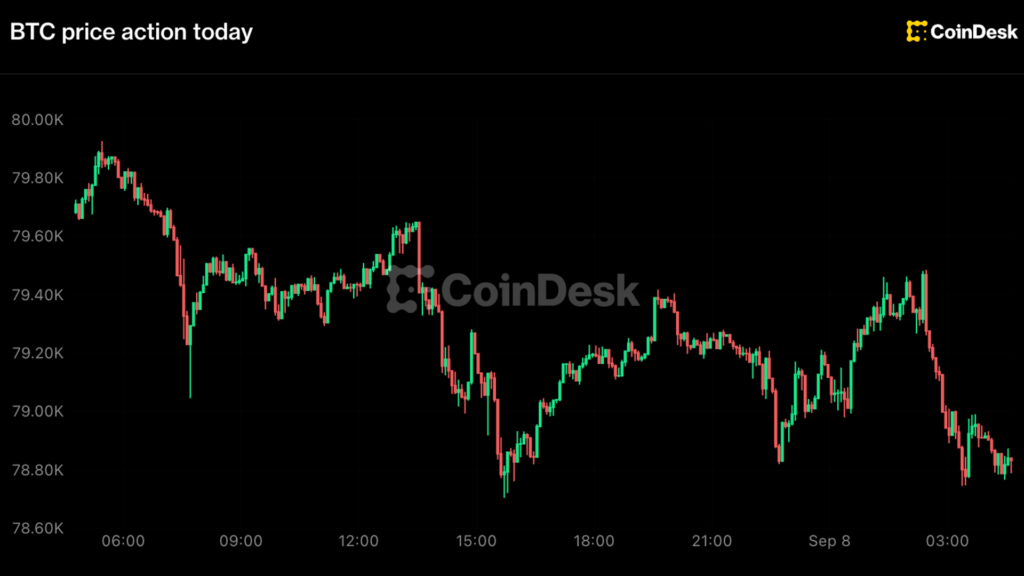
Bitcoin traded just beneath $78,800 on Tuesday, staying below the $80,000 threshold while the broader cryptocurrency market experienced a general downturn.
Increasing Treasury yields alongside a stronger-than-projected August payroll report elevated the market-implied probability of a quarter-point Federal Reserve interest rate hike next week to approximately 60%.
Upcoming inflation data scheduled for release on Thursday and Friday could further boost rate-hike projections and threaten Bitcoin’s $77,000 support level.
Market statistics from CoinDesk indicate that Bitcoin was transacting at slightly less than $78,800 on Tuesday, marking a greater than 1% loss for the session while maintaining a modest weekly profit.
The cryptocurrency has now spent two weeks unable to register a daily close past $80,000, though it has successfully retained the gains from the August surge that pushed it upward.
Zcash registered the steepest decline, dropping nearly 5% to approximately $1,125 following a rally that still leaves it ahead by 33% over a seven-day period, representing the most substantial weekly performance among major tokens. HYPE from Hyperliquid lost over 3% to trade near $84, and Solana decreased more than 2% to just above $103, with both assets wiping out their entire weekly gains.
Ether retreated by 1% to reach just under $2,482, XRP softened to $1.39, and Tron remained relatively flat at roughly 33 cents. Dogecoin and BNB exhibited the strongest resilience, each declining by only a fraction of a percent while preserving the highest weekly advances outside of Zcash, up almost 9% and exceeding 7% respectively.
Treasury yields are providing the primary downward pressure. The 10-year note remained close to 4.8% following an August payroll addition of 162,000 jobs, which exceeded expectations centered around 53,000. Market participants now price in roughly a 60% probability that the Federal Reserve will implement a quarter-point rate increase during next week’s gathering, a scenario that seemed nearly impossible during the spring.
The dollar index softened to just under 99 for a second consecutive session as yen purchasers prepared for potential monetary tightening by the Bank of Japan, while gold advanced past $4,430.
Joel Kruger, market strategist at LMAX Group, stated in an email that digital assets have absorbed these negative pressures without sustaining severe technical damage.
Brent crude stayed above $97, marking a six-week peak, after Iran announced that an agreement with Oman concerning Strait of Hormuz maritime traffic was nearing finalization, following a weekend marked by U.S. and Iranian attacks on ships and military installations. Elevated oil prices sustain inflationary pressures ahead of Friday’s consumer price inflation release.
Asian stock markets opened the week with mixed results. South Korea’s Kospi surged nearly 5% to reach its highest level since late July, and Japan’s Nikkei advanced over 2% supported by artificial intelligence and memory chip demand, whereas the Hang Seng declined by almost 1%.
Yusuf Fakhro, partner at ARP Digital, noted that options trading desks show that the persistent anxiety characteristic of the entire bear market has largely dissipated, with long-term investors transitioning to net buyers in late August for the initial time during this market cycle.
The producer price index due on Thursday and the consumer price index on Friday represent the final inflation updates prior to the Federal Reserve’s policy meeting. A higher-than-expected core inflation reading could drive rate-hike probabilities toward two-thirds and place Bitcoin’s $77,000 baseline support directly under threat.
Originally published at https://www.coindesk.com/markets/2026/09/08/bitcoin-slips-under-usd79-000-zcash-leads-losses-as-fed-hike-odds-hold-near-60.