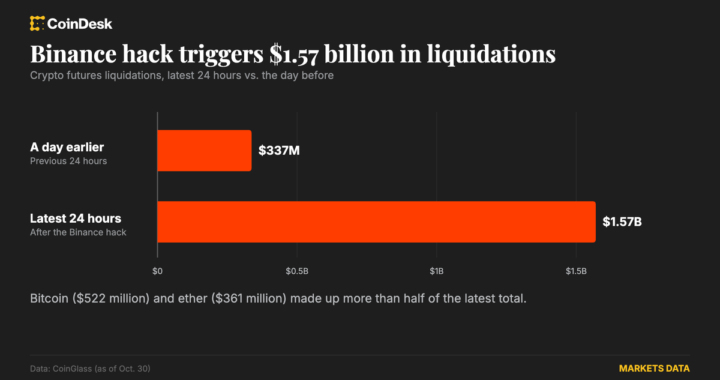
A day earlier, we highlighted how bitcoin investors were acquiring insurance against potential price declines in the top cryptocurrency. That tendency intensified after a hacker drained over $6 billion in crypto holdings from Binance, the leading cryptocurrency exchange.
This form of insurance is known as a put option, granting the holder the right to sell bitcoin at a predetermined value. The contract yields a profit if the BTC rate drops beneath the agreed sale threshold, or strike price.
The rush to acquire these protective hedges through private negotiations surged on Paradigm, a liquidity platform where major investors organize bets via block trades.
The initial massive trade executed at 20:38 UTC, roughly 15 minutes after the first unauthorized transfers left Binance’s wallet and prior to public awareness, stated Nicolas Quatravaux, head of EMEA at Paradigm, the premier institutional liquidity network for crypto derivatives.
That transaction entailed purchasing 250 lots—each representing a single BTC—of $78,000 puts expiring on October 31, carrying a notional value of roughly $20 million. Notional value represents the dollar worth of the bitcoin addressed by the agreements. Merely three minutes later, another identical 250-contract batch of the same put traded, with the purchaser paying approximately 35% more.
Altiorix Trades, an X account monitoring market flows, noted that these acquisitions appeared exceptionally telling. “The contracts were purchased with BTC around $80.15K, and by the night price was trading right at that strike. Selling the 80K calls at the same time capped any participation in further upside,” the account posted.
Throughout the subsequent eight hours following the breach, Paradigm processed roughly $590 million in notional BTC options blocks. This represents nearly half of the aggregate BTC options block trading volume observed on Deribit, the principal crypto options exchange, across the identical timeframe.
The order flow leaned heavily bearish, with the vast majority of the volume concentrated in puts. The peak trading hour occurred prior to any public statement from Binance, featuring two distinct 1,000 BTC blocks consisting of mid-November $74,000 puts, yielding a combined notional value of roughly $155 million.
The bulk of the purchasing took place in put contracts positioned slightly below, yet still in close proximity to, the spot price, rather than at drastically lower strike prices. This pattern indicates that market participants were not engaging in deep-tail hedging or speculating on catastrophic crashes via lottery-ticket bets, but rather implementing deliberate hedging strategies against a more severe near-term market retracement.
“The buying sits close to the current price, at strikes of $74,000 to $78,000, mostly expiring this week and in mid-November,” Quatravaux pointed out.
Deribit similarly experienced heightened activity within put options. The largest transaction involved a multi-leg put strategy spanning both November and December expiration dates, valued at approximately $190 million. An additional trade featured 500 BTC blocks centered on November $64,000 puts alongside some activity in March calls. “So not everyone was playing defense,” Quatravaux observed.
Beyond the derivatives and options sector, the broader cryptocurrency market is experiencing divergence. Privacy-focused digital assets Monero and Zcash, together with Hyperliquid’s HYPE token, demonstrated resilience, whereas bitcoin, ether, several other major assets, and a selection of smaller tokens declined. Decentralized finance assets are similarly facing downward pressure.
Standard Chartered cautioned that the current weakness could endure, suggesting that a definitive market bottom may only establish after comprehensive details surrounding the breach surface and exchanges along with protocols unfreeze the associated digital assets. Remain vigilant!
What’s trending
- Binance loses over $6 billion in ‘biggest crypto hack in history’ (CoinDesk): Binance estimated the total impact of the hack at around $6.3 billion in stolen assets. Some $3 billion of assets were frozen, Binance said, including $2.3 billion in USDT and USDC stablecoins.
- Strategy CFO Andrew Kang resigns as company posts record operating profit (CoinDesk): Strategy Chief Financial Officer Andrew Kang resigned and will step down on Nov. 5. Kang informed Strategy of his intention to resign for personal reasons on Oct. 26, the company disclosed as it reported record quarterly operating income.
- Binance hacker splits $1.4 billion of bitcoin into 19 wallets that no one can freeze (CoinDesk): All 18,270 coins sit in 19 wallets, 17 of them holding exactly 1,000 BTC each, and none has moved since Thursday night, a CoinDesk trace of the blockchain shows.
- Nasdaq futures tumble as Amazon, Intel results deepen AI spending woes (Reuters): Nasdaq index futures tumbled as Amazon signaled its AI spending boom is far from over and Intel warned it would burn cash, raising concerns over the rising cost of the AI buildout. Amazon shares dropped 7.2% in premarket trading.
Today’s signal
The chart illustrates bitcoin skews across various time horizons. The skew metric gauges prices—specifically the volatility premium—for put options relative to call options. Positive figures signify that puts are relatively more expensive.
The one-week skew climbed as high as 18% during Asian trading hours on Friday, demonstrating that traders rushed to secure downside protection as news of the Binance breach unfolded.
Although that elevated reading proved temporary, skews across all expiration horizons remain solidly positive, signaling ongoing speculation focused on further market declines.
Originally published at https://www.coindesk.com/daybook-us/2026/10/30/here-s-how-big-bitcoin-traders-responded-after-the-binance-hack-hit.