Reporting concluded on November 17, 2026, at 6:00 p.m. EST. The Federal Reserve maintained its hawkish tone on Tuesday, as St. Louis Fed President Musalem advocated for multiple interest rate increases ahead of next spring. Meanwhile, builder confidence in the housing sector dropped to a 14-year low.
Board has no plans to bring back Huang, states new Nvidia chairman
During the Nvidia NVDA$125.80·Market Closed earnings conference call, longtime board member and current Chairman Harvey Jones announced that the board unanimously accepted Jensen Huang’s resignation and has no intention of reinstating him. He further noted that executive leadership would refuse questions concerning the background of Huang’s departure. Company shares have receded from their peak after-hours levels, though they remain higher by 1.7%.
Bitcoin edges upward on Nvidia relief
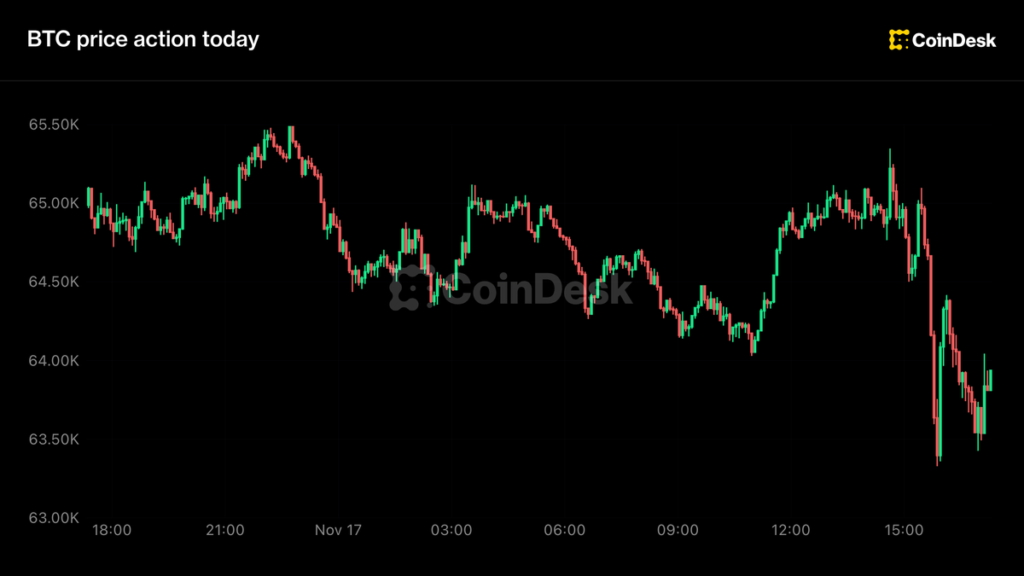
The leading cryptocurrency, BTC$59,122.18, climbed approximately $600—equating to nearly a 1% daily gain—after Nvidia surpassed analyst expectations for both third-quarter performance and fourth-quarter forecasts, arriving just days after CEO Jensen Huang left his post. Nvidia shares advanced close to 3% in after-hours trading, pushing bitcoin up to $64,500.
Nvidia beats expectations, provides optimistic guidance; stock increases
Nvidia NVDA$125.80·Market Closed delivered third-quarter earnings per share of $2.68, outperforming Wall Street predictions of $2.47. Total revenue reached $115.8 billion, exceeding the forecasted $108.8 billion. Data center revenue hit $107.6 billion, beating the anticipated $101.9 billion. The firm projected fourth-quarter revenue between $127.4 billion and $132.6 billion, surpassing the consensus expectation of $125.3 billion. Share repurchases and dividend payouts during the third quarter totaled $28.1 billion, leaving the enterprise with an additional $227.3 billion available under its existing buyback program. Naturally, these figures mark the inaugural financial update since CEO Jensen Huang’s resignation. Interim CEO Colette Kress remarked that their momentum is genuine, emphasizing that Nvidia stands as an exceptional technology leader fueled by persistent internal innovation, while noting that the Vera Rubin architecture is experiencing an explosive debut, the corporate roadmap is on schedule, and corporate ambitions have never been higher. Shareholders will closely monitor the earnings discussion to gauge executive commentary surrounding recent events, including Huang’s expression of interest in returning to lead the corporation. Stock values are up 2.4% following the close.
Key American equity benchmarks join bitcoin below the 200-day moving average
As the Wall Street maxim often attributed to hedge fund billionaire Paul Tudor Jones states, nothing positive transpires beneath the 200-day moving average. Indeed, bitcoin’s descent beneath its 200-day moving average in late October 2025 clearly marked the beginning of an ongoing bear market. When bitcoin surrendered the 200-day moving average once more earlier this month, a rapid drop exceeding 10% transpired over subsequent days. The Nasdaq dipped below its 200-day moving average for the first time in six months during a 6.4% selloff on November 5. After briefly recovering above that threshold, it fell below once again last Friday and has remained there since. Presently, both the S&P 500 and the Dow Jones Industrial Average are testing their respective 200-day moving averages, currently hovering right on or slightly beneath those lines.
Bitcoin could find stabilization following a drop to $62,000, Schwab analyst suggests
According to Jim Ferraioli, head of cryptocurrency research at Schwab, bitcoin may be approaching a price floor after declining to $62,000 over the weekend. Ferraioli pointed out that derivatives liquidations and diminishing open interest have touched levels observed during previous market bottoms, signaling a potential base for stabilization. Nevertheless, bitcoin must clear the $85,000 resistance level—which has limited price rallies throughout the year—to validate a sustained bull market. Looking forward into 2027, Ferraioli indicated that macroeconomic pressures are not exerting unusual influence on bitcoin, noting that Treasury yields remain the most dominant catalyst while debates continue over whether the traditional four-year halving cycle will dictate the next price phase.
FBI releases urgent warning concerning cyberthreats
The Dallas FBI office posted on X that cybercriminals and state-backed hackers are leveraging ARTEX, an advanced intelligence-driven penetration testing tool, to automate attacks against enterprises and institutions worldwide. The platform can expedite network intrusions from initial targeting to privileged access in under three hours, and it was deployed in the October ConnectWise supply-chain breach, which compromised Microsoft 365 customer environments and involved attempted authentications directed at more than 2,250 downstream tenants. This security bulletin arrived simultaneously with reports that the classified communications infrastructure utilized by the National Security Agency experienced an outage earlier on Tuesday, though CNN sources clarified there was no indication of a cyber assault.
Nvidia engages Heidrick & Struggles for executive search, WSJ reports
Nvidia has retained headhunting agency Heidrick & Struggles to identify its next chief executive officer, based on insider accounts shared with the Wall Street Journal. This executive hunt follows reports that co-founder Jensen Huang stepped down last week amid controversies concerning personal matters, with finance chief Colette Kress presently filling the role of interim CEO. Nvidia intends to evaluate both internal and external prospects. Jeff Sanders, co-managing partner for Heidrick’s global CEO and board director practice, is reportedly directing the recruitment process, with Arm CEO Rene Haas noted among potential candidates. Furthermore, Huang supposedly voiced interest in reclaiming the top post via a post on X.
Jensen Huang hints at readiness to resume Nvidia CEO duties
Former Nvidia chief executive Jensen Huang has broken his silence, characterizing the vast wave of backing as tremendous while indicating a willingness to steer the semiconductor enterprise once more, per reporting from The Wall Street Journal. Huang stated that since his departure, he has witnessed an overwhelming number of requests from employees, investors, business partners, and clients urging his comeback as CEO. He added that if the board of directors concludes that his reinstatement serves the optimal interests of shareholders, staff, the corporation, and the United States, he would accept the call with great pride and resume leadership. Meanwhile, bitcoin, the S&P 500, and the Nasdaq have all bounced back by over 1% from session troughs, though they continue to show substantial losses for Tuesday. Nvidia pared its losses down to a mere 0.5% drop, recovering significantly from a 3.5% decline registered prior to the announcements regarding Huang.
Equities decline following a subdued open, pulling digital assets lower
Nasdaq 100 futures initially signaled a modest recovery for the battered technology sector, but those gains reversed sharply just over an hour into the official trading session. The Nasdaq index is currently lower by 1.5%, with Nvidia NVDA$125.80·Market Closed sliding 3.2% ahead of its post-market quarterly financial report, while the S&P 500 has dropped 1.25%. This downward momentum is impacting cryptocurrency valuations, causing bitcoin to shed roughly $1,000 over the past 30 minutes down to $64,000, leaving it largely flat across a 24-hour window.
U.S. homebuilder sentiment sinks to a 14-year low
The National Association of Homebuilders Housing Market Index dropped to 25 this month, down from a previous reading of 29, defying economist predictions that the index would hold steady at 29. A reading of 25 represents the weakest score for this metric since April 2012. NAHB Chairman Bill Owens noted that construction firms face numerous hurdles in the current financial climate, explaining that elevated fuel costs are driving subcontractors to aggressively hike their pricing, and with fewer active purchasers in the market, builders are scaling back operations. The survey revealed that 46% of residential builders lowered property prices in November, marking the highest reduction rate recorded in the post-pandemic era.
Stablecoin liquidity contracts by 5% over 30 days as market capitalization retreats to September 2025 levels

The combined market valuation of USDT, USDC, BUSD, and DAI has contracted to $250 billion, slipping back to September 2025 valuations after reaching a peak of $273 billion in May 2026. Glassnode metrics indicate that the aggregate circulating supply shrank by 5% over the preceding 30 days, representing one of the most substantial supply contractions in history and signaling a reduction in stablecoin liquidity throughout the digital asset landscape.
Anthropic reportedly targets upper limit of pricing bracket, or higher
Anthropic is communicating to institutional backers that it anticipates pricing its initial public offering near or even above the established $70 to $78 per share range, according to Bloomberg. At a valuation of $78 per share, the enterprise would command a market cap near $1.4 trillion while generating upwards of $90 billion in capital. Underwriters are anticipated to close order books at 4 p.m. Eastern Time today.
U.S. retail sales surpass forecasts in October
Overall American retail sales advanced by 0.2% in October, representing a moderation from September’s 0.8% increase, yet outperforming economists’ projections of 0.1%. Retail figures excluding automotive purchases beat expectations as well, climbing 0.6% compared to the anticipated 0.4%, following a 0.9% rise in September. The core retail sales control group expanded by 0.6%, beating the 0.3% consensus estimate and accelerating past September’s 0.1% growth rate.
St. Louis Fed President Musalem states multiple rate increases are necessary by next spring
St. Louis Federal Reserve President Alberto Musalem stated in prepared remarks delivered at an Argentine banking symposium that the economy will likely necessitate several interest rate adjustments prior to the spring of 2027 to reliably restore price stability. While Musalem does not hold a voting seat on the FOMC for 2027, he would gain a vote if the Atlanta Fed leadership position remains vacant. He added that he remains unconcerned by the recent tightening of financial conditions.
Analyst asserts the Federal Reserve has walked into a policy trap
Robin Brooks’ most recent publication carries the headline that the Federal Reserve is executing a grave error. He elaborated that American real interest rates have climbed to their highest point in more than two decades, highlighting the recent collapse in crude oil prices alongside forward inflation breakevens—defined as the spread between standard Treasury yields and Treasury Inflation-Protected Securities. Brooks argued that the preference among certain FOMC participants for tying monetary policy choices to the most recent inflation readings represents the core definition of backward-looking policy, particularly given that oil valuations have dropped significantly since that data was compiled. He concluded that this sharp appreciation in real yields could push the United States toward a recession, adding that if that outcome materializes, flawed and backward-looking central bank management will shoulder significant responsibility.
Grayscale researchers suggest that the recent market correction presents an attractive accumulation window for long-term participants, with technical oscillators signaling that asset valuations have transitioned from overextended to oversold despite ongoing macroeconomic friction. Zach Pandl, Grayscale’s head of research, outlined two primary catalysts behind the November contraction in a Monday publication: traders swapping stablecoins into fiat due to platform security anxiety following a $6.3 billion Binance exploit, alongside weakness across artificial intelligence equities that forced investors to scale back exposure to volatile risk assets. Pandl emphasized that for participants maintaining medium or extended investment horizons, present valuations offer an appealing entry point. He pointed to expanding institutional adoption of stablecoins and tokenized instruments, though he cautioned that persistent inflation, potential central bank rate hikes, and uncertainty surrounding artificial intelligence capital expenditures could continue to pressure markets.
Nvidia establishes specialized board committee to oversee national security and export regulations
NVIDIA has instituted a board-level committee tasked with supervising national security, export restrictions, and international trade compliance. Led by Suzanne Nora Johnson alongside board members Stephen C. Neal and John O. Dabiri, the panel will convene on a quarterly basis at minimum. The committee possesses the authority to engage external specialists, supervise NVIDIA’s compliance personnel, and deepen governmental cooperation as artificial intelligence introduces new national security dilemmas.
Nvidia confronts earnings test in the absence of Huang as equity value retreats 40% from peaks
Nvidia is scheduled to release its third-quarter financial results following Tuesday’s market close, with revenue projections sitting near $108 billion alongside adjusted earnings of $2.47 per share. Equities trade roughly 40% below their October peaks and dipped modestly during Tuesday pre-market sessions. This upcoming event marks the inaugural earnings conference call following Jensen Huang’s departure, placing interim CEO Colette Kress and corporate forward guidance under intense scrutiny.
Bitcoin stabilizes near $64,000 following the previous week’s liquidation event
Bitcoin consolidated around the $64,000 threshold during early Tuesday trading, holding steady over a 24-hour span subsequent to a weekend correction down to $62,000 that flushed out a substantial volume of leveraged speculative positions. Jeff Ko, lead analyst at digital asset mining pool ViaBTC, explained via email that the weekend pullback to $62,000 cleared out a major portion of speculative leverage, establishing a healthier foundation for a broader market recovery. Ko noted that part of the recent selling pressure likely stemmed from investors liquidating assets to participate in Anthropic’s initial public offering scheduled later in the week, drawing parallels to bitcoin’s selloff prior to SpaceX’s public offering followed by a swift recovery. He suggested that some of those sidelined funds could eventually flow back into bitcoin. Conversely, Jeff Mei, chief operating officer at digital asset exchange BTSE, highlighted outflows from spot exchange-traded funds, noting via Telegram message that market participants remain reluctant to buy the dip given elevated rate hike probabilities and an unclear outlook for AI and technology stocks. Among major digital assets, ZEC outperformed peers with a 5% gain reaching roughly $927, while HYPE added 4% and Solana advanced nearly 3%, whereas Ether showed minimal movement just under $1,800 according to platform metrics. Nasdaq 100 futures dipped 0.5% following a two-day downward slide that erased 6% from the index. Nvidia’s scheduled earnings report later Tuesday marks its first disclosure since CEO Jensen Huang’s exit, while minutes from the Federal Reserve’s most recent policy meeting are slated for release on Wednesday. Ko is actively monitoring whether bitcoin can recapture its 200-week moving average, a multi-year trendline currently positioned near $68,000.
Originally published at https://www.coindesk.com/business/2026/11/17/live-updates-bitcoin-holds-near-usd64-000-as-tech-slides-ahead-of-nvidia-earnings.