The SEC revealed its long-awaited “innovation exemption,” establishing a framework for venues based on blockchain technology to issue tokenized securities.
Nasdaq gains 1.7% as risk markets rally after rate hike
September has proven volatile so far, but with Federal Reserve interest rate uncertainty now behind them, investors capitalized on the moment to redeploy capital on Thursday.
The Nasdaq advanced 1.7% at the close, while the S&P 500 moved up 1.15%.
Mega-cap tech equities such as Nvidia, Google, Tesla, Amazon, and Eli Lilly each recorded gains of 1% or higher, whereas semiconductor firms including Micron, AMD, and Intel climbed by 5% or more.
Yields on government bonds declined across the maturity spectrum, with the 10-year U.S. Treasury dropping 6.5 basis points to finish at 4.94% and the two-year yield sliding 5.4 basis points to 4.67%.
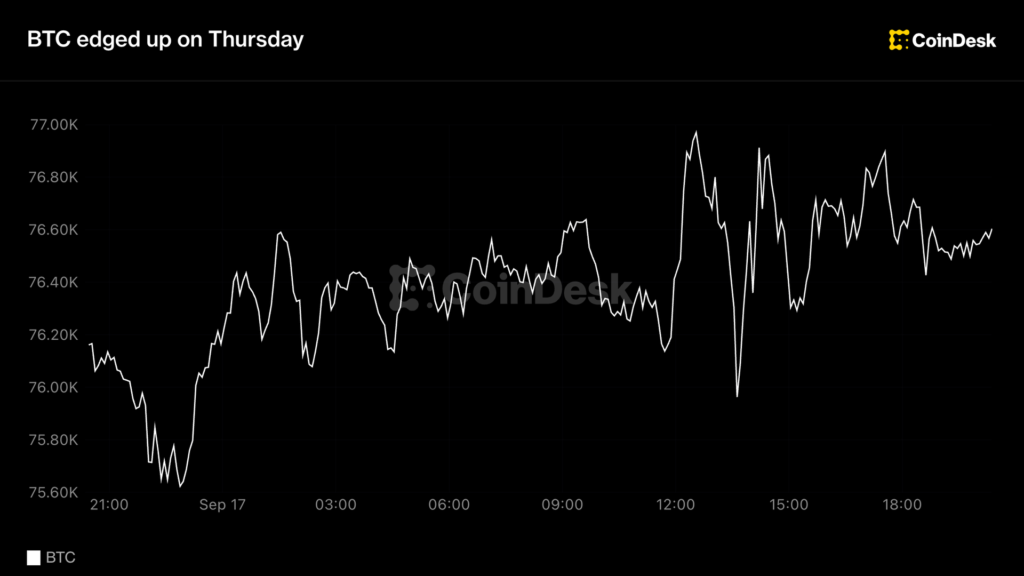
Bitcoin ticked up 0.5%, lagging behind the broader CoinDesk 20 Index, which advanced 1.5%.
‘Anything could happen with me’: Trump mulls next steps with Iran
“I have a big decision coming up,” President Trump told Axios on Thursday. “Do I want to go in and annihilate them [the Iranian regime] or do I not? It’s a big decision. Anything could happen with me.”
Trump made these remarks as his military campaign faces growing domestic opposition within the United States, compounded by record diesel fuel expenses, climbing borrowing costs, and fewer than two months remaining before the midterm congressional elections.
The probability of Democrats capturing both houses of Congress has climbed to 60% on Polymarket, up from roughly 40% at the start of the summer.
Following a dip below $100 per barrel earlier in the day, WTI crude has rebounded toward $102, leaving it down only slightly for the session.
Securitize CEO mulls SEC exemption as stock soars 20%
“The more I am reading [the SEC’s “innovation exemption” rule], the more I like some of the things I am seeing here,” wrote Securitize (SECZ) CEO Carlos Domingo shortly ago.
“Smart contracts must be auditable, publicly accessible, and deployed on public permissionless blockchains, encoding non-discretionary rules,” he observed. “This is great for Ethereum, Solana, Avalanche, and many other public chains that will be able to host tokenized securities venues (TSVs) under this exemption.”
“They allow trading against stablecoins AND tokenized money market funds!”
SECZ shares are trading up 20.3% during early afternoon hours.
Read more: SEC rolls out long-awaited ‘innovation exemption’ for tokenized securities venues
TeraWulf leads data center stocks higher as Wells Fargo sees 100% upside
“We have a favorable view of WULF’s management track record and the quality of its contracted and pipeline sites, with differentiated low-latency connectivity back to key East Coast hubs,” stated Wells Fargo as it initiated coverage of TeraWulf with an overweight designation and a price target of $30.
WULF shares rose 7.3% to reach $16.52 on Thursday.
Performance among other data center equities included CleanSpark (CLSK) up 4.5%, Hut 8 (HUT) up 2.7%, IREN (IREN) up 2.1%, and Cipher Mining (CIFR) gaining 3.9%.
JPMorgan gives up on Middle East
“For the first time since the start of the Iran conflict, we don’t have a baseline view,” stated JPMorgan’s commodities research division on Thursday. “We simply don’t know how to model the endgame.”
The department’s assessment is circulating widely across financial commentary on X as the Middle East hostilities have grown overly complex and multifaceted for any single individual or coalition to easily resolve.
WTI crude oil trades slightly softer today while holding near elevated levels above $100 per barrel. Meanwhile, domestic U.S. diesel prices established a fresh peak on Thursday at $6.29 per gallon.
Julian Assange returns
“I’m back,” stated Julian Assange in an X message moments ago. His announcement was preceded by a publication from WikiLeaks conveying the same message alongside an image of the investigative publisher looking healthy and prepared.
While de-banking has emerged as a common phrase in recent years, Assange’s WikiLeaks was the original target, cut off from payment channels in 2010 by entities such as Visa, MasterCard, and PayPal under pressure from the U.S. administration.
At the recommendation of Bitcoin creator Satoshi Nakamoto, Assange initially avoided utilizing the newly created cryptocurrency for donations due to fears that authorities might move to disable the network.
Subsequently, relatives of Assange collected financial support through bitcoin to cover his legal expenses.
SEC’s ‘innovation exemption’ helps crypto-related stocks claw back some big losses
Having experienced steep declines earlier in the week following the defeat of the Clarity Act, Coinbase (COIN), Circle (CRCL), Bullish (BLSH), Robinhood (HOOD), and Securitize (SECZ) are exhibiting strong pre-market rallies following the release of the SEC’s long-anticipated “innovation exemption.”
“Blockchain-based trading venues that want to list and trade tokenized securities received fresh permission and an explanation of how to do that from the U.S. Securities and Exchange Commission on Thursday,” wrote CoinDesk’s Krisztian Sandor, Nikhilesh De, Jesse Hamilton.
“Tokenization is coming to America,” commented Robinhood CEO Vlad Tenev. “Thanks to the SEC’s leadership, Americans can start to reap the benefits of tokenization: instant settlement, 24/7 trading, fractionalization by default and more. It’s a good day for U.S. innovation.”
Cleanspark rises 5%, Coreweave falls 2% as both unveil multibillion-dollar debt offerings
CleanSpark (CLSK) advanced 5% after revealing plans for a $2.227 billion debt issuance maturing in 2031. Funds will be directed toward completing its Sandersville data center, reimbursing CleanSpark for prior capital outlays into the initiative, and reserving capital for interest obligations.
CoreWeave (CRWV) moved down 2% after putting forward a $3 billion convertible debt issuance due in 2033, which could potentially expand to $3.5 billion. The majority of proceeds are designated for general corporate operations without a specified project assigned, while a portion will fund transactions aimed at mitigating shareholder dilution if the notes convert to equity.
Latest data shows continued strong labor market, softening housing
Initial jobless claims in the U.S. declined to 196,000 during the prior week, according to a Bureau of Labor Statistics release on Thursday morning. That represents a drop from the already subdued 206,000 figure reported the week before, coming in well below market expectations for a slight increase to 208,000.
The four-week moving average dropped to 203,250 from 206,000.
Conversely, the interest-rate-sensitive real estate sector continues to cool, as U.S. housing starts dropped 2.6% in August to a seasonally adjusted annualized rate of 1.275 million. This compares downward from July’s 1.309 million level and misses projections of 1.31 million.
Oil falls on report of China intervention with Iran
WTI crude oil dropped below $100 per barrel for the initial time in roughly a week following a Reuters report indicating that Beijing has urged Iranian officials to help restrain Yemen’s Houthi movement.
This diplomatic action by China was initiated following an appeal from Saudi Arabia in response to recent Houthi tactical advances.
WTI has subsequently retreated 3% to trade at $99.40 per barrel.
This decline has provided relief to sovereign bond yields, with the 10-year U.S. Treasury shedding 5.4 basis points to 4.95%. Consequently, risk-on assets rallied, lifting bitcoin (BTC) 1.15% to $76,900 alongside a 1.5% advance in Nasdaq 100 futures.
Stocks shrug off rate hike, with futures pointing to sharply higher open
Nasdaq 100 futures traded 1.1% higher roughly two hours prior to the opening bell in New York. Contracts tied to the S&P 500 and Dow Jones Industrial Average advanced 0.9%.
With the Federal Reserve’s interest rate adjustment behind them and another increase widely anticipated for either the October or December policy gatherings (or both), market participants appear to be resuming strategies focused on buying market dips.
U.S. Treasury yields eased, featuring the 10-year note down 3 basis points at 4.975% and the two-year yield dipping 1.4 basis points to 4.71%.
Crude prices also softened, with WTI pulling back to $100.76 per barrel from earlier weekly highs of $107.
Cryptocurrency prices remained relatively stable, with bitcoin changing hands at $76,100, mirroring levels recorded just ahead of the central bank’s rate decision.
Bank of England holds rates at 3.75% as oil surge threatens inflation
The Monetary Policy Committee of the Bank of England voted 6-3 to maintain benchmark interest rates at 3.75%, issuing a caution that ongoing hostilities in the Middle East and climbing crude costs could amplify inflationary pressures approaching the opening quarter of 2027. Brent crude continues to trade above $103 per barrel.
Zcash runs 17% as a $345 million liquidation wave follows the Fed hike
Zcash advanced in excess of 17% to approach $1,358 during Thursday morning trading in Asia, significantly outperforming all other major digital assets according to metrics from CoinDesk.
Solana and Hyperliquid each posted gains of approximately 3%, while BNB, Dogecoin, and Ether increased roughly 2%. Bitcoin rose 1% to surpass $76,400, XRP matched that performance, and Tron remained unchanged.
The Federal Reserve implemented a quarter-point adjustment to its target rate range, bringing it to between 375 and 400 basis points on Wednesday, representing its initial hike of the easing/tightening cycle after markets had priced in a 69% probability beforehand. Bitcoin showed minimal price reaction to the announcement. Alex Kuptsikevich, senior market strategist at FxPro, noted via email that bitcoin had previously undergone an “overreacted negatively” phase due to the defeat of the CLARITY Act in the Senate earlier in the week, rendering it less vulnerable to a strengthening dollar.
Approximately 86,816 investors experienced position liquidations across a 24-hour window totaling $345 million, data from CoinGlass indicates. Liquidations occur when trading platforms forcibly close leveraged positions because a trader’s margin can no longer sustain the losses. Short sellers accounted for $208 million of those liquidations compared to $137 million in long positions, meaning the heavy losses fell primarily on speculators anticipating downward price action.
Ether led the liquidation volume at nearly $89 million, followed by bitcoin at $85 million and zcash at $56 million. The single largest individual transaction was an $18 million bitcoin trade closed out on Hyperliquid.
Zcash generated $56 million in liquidations against a total market capitalization of $23 billion. Observers should monitor whether leverage begins to accumulate again through Thursday, as borrowed funds have driven every phase of this price expansion.
Originally published at https://www.coindesk.com/tech/2026/09/17/live-updates-zcash-jumps-17-as-usd345-million-of-liquidations-hit-crypto-traders.