Reporting coverage concluded on September 16, 2026, at 9:00 PM.
Meanwhile, the privacy-focused cryptocurrency zcash has advanced 130% across a 30-day window and is currently changing hands near its historical peaks established back in 2016.
Accelerate U.S. interest rate cuts: Trump weighs in
“Interest Rates in the United States should be 1%, or less, because we are the Best Credit in the World,” stated President Trump via Truth Social, following the Federal Reserve’s first rate increase in over three years.
“If we stopped Trading with every country that we have a Deficit with, which is most of them, we would make, at least, 1.5 Trillion Dollars a year.”
“We are ‘carrying’ almost every country in the World, and that cannot go on any longer.”
“LOWER THE INTEREST RATES FOR THE UNITED STATES OF AMERICA, AND FAST!”
Equities decline, bitcoin maintains stability at depressed levels following Federal Reserve increase
With just over 30 minutes remaining in the trading day, equity markets have ultimately drifted lower subsequent to the Fed interest rate adjustment and Kevin Warsh press briefing.
Financial shares are pacing the downward movement since a rate hike—with additional increases anticipated—results in a flatter yield curve, which can compress lender margins. The State Street Financial Sector SPDR (XLF) retreated by 2.4%, pushing the Dow Jones Industrial Average down by 1.6%.
The S&P 500 is performing somewhat better, experiencing a loss of only 1%, whereas the Nasdaq is lower by 0.55%.
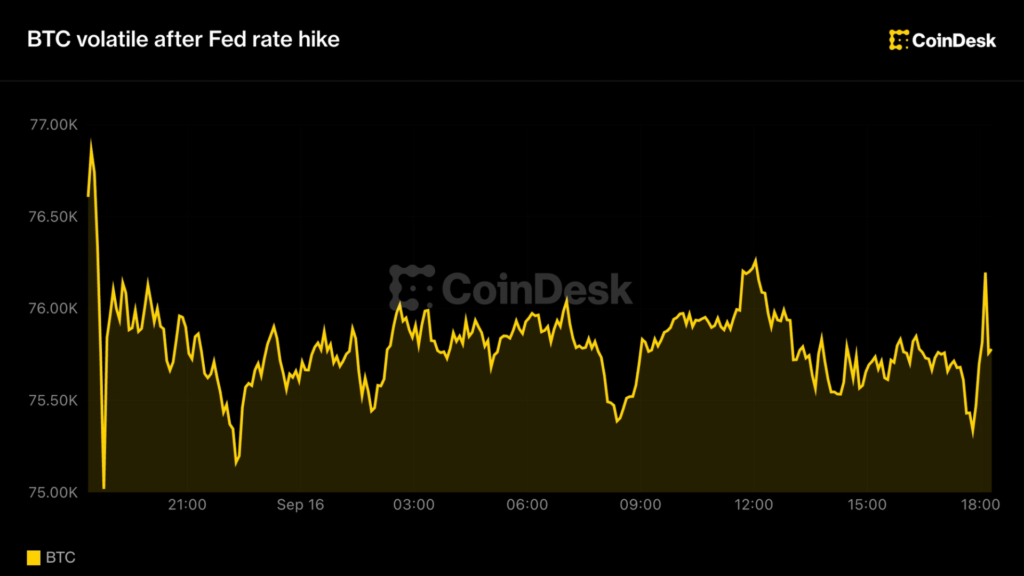
Having already fallen significantly over the course of the week, bitcoin (BTC) has sustained those reduced valuations, currently sitting at $75,400. Gold dropped 1% to reach $4,290 per ounce.
The U.S. dollar is strengthening against major global currencies, and bond yields are climbing across the maturity spectrum.
Fed official Warsh notes rate hike eliminated a measure of policy accommodation as inflation persists
Federal Reserve Chair Kevin Warsh remarked that inflation continues to represent the central bank’s primary anxiety after policymakers lifted borrowing costs by 25 basis points.
“The plain fact is that inflation is too high, and has been for too long,” Warsh noted. “This summer’s inflation readings do not tell me that underlying trends have meaningfully improved.”
“We removed a dose of accommodation,” Warsh stated, adding that this adjustment should steer financial and credit conditions closer to official central bank targets.
“Trends matter. Data points are noisy,” he added. “Data point dependence is a dangerous preoccupation.”
Warsh emphasized that the Fed maintains its dedication to the 2% inflation objective.
Fixed-income veterans evaluate Federal Reserve increase, Warsh press conference
“I would have hiked 50 (basis points),” expressed Jeff Gundlach, head of Doubleline Capital and a frequently cited bond market specialist.
“Warsh was not being honest when he said the Fed made the rate hike decision on its own,” commented Peter Schiff. “I think the Fed was backed into a corner, and with a 90% probability of a hike, it had to deliver or lose credibility. It was put up or shut up. Unfortunately, the Fed didn’t put up enough.”
“What did the Fed accomplish by raising rates today?” inquired Jim Bianco. “For the first time in over half a century, a completed prolonged rate-cutting cycle produced HIGHER long-term interest rates. The market has been telling the Fed for 2 years that it had the wrong policy. They finally listened today.”
“The Fed has chosen the illusion of action over effective policy,” wrote Daniel Lacalle. “Raising rates will not lower energy prices. It will not create oil, gas, pipelines, refineries, or electricity capacity. And it will not curb government spending. What it will do is engineer a private sector recession and make mortgages, credit, working capital, and investment more expensive or simply unaccessible, hurting families, SMEs, and job creation.”
Declining to prejudge upcoming adjustments: Warsh
Answering inquiries during his post-meeting news conference, Kevin Warsh explained that he will not prejudge any future Federal Reserve actions.
This assertion implies Warsh has not yet determined whether he will support subsequent rate increases, even though the dot plot within the central bank’s updated macroeconomic outlook points to one additional hike arriving in 2026. Consistent with his historical approach, Warsh seemingly abstained from contributing to the Fed’s dot plot.
“I’m not in the forward guidance business,” Warsh declared.
We eliminated a measure of accommodation: Warsh
During the early phases of his post-meeting briefing, Federal Reserve Chairman Kevin Warsh stated that neither he nor any other member of the FOMC observes any indicators pointing toward an economic slowdown.
Consequently, “we removed a dose of accommodation,” he stated.
Both bitcoin and equities are shedding prior gains as the central bank’s sudden hawkish stance becomes more transparent.
Bitcoin edges upward following Federal Reserve rate adjustment
The Federal Reserve implemented a 25-basis-point increase to benchmark rates, meeting general expectations. Furthermore, the monetary authority signaled that another rate rise remains likely before the conclusion of the year.
Bitcoin has experienced notable fluctuations in the minutes following, yet trades modestly higher since the announcement, currently changing hands at $76,300.
U.S. stocks expanded upon their initial gains, with the Nasdaq index climbing 0.8%.
Fed increases rates by 25 basis points, meeting expectations
The United States Federal Reserve enacted monetary tightening for the initial time in upwards of three years on Wednesday.
In an action that was almost universally anticipated, the central bank lifted the target federal funds rate bracket by 25 basis points to reach 3.75%-4%.
The vote approving the rate increase was unanimous, and the updated economic dot plot indicates the institution anticipates one additional rate rise over the current year.
“Economic activity is expanding at a solid pace,” the FOMC noted inside its official policy statement. “While uncertainty remains elevated owing, in part, to geopolitical developments, domestic spending has been resilient … Inflation remains elevated. Today’s policy action will support a timelier return to the Committee’s 2 percent goal. The Committee will deliver price stability.”
Bitcoin exhibits turbulence directly following the announcement, yet stays largely unchanged compared to pre-announcement levels at $75,700. U.S. equities continue posting minor gains, while bond yields drift slightly lower.
Federal Reserve interest rate decision approaches while El-Erian questions market confidence in 90% hike probability
Only moments remain before the Federal Reserve reveals its monetary policy verdict, with financial markets pricing in a strong likelihood of an interest rate increase.
Market participants will also scrutinize the central bank’s revised economic forecasts, featuring the closely monitored dot plot, to glean insights regarding potential interest rate trajectories at forthcoming sessions.
Mohamed A. El-Erian, a professor affiliated with Wharton, posted on X that it is “striking” to observe financial markets pricing in a 90% probability of a rate increase despite mixed macroeconomic metrics and conflicting signals originating from Fed officials.
He noted that intense scrutiny directed at the newly updated rate dots additionally underscores the complicated dynamic governing central bank communications versus market anticipations.
Bitcoin is presently exchanging at $75,400.
Late-stage hedging observed regarding interest rate hikes
While still considered a near certainty, traders are executing minor hedges against higher borrowing costs just moments prior to the Fed’s monetary announcement.
According to the CME FedWatch Tool—which aggregates information derived from short-term interest rate pricing across its derivatives operations—the implied probability of a 25-basis-point rate increase receded to 88% compared to nearly 95% recorded a day prior.
Bitcoin maintains a cautious trading posture at $75,500, marking a 1.6% decline over the trailing 24 hours. U.S. equities show slight gains, with the Nasdaq advancing 0.55% and the S&P 500 rising 0.3%.
Cipher gains 16% on conditional ERCOT classification for 3.2 GW Texas initiatives
Cipher Digital (CIFR) equity values jumped 16% subsequent to revealing conditional ERCOT approvals covering 3.2 GW of infrastructure initiatives across Texas, which strengthens optimism surrounding its data center development roadmap. This aggregate capacity encompasses 1.1 GW of conditional baseload alongside 2.1 GW of conditional studied load.
This upward momentum spread broadly across artificial intelligence infrastructure equities, with IREN (IREN) climbing 5.3%, CoreWeave (CRWV) advancing 4.3%, and TeraWulf (WULF) rising 5.5%.
Consumer sector experiences strain: Dollar General
“Any time that gas price gets anywhere close to $4 and then crests $4 a gallon, the customer changes their shopping behavior,” explained Todd Vasos, chief executive officer of Dollar General, speaking during the Goldman Sachs Global Consumer and Retail Conference.
Vasos stated that the enterprise’s foundational consumer base—individuals earning between $40,000 and $45,000 or less—have increased their store visitation frequency while simultaneously purchasing fewer goods per transaction.
Regarding consumers generating annual incomes of $100,000 or greater, Vasos indicated that financial pressures have caused them to lose their sense of financial prosperity.
Bond yields edge down ahead of anticipated Federal Reserve rate increase
U.S. government debt yields on Wednesday are pausing from what appeared to be an uninterrupted succession of daily advances.
The benchmark 10-year Treasury yield retreated by 3.2 basis points to settle at 4.964%, whereas the 2-year yield contracted by 4.6 basis points to hit 4.617%.
This market activity transpires ahead of the afternoon monetary policy determination, where the nation’s central bank is broadly anticipated to elevate borrowing costs for the initial time in over three years.
Given this context, market participants are expected to heavily monitor the updated economic projections published simultaneously with the policy verdict, particularly the dot plot indicators and their implications for potential subsequent rate adjustments.
U.S. homebuilder confidence contracts to nearly four-year minimum
The NAHB Housing Market Index declined to 32 during the current month compared to 35 recorded in August. Market predictions anticipated a milder drop to 34.
An index reading exceeding 50 indicates that a majority of constructors maintain a positive perspective regarding present and near-term housing conditions, while readings below that threshold signify diminished optimism.
The reading of 32 matches the lowest HMI level registered since late 2022.
“The latest HMI survey found that 38% of builders cut prices in September, up from 35% in August,” reported the NAHB. “The average price cut remained at 6% for the sixth consecutive month. Meanwhile, 66% of builders reported using sales incentives in September, up from 63% in August and the highest share since 67% posted in December.”
‘Bond market has fulfilled its function’: Market participants await initial Federal Reserve rate increase since 2023
Bitcoin (BTC) investors are not demonstrating overt panic concerning Wednesday’s anticipated Federal Reserve rate hike, yet they are simultaneously avoiding excessive exposure.
Financial markets price in a 92.5% likelihood that the central bank increases borrowing costs for the first time in three years following robust labor metrics and persistent inflation. Bitcoin has spent the previous 24 days oscillating roughly between $76,000 and $80,000, accompanied by volatility sinking to a one-month low.
For select market participants, the quarter-point adjustment is already fully priced in.
“The bond market has done its job and fully priced in tomorrow’s hike,” remarked Chris Sullivan of Hyperion Decimus. In his estimation, the more substantial shock could materialize if the Fed refrains from hiking, which would leave investors questioning what underlying factors policymakers observe that the broader market has missed.
Cryptocurrency investors are actively directing a portion of their capital away from risk.
Talos recorded a 28% net buying preference oriented toward stablecoins ahead of the scheduled gathering, according to research analyst Cooper Duschang. During prior Federal Open Market Committee gatherings, market participants typically exhibited an average 8% selling preference toward stablecoins.
Capital demand directed toward the two primary cryptocurrencies moved in the opposite direction. Bitcoin accumulation confidence receded from 10% to 3%, while ether (ETH) dropped from 23% to 9%.
“The clearest shift has been into stablecoins,” Duschang noted, explaining that investors appear to be “reducing risk and holding greater liquidity ahead of the Fed.”
The broader inquiry for Wednesday afternoon involves determining where this sidelined capital will deploy once the monetary policy decision is concluded.
Historical precedent exists for a subdued immediate reaction. Duschang noted that bitcoin barely moved during the central bank’s prior rate increase in July 2023, as the adjustment had been thoroughly factored into prices prior to the official announcement.
Derivative exchanges are similarly devoid of panic. K33 Research highlighted that aggregate open interest across bitcoin futures and perpetual contracts sits below its annual average, displaying minimal indications of leverage that typically transforms a standard market pullback into cascading liquidations.
Crude oil represents the primary variable. Petroleum prices have surged in excess of 20% over the trailing five days, according to Mark Connors, chief investment officer at Risk Dimensions. Elevated energy costs could exacerbate inflationary pressures even as the central bank attempts to suppress them via higher borrowing expenses.
Connors characterized another rate increase as “using a pitchfork to bail out our boat of inflation,” arguing that monetary tools cannot easily resolve inflation driven by external petroleum supply constraints.
Consequently, for bitcoin, Wednesday’s session may depend less on whether the Fed executes the universally expected rate hike and more on the forward-looking commentary delivered by Fed Chair Kevin Warsh.
Duschang indicated he will likewise monitor the accumulated stablecoin reserves. Should those funds begin returning to digital asset exchanges following the declaration, participants who adopted defensive postures during the run-up may prepare to reintroduce risk.
August retail sales surpass forecasts
Prior to the Federal Reserve’s monetary announcement later in the day, additional robust macroeconomic data emerged.
Government figures indicated that retail sales expanded by 1.2% in August, comfortably outpacing economist projections of 0.8% and rebounding from a 0.6% contraction in July.
Excluding automobile transactions, retail sales advanced 1.4% last month, outperforming the anticipated 0.5% growth and reversing the 0.2% decline seen in July.
Historically, the retail sales report commanded intense market scrutiny, though its influence has diminished due to the availability of nearly real-time credit card transactional intelligence accessible to institutional players.
Government debt yields maintain minor losses for the trading session, with the benchmark 10-year U.S. Treasury yield down 1.7 basis points at 4.98%.
‘Government appears dysfunctional’: Reactions persist regarding the failure of the Clarity Act
“Government feels broken,” wrote Mike Novogratz, chief executive officer of Galaxy Digital. “18 months of work between our industry, dems and republicans and Clarity falls apart on the 5 yard line.”
“Republicans were afraid of putting real limits on a President’s ability to profit from digital assets,” he continued. “Dems decided that this one industry is where they would fight a corruption battle. They were scared to be seen doing anything that could be perceived as being soft on the President.”
“I do have faith that the SEC and CFTC will drive on with rules for the road and hopefully in time Congress will find a way to memorialize them so people can have a longer term confidence in how digital assets will be treated in the U.S.”
“Progress need not wait for Congress,” stated Michael Saylor, executive chairman at Strategy. “With CLARITY stalled, I expect the SEC, CFTC, and Treasury to advance rules under existing law, banks to expand Bitcoin custody and loans against it, and more capital to favor Bitcoin and digital credit. GENIUS supports stablecoin adoption.”
“The banks did everything in their power to kill the Clarity Act,” declared Coinbase representative Kara Calvert. “The big banks and the small banks worked together to hand Donald Trump a loss and stop financial innovation and competition in America, and they successfully put several Republicans on record as anti-crypto. This was not a zero-sum game, but they made it one.”
Bitcoin exchange-traded funds report largest single-day outflows since June 25
U.S. bitcoin exchange-traded funds experienced $450.4 million in net redemptions on Tuesday, marking their largest single-day outflow since June 25, with BlackRock’s IBIT fund accounting for $161.7 million of the total. These capital withdrawals coincided with the legislative collapse of the Clarity Act and bitcoin dropping under the $75,000 threshold.
Zcash advances while broader market hovers near session lows
Zcash climbed nearly 6% to reach slightly above $1,200 during European morning hours on Wednesday, standing out as the singular major digital asset in positive territory based on CoinDesk metrics.
XRP paced the downward performers, receding in excess of 7% to $1.29. Both ether and solana experienced losses of approximately 3%, while bitcoin, BNB, and tron each dropped roughly 1%. Bitcoin traded just beneath $76,000 after slipping under $75,000 on Tuesday.
That downward move followed the legislative defeat of the CLARITY Act within the U.S. Senate, a proposed statute intended to define regulatory oversight responsibilities among agencies for specific digital assets and representing the sector’s primary legislative initiative for the year.
The Federal Reserve delivers its interest rate determination later on Wednesday, with a quarter-point adjustment already factored into pricing. Bitunix analysts shared in an email to CoinDesk that the magnitude of the immediate move holds less significance than the subsequent trajectory of long-term Treasury yields.
Observers should monitor those long-dated yields once the official policy decision is released. If those yields remain anchored near present levels notwithstanding higher short-term rates, financial markets are pricing domestic inflation and sovereign fiscal risks independently of any subsequent Fed actions.
Originally published at https://www.coindesk.com/business/2026/09/16/live-updates-zcash-climbs-6-as-majors-slide-ahead-of-fed-rate-decision.