Last week, the shutdown of Paraguay’s online financial institution Ueno Bank left roughly three million users—accounting for about 60% of the adult population in Paraguay—cut off from their financial accounts.
On Nov. 3, the Central Bank of Paraguay initiated a resolution process for Ueno after its capital adequacy ratio dropped beneath half of the mandated legal threshold. An inquiry subsequently revealed questionable lending behaviors alongside flaws in credit paperwork and financial record-keeping.
This failure also sparked a political upheaval, leading crowds to protest in the streets while President Santiago Peña sought to step down before being impeached and detained on allegations of breach of trust and abusing his official position for personal benefit.
The turmoil instantly showed up in Paraguay’s peer-to-peer digital asset market, where certain vendors demanded a USDt markup reaching as high as 13%. Tether chief executive Paolo Ardoino noted that USDt serves as a crucial lifeline for hundreds of millions globally.
The situation created widespread doubt regarding personal savings, wages, and funds required for daily costs. With the domestic guaraní (PYG) dropping 12.3% across a single week, some individuals shifted to stablecoins to preserve the purchasing power of their capital or simply to keep transactions flowing.
David Eisenmann, the founder and CEO of the Paraguayan digital asset platform X4T, explained to Magazine that the timing amplified the urgency for liquidity.
He pointed out that the intervention occurred during the opening days of the month, which is precisely when salaries, rent, and vendor bills become payable, and he noted that numerous business proprietors were unable to handle payroll. For specific individuals, USDt abruptly turned into the most liquid asset available to them:
“This week they learned that having an account isn’t the same as having access to your money.”
Yet, apart from offering yet another traditional finance lesson concerning the merits of self-custody, the failure of Ueno underscores the expanding function of dollar-linked stablecoins as backup liquidity options during traditional banking collapses.
Crypto as a source of liquidity
Eisenmann reported that X4T processed upwards of $10 million in domestic fiat-to-crypto volume during the 30-day window leading up to early November, though a portion of that activity predated the Ueno shutdown.
He mentioned that the dollar started climbing against the guaraní back in October, and the Ueno developments merely accelerated a trend that was already underway.
Related: Stablecoins can drain from banks and nations at lightning speed
He stated that transactions move in both directions, with certain clients exchanging crypto for guaraníes or dollars to settle financial obligations they could no longer process via Ueno, whereas interest in USDt and USDC as dollar-denominated stores of value climbed significantly.
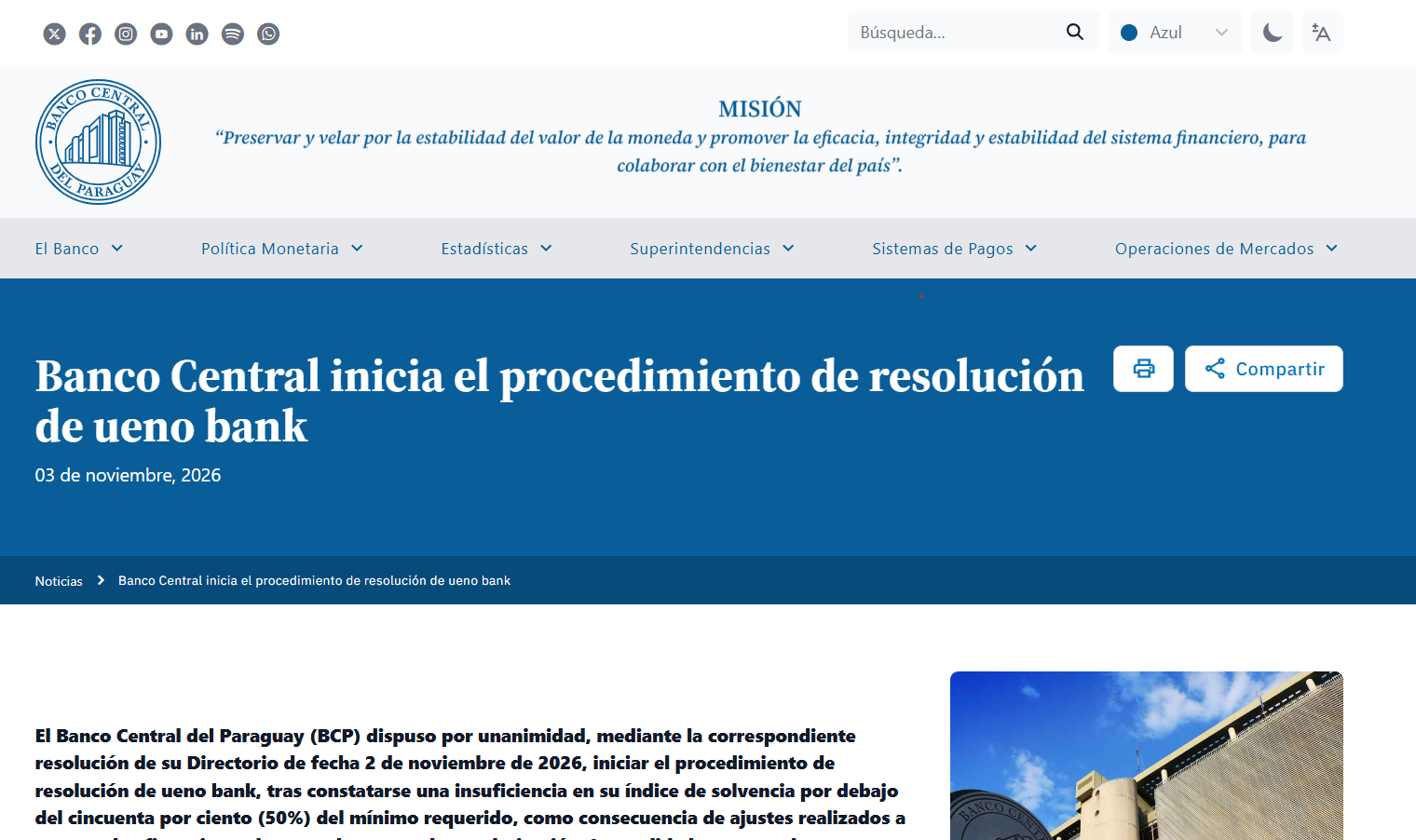
Paraguay’s Central Bank placed Ueno into resolution on Nov. 3. Source: Central Bank of Paraguay
By Nov. 9, the Central Bank reported that 93.1% of depositors holding funds at Ueno had received reimbursements. Despite this, general confidence has taken a hit, and X4T continued observing elevated online interest regarding dollar-pegged stablecoins. In fact, Eisenmann indicated that this metric remained largely unchanged compared to the week of the crash.
Rhys Hicks, an analyst at research firm GlobalData, argued that the digital lender’s collapse demonstrated the extent of potential problems when governance fails to keep pace with rapid expansion.
Even so, he does not observe indicators pointing to a massive migration of funds from Paraguayan financial institutions into stablecoins, given that alternative lenders stepped in to fill the gap and the public appeared more frustrated with political leaders than traditional banks.
He noted that while some consumers will seek alternative ways to secure their funds, he does not yet perceive a massive transition toward stablecoins.
An old impulse, with new rails
The pursuit of US dollars during periods of shaken faith in local banking institutions is hardly unprecedented. During the financial crisis of 2001 in Argentina, authorities enforced the “corralito,” which limited cash withdrawals from checking and savings accounts following a massive bank run.
Related: Peter Thiel backs crypto-friendly Silicon Valley Bank rival — Report
Amid an escalating crisis surrounding the nation’s currency peg and sovereign debt obligations, the government subsequently converted dollar accounts into local pesos, cutting citizens’ savings by approximately 30% overnight and further eroding trust in the deteriorating banking infrastructure.
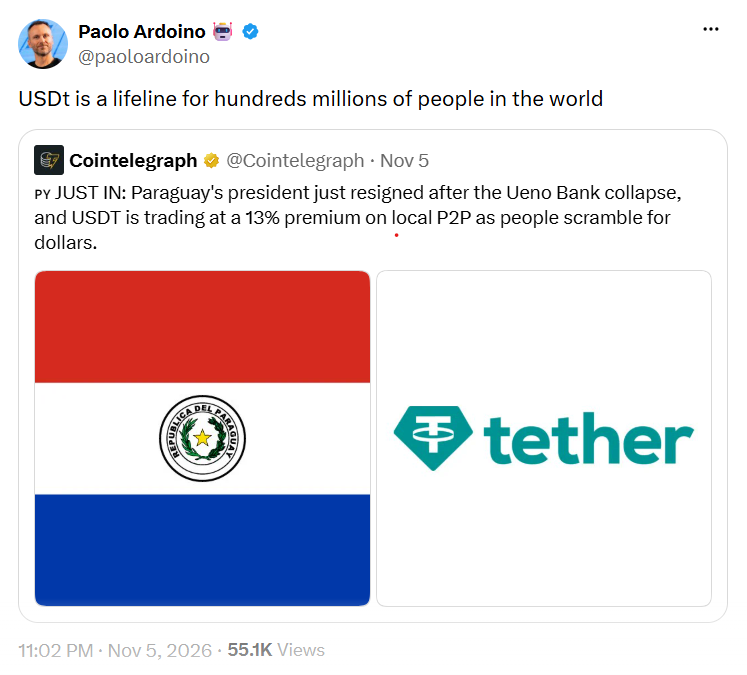
Tether CEO calls USDt a lifeline. Source: Paolo Ardoino
Nonetheless, stablecoins are neither decentralized nor entirely decoupled from the traditional banking ecosystem.
Throughout the March 2023 collapse of Silicon Valley Bank, stablecoin issuer Circle revealed that $3.3 billion backing USDC reserves—representing about 8% of the total amount—were deposited with that institution. USDC temporarily lost its dollar peg, dropping to 86 cents on secondary platforms after Circle announced it was unable to access those reserves.
A Bank for International Settlements research paper focusing on stablecoins and the global monetary framework cautions that widespread adoption of dollar-pegged digital tokens could pose obstacles to monetary sovereignty within developing economies.
Hicks suggested that stablecoins offer a viable alternative during phases of political turmoil and diminished trust in domestic frameworks because they anchor value to a more resilient fiat currency like the US dollar.
However, he emphasized that regulators must focus on transparency and consumer protections, pointing out that stablecoin holders lack the deposit insurance protections available to traditional bank clients and have no central bank authority ready to bail them out.
Eisenmann anticipates that this event will encourage greater diversification, with individuals distributing funds across traditional banks, physical cash, and digital assets rather than depending solely on one financial institution.
He concluded that the speed at which faith in the banking sector rebounds will rely on how swiftly and transparently regulatory bodies manage the resolution process.
Magazine: What Democrats’ US midterm sweep means for the CLARITY Act
Originally published at https://cointelegraph.com/magazine/paraguay-bank-collapse-shows-stablecoins-can-offer-a-lifeline-of-sorts?utm_source=rss_feed&utm_medium=rss&utm_campaign=rss_partner_inbound.