Ripple, the financial technology enterprise closely tied to the XRP Ledger (XRP) network, is targeting corporate treasurers to fuel the next phase of expansion for its Ripple USD RLUSD$1.0017 stablecoin, aiming at a client base that manages approximately $13 trillion in yearly transfers.
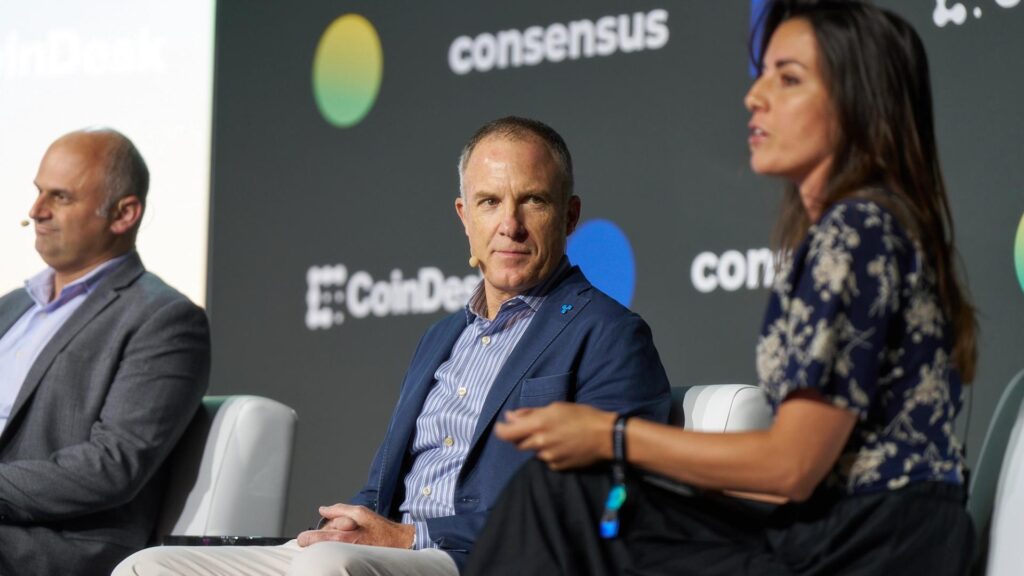
Jack McDonald, Ripple’s senior vice president of stablecoins, mentioned during a discussion with CoinDesk that one of the most significant opportunities lies within Ripple Treasury, the division formed around the $1 billion purchase of treasury platform GTreasury last year.
The system’s roughly 1,200 corporate finance officers and treasurers transfer funds internationally, between corporate branches, and domestically, granting Ripple access to a vast volume of traditional financial operations to migrate onto blockchain infrastructure, McDonald explained.
“That customer base hadn’t been onchain,” he stated. “They touch roughly 13 trillion dollars worth of transactions on an annual basis.”
“So that opportunity set is just massive,” McDonald continued.
This market is opening up as stablecoins transition past their origins in digital asset trading to form a more substantial component of global payments and financial architecture. More than $300 billion worth of stablecoins currently circulate, while regulatory bodies establish formal frameworks and traditional financial institutions, payment processors, and fintech companies increasingly build products around the underlying technology.
RLUSD, introduced nearly two years ago, remains far behind legacy market leaders Tether’s USDT USDT$0.9995 and Circle’s USDC USDC$0.9995, yet it has experienced swift adoption.
Its total supply in circulation has grown to $2.4 billion, marking an increase of over 50% across the preceding month, according to figures from Token Terminal. Approximately $1 billion resides on the XRP Ledger, while $1.4 billion exists on Ethereum ETH$2,520.91.

Nevertheless, Ripple places greater emphasis on actual token utility rather than headline market capitalization figures.
“What’s more exciting to us is the utility and the daily activity,” McDonald noted.
Daily transactional volume for RLUSD has more than tripled since the year began, rising to roughly $750 million daily last month from an initial level of about $200 million, he observed.
Payments and capital markets drive usage
Global payments and capital markets currently serve as the two primary vectors for adoption. Ripple has integrated RLUSD as the foundational stablecoin within its payment ecosystem, whereas in capital markets, the digital token serves transaction cash legs, settlement processes, and collateral management.
Ripple has collaborated with entities such as Franklin Templeton and DBS concerning tokenized money market funds and lending initiatives, and RLUSD can likewise be deployed as collateral via Ripple Prime, the institutional brokerage arm established through the purchase of Hidden Road.
Such an approach illustrates Ripple’s broader strategy to merge stablecoins with custody, trading, payment solutions, and prime brokerage services instead of running RLUSD as an isolated asset.
“What we’re seeing […] is this evolution from stablecoins being a crypto asset to [become] part of financial infrastructure,” McDonald said.
Europe and broader expansion
Europe represents another territory Ripple intends to unlock for RLUSD.
McDonald indicated the firm hopes to introduce the dollar-pegged token locally via a dual-issuance framework that adheres to the European Union’s Markets in Crypto-Assets (MiCA) guidelines.
“We would first and foremost like to offer RLUSD into Europe,” he remarked. “That’s a bit of a process to have dual issuance approved.”
Ripple has already secured regulatory approval within Luxembourg, which McDonald mentioned could facilitate a wider MiCA-compliant stablecoin, payments, custody, and trading operation.
He further noted that market demand continues to heavily favor fiat-backed U.S. dollar stablecoins over alternatives denominated in euros or emerging-market currencies.
Additionally, Ripple views the proliferation of bank-backed stablecoins and tokenized deposit initiatives as a validation of onchain finance. McDonald explained that deposit-based tokens function effectively inside proprietary bank environments or consortium networks, whereas stablecoins offer superior utility when value must traverse outside those boundaries.
“When you want to go outside of that walled garden, that’s where stablecoins come into play,” he stated.
RLUSD is also extending its reach beyond its initial deployments on the XRP Ledger and Ethereum. McDonald shared that Ripple has incorporated or obtained authorization for additional networks including Base, Ink, Optimism, and Unichain, though the company does not intend to deploy everywhere indiscriminately.
“We want to be where demand is,” he added. “We’re not chasing retail meme coin chains.”
Originally published at https://www.coindesk.com/business/2026/09/12/ripple-stablecoin-chief-sees-usd13-trillion-corporate-treasury-opportunity-for-rlusd.