Decentralized exchanges and blockchain platforms seeking to list and trade tokenized securities obtained fresh guidelines and permissions from the United States Securities and Exchange Commission on Thursday.
The SEC revealed its anticipated tokenization exemption early Thursday, officially giving these designated tokenized securities venues (TSVs) the authorization to deploy automated market makers and liquidity pools meant for trading tokenized shares. These entities receive a five-year conditional waiver from qualifying as a traditional exchange under federal securities regulations, according to the SEC announcement.
Operated under regulatory oversight, these venues will supervise pools of essential assets and deploy code-based automation to direct the transactions between buyers and sellers. Thursday’s directive outlines pathways for tokenizing assets through either the equity issuer or an independent third party, provided specific conditions are met.
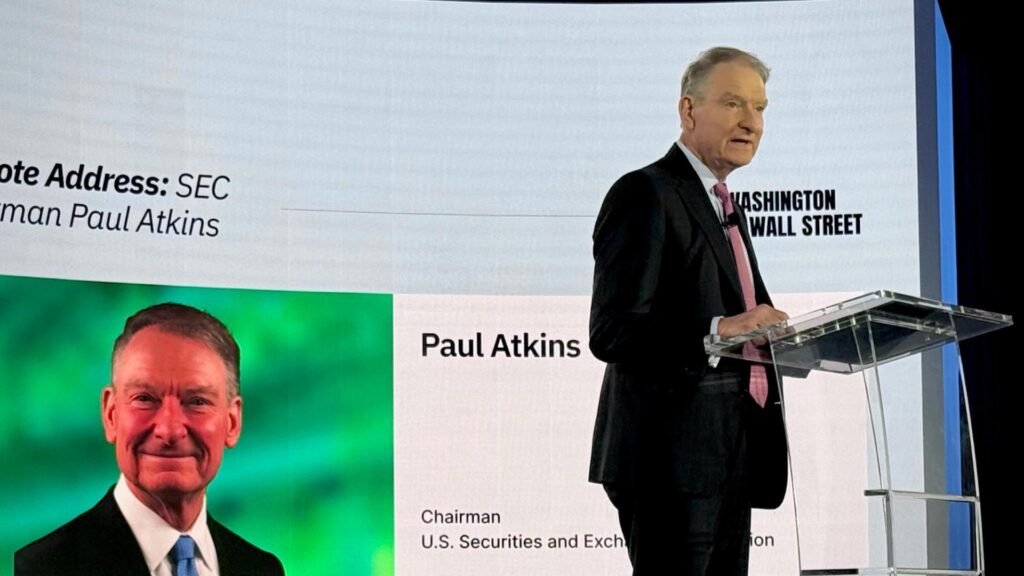
SEC Chairman Paul Atkins stated in a release that the agency is taking a substantial and lawful step to propel American financial markets into the digital era by supporting onchain trading of specific tokenized equities via the Innovation Exemption.
The regulatory body deliberately excluded synthetic security tokens which function as derivatives and fail to grant direct share ownership. The SEC permits only tokens that embody actual ownership of the underlying equity, noting through Atkins that such tokens must grant owners identical rights and advantages as conventional securities, including dividend collection and voting capabilities.
This restriction may rule out certain derivatives and debt products featured in overseas trading channels, such as those from Robinhood.
The temporary innovation exemption does not mandate formal SEC designation for these venues. Instead, any marketplace that considers itself capable of satisfying the agency’s criteria and adhering to the stipulations merely needs to submit notification ahead of launching its tokenization operations, the commission stated.
5 years, to start
Atkins acknowledged the short-term design of the initiative, explaining that it allows businesses to run within a permitted framework while the commission evaluates whether further measures are necessary to foster onchain exchange. He noted that this step must eventually be paired with permanent rulemaking to guarantee that onchain marketplaces remain a sustainable option as our financial markets continue to develop.
Tokenizing assets has emerged as one of Wall Street’s primary blockchain initiatives, lending considerable weight to the SEC’s opening maneuver. The fundamental premise involves taking familiar instruments like equities, notes, or investment funds and representing ownership digitally on a distributed ledger, which could allow them to transition more frictionlessly across investors and financial infrastructures.
International asset managers, banking institutions, and market infrastructure corporations have accelerated their exploration of the technology, betting it could ultimately deliver accelerated clearing, continuous 24/7 markets, reduced expenses, and simplified asset distribution for use as collateral. This presents a massive financial prospect, as analysts at Citi estimated that tokenized assets could blossom into a $5.5 trillion industry by the year 2030.
To safeguard issuers, a TSV is required to deliver a 30-day advance notice prior to tokenizing another enterprise’s securities, thereby granting that firm an opportunity to object. Officials clarified that the objection process could be as straightforward as the company issuing a formal statement of refusal.
Delivering ‘certainty’
Although the SEC previously held off on the program while the Senate deliberated on legislation intended to provide a statutory framework for this and related policies, those legislative hurdles have largely vanished. The Digital Asset Market Clarity Act stalled on Tuesday after the Senate secured merely 49 of the 60 votes required to advance the comprehensive crypto market structure bill.
Following that legislative defeat in the Senate, Atkins announced via the social media platform X on Wednesday that his department would act decisively within its statutory powers to deliver certainty for American investors and the innovators shaping our technological horizon.
He advised audiences to stay tuned before following up a day later with the long-awaited waiver.
The SEC previously revealed the first major proposal for a fresh cryptocurrency rule last month through a regulation designed to establish a clear pathway for digital asset distributions without triggering stringent oversight requirements typically applied to securities.
Subsequently, the commission proposed the initial major structural update to transfer-agent regulations in four decades on September 1, officially accommodating blockchain-based recordkeeping for asset ownership.
On Thursday, Atkins’ agency is also scheduled to convene a roundtable regarding round-the-clock trading, a practice native to digital assets but potentially transformative for traditional financial institutions.
It remains undetermined whether the regulator will eventually secure statutory crypto legislation from Congress to solidify its tokenization framework, which presently relies on the SEC’s discretionary authority to exempt narrowly scoped enterprises from comprehensive regulatory burdens.
For the time being, Atkins along with his two fellow Republican commissioners are fully utilizing the extent of the agency’s powers, though policies established in this manner could potentially be reversed by future actions in a similar fashion.
Originally published at https://www.coindesk.com/policy/2026/09/17/sec-rolls-out-long-awaited-innovation-exemption-for-tokenized-securities-venues.