The United States Dollar Index (DXY) is currently climbing, a development typically interpreted as negative news for bitcoin and alternative dollar-denominated holdings such as gold. Available figures indicate that this connection is actually much weaker than that conventional perspective suggests.
The DXY gauge, which measures the greenback against a collection of leading foreign currencies including the Japanese yen and the European euro, has climbed roughly 2.6% starting from September 9 and reached a two-month peak of 101.69 on Tuesday.
Because the dollar serves as the primary global reserve currency, it anchors international finance and indebtedness. When its value rises, borrowers carrying debt denominated in dollars encounter elevated servicing expenses and generally reduce their risk exposure. Conversely, a declining dollar produces the exact opposite outcome.
Therefore, economic theory dictates that a surging dollar ought to pressure bitcoin downward. Indeed, the recent upward momentum of BTC has plateaued since September 21, with valuations easing back toward the $83,000 to $84,000 range after previously nearing $87,500. While a sturdier dollar might be limiting upward movement, the actual adverse impact so far remains minimal.
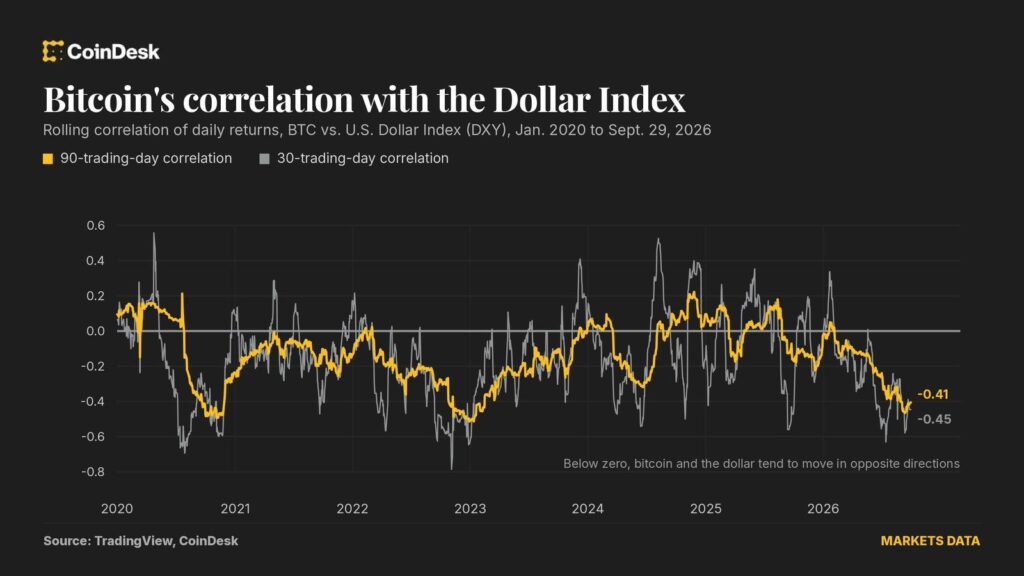
Furthermore, correlation statistics reinforce this underlying toughness. Over the previous 90 trading sessions, day-to-day price movements between BTC and the DXY exhibit a correlation coefficient of -0.41, according to TradingView metrics evaluated by CoinDesk. A negative figure indicates that these two instruments generally travel in opposite directions. This marks the most pronounced negative reading recorded since February 2023.
Nevertheless, although this relationship is genuine, it remains relatively modest, as illustrated in the accompanying visual. The correlation points to an R-squared value of 0.17, signifying that shifts in the DXY account for a mere 17% of the overall fluctuation observed in daily bitcoin returns.
Shorter-term calculations exhibit greater volatility. The 30-day correlation stands at -0.45, though it heavily relies upon two specific dates—August 19 and September 3—when BTC advanced more than 5% while the DXY declined. Excluding those instances, the metric softens to -0.19.
Extending the analytical horizon reveals an even weaker connection. Beginning in January 2020, the 90-day correlation has maintained an average of -0.14, and has occasionally crossed into positive territory, reaching a high of +0.22 in November 2024.
Additionally, bitcoin demonstrates minimal notable correlation with yields on U.S. Treasury securities, a topic CoinDesk explored recently.
Coupled with its limited connection to the dollar, this dynamic strengthens the proposition of bitcoin functioning as an effective portfolio diversifier—an asset driven primarily by its own internal catalysts. Whether this autonomy persists will be crucial to monitor. Stay alert!
Originally published at https://www.coindesk.com/daybook-us/2026/09/30/a-stronger-dollar-is-a-weaker-threat-to-bitcoin-than-traders-think.