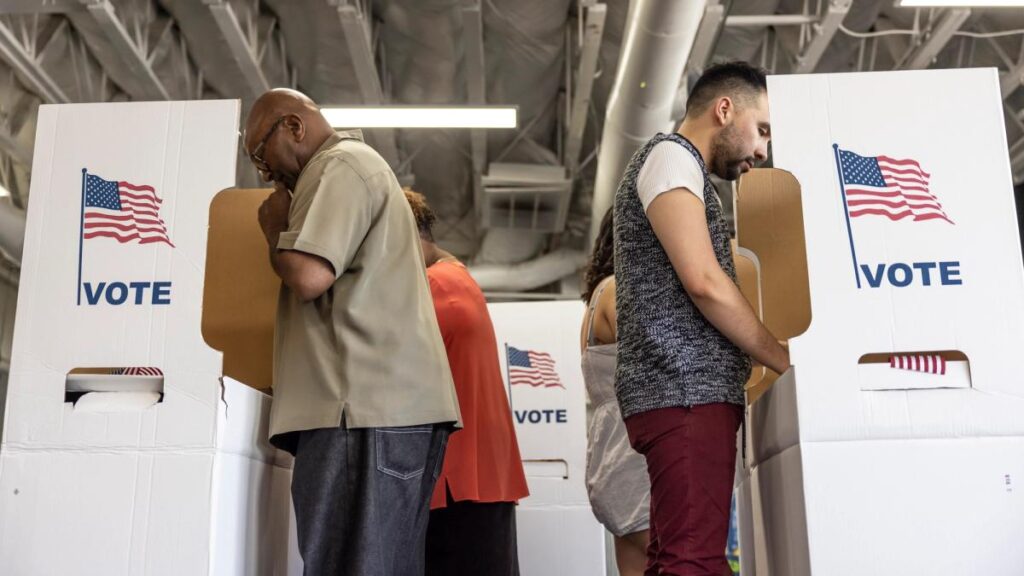
Tomorrow, Ohio voters will participate in one of just three non-presidential elections ever to exceed $500 million in advertising expenditures, following only Texas in this current cycle. Cryptocurrency super PACs have poured $63 million exclusively into the Ohio contest, driven by a single objective: preventing Sherrod Brown from securing a Senate seat.
The Fairshake super PAC network accounts for $56 million of that total, with the remaining $7 million supplied by the Winklevoss brothers’ political action committee, the Digital Freedom Fund. A representative for Fairshake asserts that it will permanently function as an issue-driven entity, supporting pro-crypto candidates across both major parties who foster American innovation.
Yet Brown lost his legislative seat back in 2024 and has not cast a single ballot regarding cryptocurrency throughout the entire 119th Congress. Even so, Fairshake announced its largest financial contribution to halt Brown shortly after Senate Democrats stalled the Clarity Act—a vote in which Brown did not participate.
Following Brown’s defeat in 2024, a Fairshake representative gloated that Brown was a leading adversary of digital assets and was exiting the Senate as a direct consequence of their efforts. While the crypto sector was initially trying to secure legislation, Brown led the Senate Banking Committee and could have scheduled a committee vote on the House-approved FIT21 bill, though he chose not to do so.
While Brown’s political record is open for discussion, does his inactivity in 2024 combined with his total absence from Capitol Hill over the past two years genuinely justify the crypto super PAC’s largest congressional expenditure of 2026?
This was never about merit
If political spending by the sector actually relied on legislative performance, the targets would be self-evident. Following the 2024 elections, prominent industry figures rushed to celebrate how the digital asset community had secured a pro-crypto Congress, especially given that Republicans have held the House, Senate, and White House for the preceding two years.
The widespread expectation stemming from this unprecedented financial investment was a legislative body that would finally enact a market structure framework, rather than leaving the future of the sector at the mercy of whichever individual happened to lead the SEC or CFTC.
As everyone is aware, however, the Clarity Act failed to achieve cloture.
Republicans will argue that the Clarity measure required 60 votes and could not pass without Democratic backing. That assertion holds merit, but the same threshold applied to controversial measures like the Laken Riley Act, which mandates the detention of certain noncitizens accused of offenses such as shoplifting without a formal conviction. The HALT Fentanyl Act and the 21st Century ROAD to Housing Act faced the same requirement, yet all cleared the hurdle and became law.
Different pieces of legislation demand distinct coalitions, but holding the majority along with control of the calendar, agenda, and committee assignments comes with the responsibility of negotiating one.
A merit-driven approach would involve funding the replacement of Republican lawmakers who failed to deliver results.
Instead, the largest financial contribution of this election cycle is being deployed to penalize a Democratic politician who was not even present.
Historically, when questioned about inconsistencies in its funding choices, Fairshake has directed observers toward the Stand with Crypto evaluation scorecard.
Therefore, does that exact scorecard truly explain where the money goes?
The scorecard hiding the scorecard
Everyone in the space has encountered the cryptocurrency evaluation scorecard published by Stand with Crypto, an advocacy organization initiated by Coinbase.
If the established principle is that Fairshake aligns its financial allocations with this scorecard, shouldn’t we expect Fairshake to target other politicians with failing grades in a similar manner?
The actual financial distributions reveal a different reality.
During 2026, there are 29 sitting senators holding F ratings, with four seeking re-election: Chris Coons of Delaware, Ed Markey of Massachusetts, Jeff Merkley of Oregon, and Jack Reed of Rhode Island. Every single one of these four voted against invoking cloture on the Clarity Act, yet Fairshake is spending $0 to oppose any of them.
Brown is listed on the Stand with Crypto evaluation table as one of 11 alternative political figures with a failing grade. One might guess how much general election capital Fairshake is deploying against those remaining 10 individuals with F grades; a guess of zero dollars would be entirely correct.
Fairshake’s second-largest general election contest is taking place in Nebraska, where the group has invested $13.5 million opposing Dan Osborn. Osborn’s rating on the Stand with Crypto index? A grade of B, which was earned based on a solitary supportive remark from 2024 regarding the significance of digital assets in driving technological progress, economic expansion, and job creation.
A failing grade does not guarantee an attack, and a questionable B rating does not prevent one, leaving open the question of who actually decides where these funds flow.
Who gets to say what is “pro-crypto”
Fairshake has never functioned as a grassroots campaign. In 2024, three major entities—Coinbase, a16z, and Ripple—provided over 80 percent of its total financial backing.
The decisions to target Brown and Osborn cannot be justified solely through evaluation grades, yet “pro-crypto” remains the label Fairshake uses to defend its actions while operating behind closed doors.
The evaluation scorecard itself remains equally opaque, lacking any publicly available methodology or consistency. One might wonder why Senator Mark Kelly merits a D grade after casting votes to overturn SAB 121 and supporting the GENIUS Act.
Political evaluations do not inherently need to operate this way.
The League of Conservation Voters has published an annual congressional scorecard since 1970, complete with a publicly accessible methodology, clear explanations of scoring weights, and the names of every individual serving on the committees that make those determinations. Similarly, the ACLU publishes scorecards that transparently indicate whether members of Congress voted in alignment with the organization’s specific stances, rating them on organizational alignment rather than abstract labels like “pro-liberty.”
The foundational tenet of the cryptocurrency movement is “Don’t trust, verify,” yet Fairshake and Stand with Crypto instruct the community to accept the first instruction while ignoring the second.
Big Crypto is filling the “pro-crypto” void Democrats created
The Democratic Party has never formulated an independent digital asset policy. Under the Biden administration, the party’s official posture relied heavily on regulatory enforcement and reflexive rhetoric that incorrectly linked crypto to illicit finance. Under Trump, the focus has shifted toward ethics concerns related to the administration. Both approaches raise valid points, but neither constitutes a comprehensive agenda for the underlying technology.
That exact policy vacuum surrounding peer-to-peer technological innovation is precisely why Fairshake and Stand with Crypto have been able to position themselves as the sole representative voice of the broader ecosystem.
However, who granted three of the industry’s largest corporate intermediaries the authority to define what qualifies as being “pro-crypto”? Furthermore, for a technology that heavily champions transparency, why are those determinations conducted behind closed doors?
The fundamental reality is that major crypto firms operate as commercial businesses whose capital funds these advertising campaigns and underwrites these scorecards.
Their underlying message to elected officials is straightforward: there is no need for education or persuasion, because crossing the industry will simply make an upcoming election campaign exceptionally costly.
For the 2026 cycle, Brown has been designated as the primary target, while other politicians serve as the intended audience meant to observe the consequences.
Ultimately, this entire strategy only succeeds if corporate political spending actually translates into ballots cast inside voting booths.
The underlying trap lies in believing that supporting digital assets equates to blind loyalty toward the corporate entities financing political campaigns. While these groups utilize the community’s name, they still depend entirely on the community’s votes.
Regardless of the electoral outcome in Ohio tomorrow, major cryptocurrency interests cannot physically step inside a voting booth to cast a ballot.
Note: The views expressed in this column are those of the author and do not necessarily reflect those of CoinDesk, Inc. or its owners and affiliates.
Originally published at https://www.coindesk.com/opinion/2026/11/02/big-crypto-wants-the-one-thing-it-can-t-buy-your-vote.