While government employment statistics arriving tomorrow usually serve as the primary monthly economic indicator, next week’s inflation metrics will instead determine the direction of Federal Reserve policy.
Robinhood Increases 12% as Proprietary Network Claims Top Fee Spot
Robinhood equities climbed 12% on Thursday as market participants shifted focus toward the brokerage’s two-month-old blockchain, which currently pulls in higher revenue than any alternative network in the digital asset space.
Data compiled by DefiLlama indicates that Robinhood Chain recorded $4.3 million in onchain income during the prior 24 hours alongside $4.45 million in total fees, positioning it just ahead of Solana at $3.9 million.
This expansion extends beyond fee generation, as total value locked climbed to $801 million on Thursday, marking a 2.4-hour increase of 6.88% and doubling over the preceding month, placing the network 10th in decentralized finance TVL ahead of ecosystems such as Polygon and Avalanche.
The principal revenue drivers on Robinhood Chain include the trading bot GMGN at $2.2 million over the past 24 hours and the token launchpad Pons at $1.24 million, pointing to a prevalence of speculative token trading rather than the tokenized stocks the platform was originally engineered to support.
August ISM Services PMI Surpasses Projections
The ISM Services PMI for August reached 55.4 compared to July’s reading of 54.1, exceeding analyst expectations which had anticipated a modest increase to 54.3.
New Orders advanced to 60.9 from 57.2, while Prices Paid grew to 72.6 from 70.3.
These metrics imply that the service sector continued to function steadily throughout the previous month, matching the trajectory of inflation.
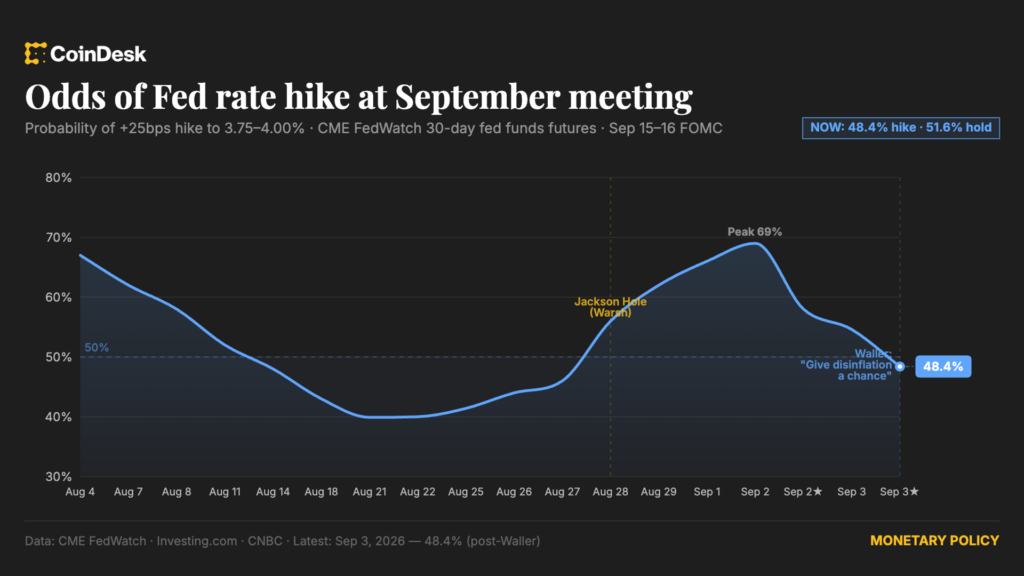
September Federal Reserve Rate Hike Probabilities Drop Below 50% Following Waller Address
It remains unclear whether newly appointed Federal Reserve Chairman Kevin Warsh anticipated this outcome when pledging to alter the internal culture of the American central bank.
Expectations for a rate increase have fluctuated wildly like a digital token ever since Warsh adopted a surprisingly hawkish stance at Jackson Hole last week.
Those probabilities are currently declining rapidly following remarks made one hour ago by Fed Governor Chris Waller, who stated he would support maintaining current policy in two weeks provided next week’s Consumer Price Index report adequately demonstrates an ongoing downward trajectory in core inflation.
Conversely, Waller would cast a vote in favor of raising borrowing costs should the inflation statistics prove unsatisfactory.
Ultimately, monetary policy from the world’s most influential central bank appears dependent on data that may effectively track long-term inflation trends while offering short-term reliability comparable to a random number generator on a monthly basis.
According to CME FedWatch, the probability of a September rate hike has decreased to 48% from nearly 70% just one day prior.
The ball is in your court, Chairman Warsh.
Fed Official Waller Indicates Rate Pause Likely If August CPI Data Proves Favorable
Fed Governor Chris Waller noted during a presentation moments ago that underlying inflation appears healthier than core figures indicate.
He added that elevated energy expenses and tariffs are no longer viewed as primary drivers of persistent inflationary pressure, noting that his previous concern regarding energy costs spilling over into general goods and services has not materialized.
Waller mentioned he anticipates little market movement from tomorrow’s employment figures while remaining highly attentive to next week’s August CPI figures, noting that any sign of sustained advancement toward the central bank’s 2% objective would lead him to support keeping interest rates unchanged in September.
Bitcoin extended its advance in response to these dovish remarks, climbing to $78,400, while the two-year Treasury yield retreated to 4.33%, registering a six-basis-point decline for the session.
Initial Jobless Claims Maintain Low Levels
U.S. initial jobless claims increased slightly to 206,000 during the previous week compared to 203,000 previously, while consensus forecasts had projected 205,000.
The four-week moving average advanced to 207,250 from 205,500.
Even so, filings persist near historically subdued levels, indicating minimal strain within the labor market.
Nvidia Agrees to Acquire Hugging Face in $13 Billion Transaction
Nvidia Chief Executive Officer Jensen Huang stated in an official acquisition announcement that both entities will scale the Hugging Face platform, reinforce its infrastructure, and broaden artificial intelligence availability for developers and enterprises globally for $12.93 billion.
Huang emphasized that as open-source model opportunities accelerate, Hugging Face can service the worldwide artificial intelligence community at an unprecedented scale, leveraging Nvidia’s infrastructure, engineering talent, and global reach to enhance reliability, safety, model evaluation, inference, and deployment capabilities while protecting the open framework that established Hugging Face as a foundational entity.
Nvidia stock remained unchanged during pre-market trading.
Interest Rates Ease as Bond Sellers Secure Gains Ahead of Employment Report
American borrowing costs on Thursday paused their recent upward trajectory, with the 10-year Treasury yield dropping back to 4.77% after touching 4.82% the previous day.
The two-year yield, which exhibits greater sensitivity to Federal Reserve actions, drifted down to 4.36% following a peak of 4.41% yesterday.
Expectations for a September rate adjustment receded to 60% after approaching 70% on Wednesday.
This downward movement in yields occurred despite crude oil prices rebounding to multi-month peaks following reports of Iranian aggression directed at American assets throughout the Middle East.
Rather than reflecting fundamental developments, the activity within fixed-income markets stems primarily from investors locking in gains prior to tomorrow’s release of the U.S. Nonfarm Payrolls report for August, given that recent employment reports have shown weakness and another subdued reading could spark a substantial reversal in interest rates.
Bespoke observed that since the Federal Reserve initiated rate announcements on FOMC meeting days in 1994, the institution has never increased borrowing costs within a six-month window following a negative employment report, though market skeptics might counter that policymakers have never previously confronted the persistent inflation levels currently observed.
Petroleum Advances While Bitcoin and Gold Dismiss Rising Energy Costs
Crude oil extended its upward movement, with West Texas Intermediate gaining another 2% to reach $93 per barrel—its highest mark since July 23—while Brent crude advanced to $97 per barrel as renewed geopolitical friction in the Middle East sustained upward momentum on energy valuations.
The U.S. 10-year Treasury yield registered a minor daily gain of 0.17%, staying just beneath the multi-year peak recorded on Wednesday.
Gold and bitcoin have thus far ignored climbing petroleum expenses, with bitcoin sustaining levels above $77,000 and gold holding past $4,400 per ounce.
Major Tokens Recover From Sluggish Week While Currency Hedging Reaches Decade Lows
Bitcoin hovered just over $77,500 during Asian morning trading hours on Thursday, representing a 24-hour gain of roughly 1% alongside a weekly decline of approximately 3%, per CoinDesk data.
BNB paced the day’s advances with an increase nearing 3%, whereas XRP and dogecoin each added over 2%, and Tron, Solana, Zcash, and Bitcoin recorded gains near 2%, while Ether and Hyperliquid remained unchanged.
As of June 30, pension funds and insurance providers across Japan, Canada, Taiwan, and three additional regions had protected merely 41% of their foreign currency exposure, marking the lowest measurement since at least 2015 according to Bloomberg data.
Currency hedging involves paying a fee to secure a fixed exchange rate, and these institutional participants have ceased incurring this cost because the dollar has consistently appreciated during periods of market distress over the past ten years.
An unhedged investor who concludes that the greenback no longer serves as a reliable safe-haven asset must liquidate dollar holdings to minimize exposure.
Observers should monitor whether the Japanese yen strengthens beyond the 160 threshold, as that level represents where capital unwinding would manifest initially and where digital assets have closely tracked currency movements throughout the week.
Originally published at https://www.coindesk.com/business/2026/09/03/live-updates-crypto-majors-bounce-while-global-funds-run-their-lowest-dollar-hedges-since-2015.