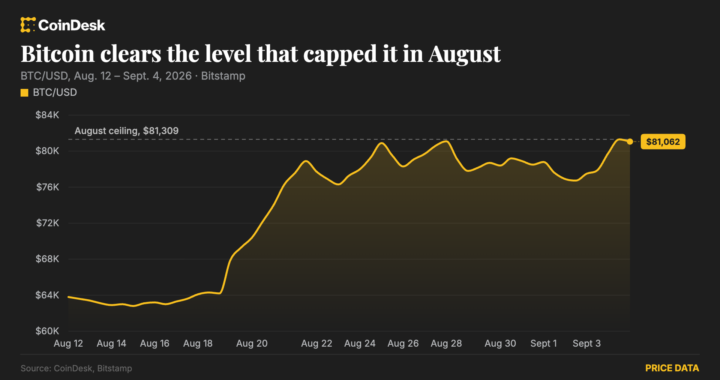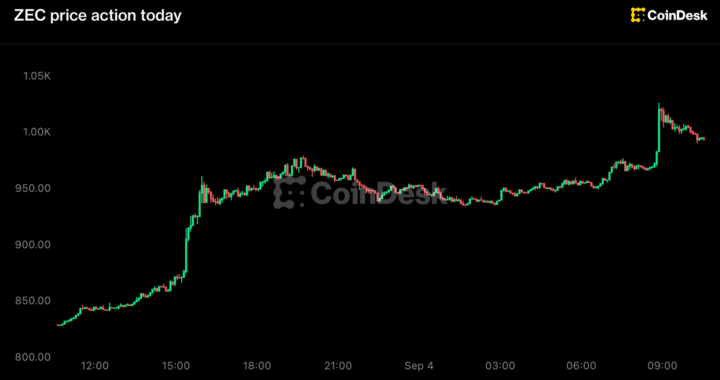
It is the first Friday of the month once again, meaning the U.S. Bureau of Labor Statistics is preparing to publish the nonfarm payrolls (NFP) report, a vital metric closely observed by Federal Reserve policymakers alongside both conventional financial and cryptocurrency markets. Nevertheless, historical figures indicate that it acts as a non-event for day traders.
Scheduled for release at 08:30 ET, the data is anticipated to show that the economy created 56,000 jobs, marking a recovery from the unexpected reduction of 23,000 jobs in July, according to FactSet. Meanwhile, the unemployment rate is projected to edge upward to 4.2% from 4.1%. Average hourly earnings are anticipated to have advanced 3% year-over-year, dropping from July’s 3.2% figure, which implies that wage acceleration is easing.
Financial markets currently price in approximately a 65% probability of a 25-basis-point rate reduction later in the month. A report coming in stronger than expected could reinforce those probabilities, drive the dollar upward, and establish an unfavorable headwind for bitcoin.
All of this demonstrates the significance of this metric.
Even so, an evaluation of bitcoin’s price behavior on previous NFP dates reveals that the announcement fails to immediately provoke dramatic price fluctuations. (check Today’s signal)
Beginning in January 2020, bitcoin has registered an average swing of merely 2.1% on nonfarm payrolls (NFP) days, matching BTC’s standard daily volatility observed on non-NFP days over recent years, based on figures tracked by CoinDesk.
Across all 79 NFP publications within that timeframe, BTC’s intraday response has divided evenly: values closed higher on 39 of those dates and lower on 40. That represents a coin toss regarding direction. (The cumulative count is 79 instead of 80 reference months because the employment report for October 2025 was never issued as an independent release.)
The magnitude of the movements, however, has fluctuated based on conditions in the wider market. For example, the most severe single-day reaction materialized on February 4, 2022, when bitcoin surged 11.4% following the January 2022 employment figures. Scarcely a month afterward, on March 4, 2022, the immediate subsequent NFP release yielded the direct opposite result, featuring a 7.8% decline. The year 2022 characterized an intensely volatile bear market period.
The central conclusion is that, regarding day traders, the NFP holds minimal predictive value and functions as a non-event, indistinguishable from any other arbitrary weekday.
Will today prove to be different? That scenario cannot be entirely dismissed. Recently, Treasury yields have surfaced as a central focus across all financial sectors, including crypto. Should the NFP instigate a substantial shift in Treasury yields, BTC and alternative markets might follow suit. Remain vigilant.
Today’s signal

The chart displays bitcoin’s price behavior on NFP dates.
Ever since January 2020, the average movement has totaled just past 2% – aligning with standard volatility seen on non-NFP days.
If you happen to be a day trader anticipating fireworks on NFP Fridays, good luck.
Originally published at https://www.coindesk.com/daybook-us/2026/09/04/we-checked-6-years-of-bitcoin-data-the-nfp-report-isn-t-big-price-mover.