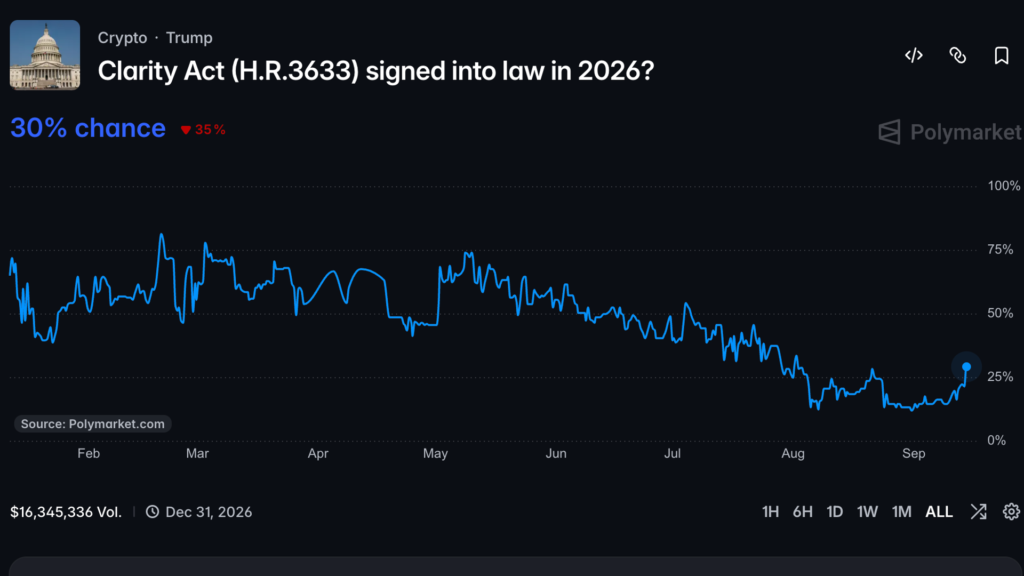
Prediction market participants are feeling more confident that Washington could finally pass a regulatory framework for digital assets, with probabilities jumping to multi-week highs on Monday across both Kalshi and Polymarket.
Polymarket bettors estimated that the probability of the Clarity Act being enacted into law within the current year reached nearly 30% on Monday morning, climbing from just 12% earlier in September. According to the event contract dashboard, this marks the highest point observed since early August.
On Kalshi, the contract tracking whether the crypto market structure legislation becomes law before October 1, 2027, spiked overnight to 64% from 26% on Thursday, before stabilizing near 53% on Monday morning.
Traders placed the likelihood of passage prior to July 1 at 53%, compared to 30% on Thursday, following a brief peak at 69%. Meanwhile, the probability of the bill becoming law before April was recently evaluated at 45%, representing roughly double Thursday’s figure of 23%.
These shifts indicate that speculators perceive a clearer trajectory for digital asset legislation as the Senate nears a critical procedural vote on Tuesday. Nevertheless, a substantial distance remains between a favorable vote and presidential approval.
The cloture vote scheduled for Tuesday in the Senate demands 60 senators, thereby compelling the proposal to secure bipartisan backing. Surpassing that threshold would represent a significant political milestone, though it would not equate to final Senate adoption.
Lawmakers might still encounter an extended amendment procedure concerning the bill. Furthermore, any modifications would need to be reconciled with the House before the legislation could proceed to the president, while the congressional schedule introduces an additional element of unpredictability.
One analyst noted that initiative now rests with the Democrats, given that the measure was not formulated as a negotiated package.
Jaret Sieberg, a financial policy analyst at TD Cowen, remarked that Democratic legislators might not find sufficient incentive here to support the initiative, keeping his estimated probability for the Clarity Act’s passage at 25% on Monday.
In a note addressed to clients, he wrote that they remained unconvinced that the revised ethics terms released by Senate Republicans the previous evening carried enough weight to satisfy moderate Democrats.
The complications for Democrats include the reality that President Trump would retain his cryptocurrency holdings, even if managed through a blind trust, meaning he is not entirely cut off from the sector where he exerts substantial influence. Additionally, the enforcement powers granted to state attorneys general remain quite restricted, with no provisions for direct legal action against the president. Sieberg also pointed out that Trump would likely frame a yes vote as a major personal triumph, which could create political disadvantages for Democrats in the November elections.
On the flip side, Sieberg highlighted that these adjustments might offer Democrats somewhat greater political justification should they choose to back the legislation. Simultaneously, traditional bankers could grow more comfortable with the proposal due to the added safeguards it provides to their deposit bases against customers shifting funds into stablecoins.
He suggested that because the administration has yet to put forward Democratic nominees for the Commodity Futures Trading Commission and the Securities and Exchange Commission, those positions could be utilized as concessions to facilitate a final compromise.
Originally published at https://www.coindesk.com/policy/2026/09/14/clarity-act-odds-surge-on-prediction-markets-but-crypto-bill-still-faces-long-road.